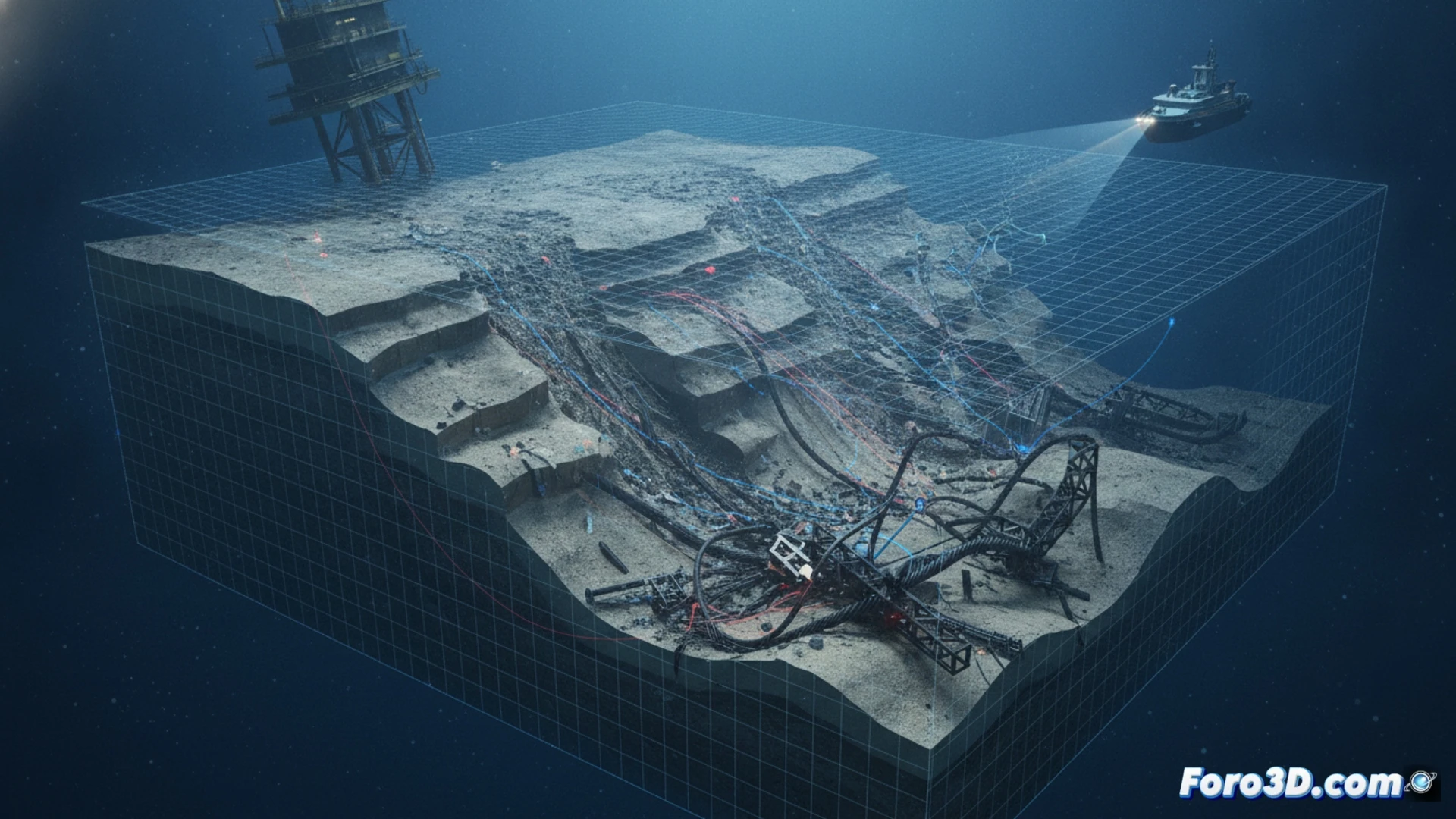
Submarine erosion is a silent geological process that undermines the foundations of the seabed, triggering slope landslides and local tsunamis. Unlike surface erosion, this dynamic occurs hundreds of meters deep, invisible to the human eye. However, 3D modeling and computational fluid dynamics have revolutionized our ability to visualize this phenomenon, allowing engineers to anticipate collapses of critical infrastructure such as oil platforms or submarine cables.
Multibeam Bathymetry and Simulation of Submarine Slope Failures 🌊
The technical basis of the analysis lies in high-resolution multibeam bathymetry, which generates precise point clouds of the ocean floor. This data is integrated into 3D modeling software like Blender or geotechnical simulation tools such as FLAC3D to recreate the real topography. Subsequently, computational fluid dynamics (CFD) simulations are applied to calculate the shear stress exerted by turbidity currents and eddies. A key case study was the Storegga slide in Norway, whose 3D modeling revealed that saturated clay layers acted as a lubricant, allowing the resulting megatsunami to be recreated and pipeline routes to be adjusted to avoid future disasters.
The Lesson from the Seabed: Prevention Through Visualization 🧠
The true value of 3D modeling lies not only in prediction but also in risk communication. Visualizing the progression of an erosion scar in three dimensions allows decision-makers to understand the urgency of reinforcing dikes or relocating infrastructure. In the Nile Delta, simulations revealed that natural gas extraction accelerated sediment compaction, a fact invisible in 2D maps. 3D technology reminds us that the seabed is not static; it is a living landscape whose collapse can be catastrophic, but also preventable if we learn to read its digital relief.
What geological and oceanic parameters are critical for modeling the submarine erosion rate and accurately predicting the risk of coastal slope collapse?
(PS: Simulating catastrophes is fun until the computer crashes and you are the catastrophe.)