A deflagration in a building is not a conventional explosion; it is a sudden combustion that generates a subsonic pressure wave. For simulation experts, modeling this phenomenon in 3D involves solving computational fluid dynamics (CFD) equations along with flame propagation models. The goal is to predict how the flame front expands and how overpressure affects enclosures, critical data for incident reconstruction.
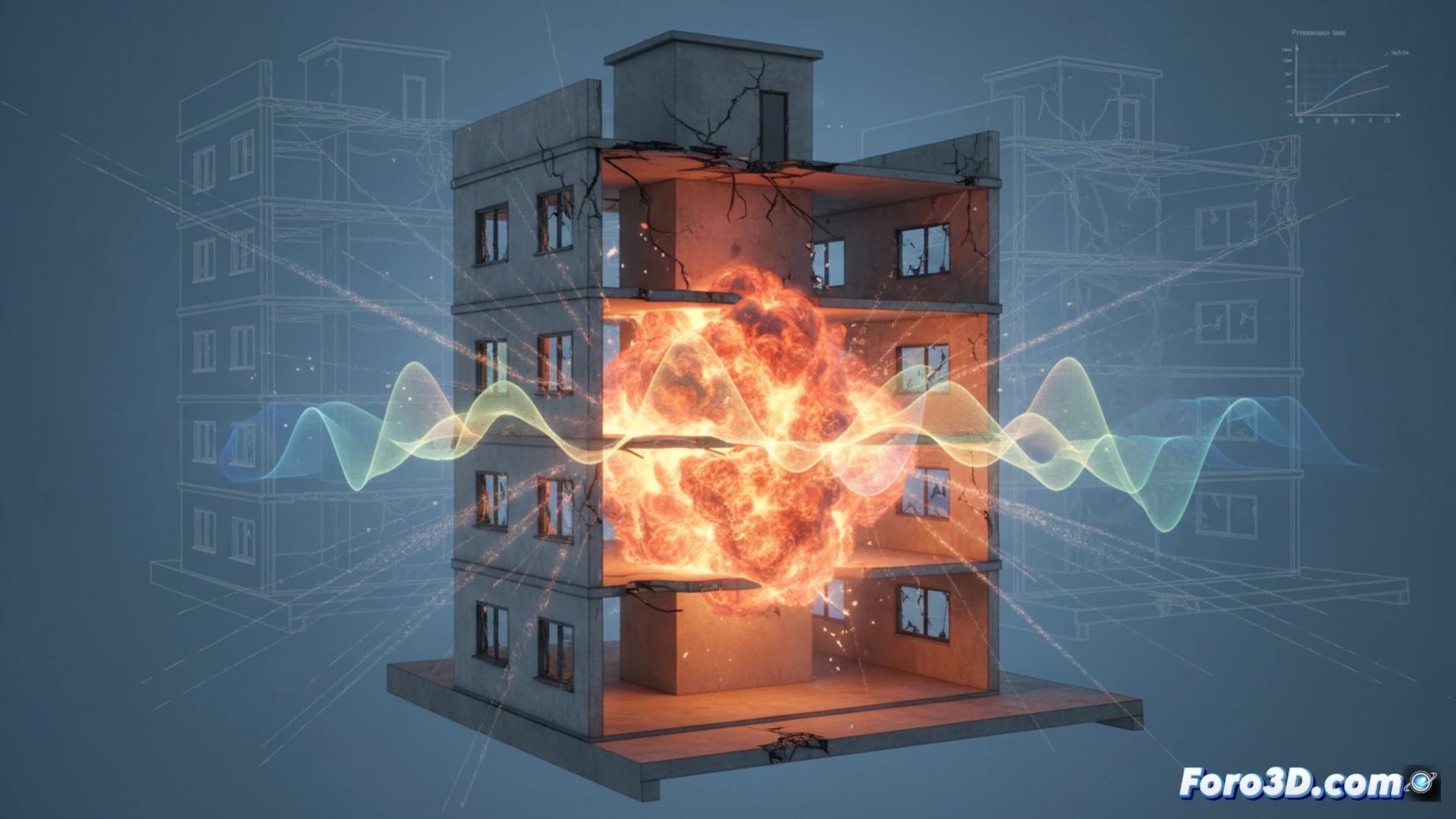
Fluid dynamics and structural damage in simulation 💥
In software such as Ansys Fluent or Fire Dynamics Simulator (FDS), a volumetric domain of the building is defined, and a mixture of combustible gases (e.g., methane or LPG) is injected. The simulation solves for laminar combustion velocity and turbulence generated by the expansion of hot gases. The pressure wave, traveling at speeds between 5 and 10 m/s in a typical deflagration, is coupled with a finite element model to evaluate the rupture of walls and windows. This allows distinguishing a deflagration from a supersonic detonation, key in forensic investigations.
Prevention and response to complex fires 🔥
Beyond the cause of the incident, these simulations allow safety engineers to redesign ventilation systems and evacuation routes. By visualizing in 3D the progression of the thermal front and overpressure zones, relief panels or fire dampers can be installed at strategic points. In a world where industrial and domestic accidents are increasingly studied, deflagration simulation is consolidating as an essential tool to save lives and optimize infrastructure.
How the transition from a sudden combustion to a pressure wave inside a building is accurately modeled to distinguish it from a conventional explosion in forensic simulations
(PS: Simulating catastrophes is fun until the computer crashes and you are the catastrophe.)