Recreating a gunshot in zero gravity represents a unique technical challenge for experts in 3D animation and physical simulation. Unlike a terrestrial environment, where gravity dictates the parabolic trajectory of the bullet and the immediate fall of the casings, in microgravity these elements follow linear motion laws until impacting an object. This article breaks down the modeling process and the physical variables that must be adjusted to achieve an accurate and believable recreation, applicable to both forensic research and space mission planning.
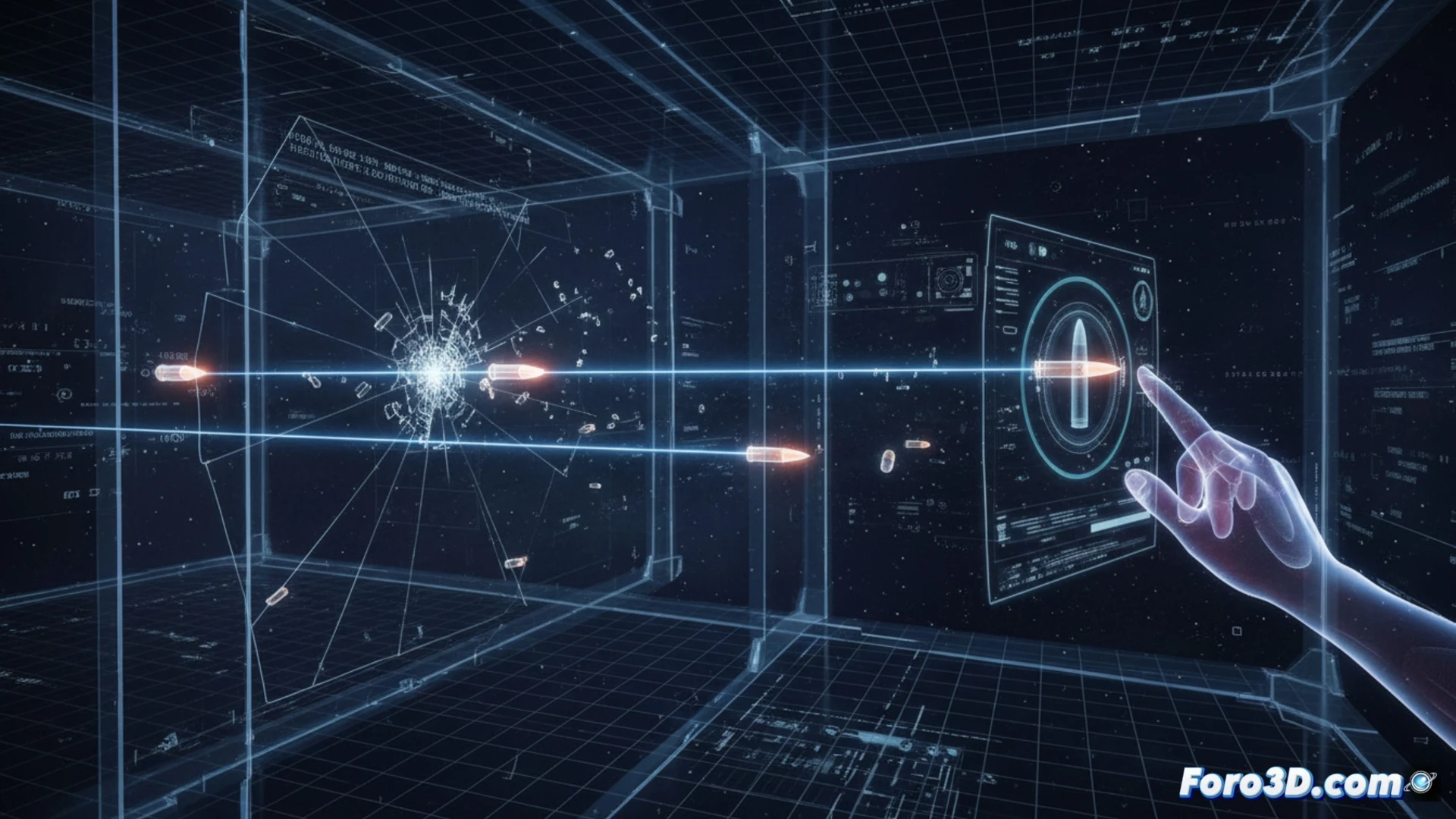
Physical simulation of ballistic trajectory and casing ejection 🚀
To model the trajectory of a bullet in microgravity, the first step is to disable the gravitational acceleration vector (9.81 m/s^2) in the physics engine of the 3D software, such as Blender or Unreal Engine. The bullet, upon leaving the barrel, will maintain a straight and uniform trajectory, governed solely by the recoil force and air resistance (which is zero in a vacuum). The behavior of ejected casings is more complex: in the absence of gravity, they retain the initial velocity and rotation imparted by the weapon's ejection mechanism. The simulation must calculate their angular momentum and elastic collisions with the shooter or the wall, as they will not fall to the ground. To do this, particles with mass and surface friction are configured, and a rigid body dynamics solver is used to process each interaction in real time, ensuring that the casings float and bounce without downward acceleration.
From science fiction to orbital forensic evidence 🔬
Comparing this recreation with one in terrestrial gravity reveals the importance of adjusting each parameter: on Earth, the bullet's trajectory curves and the casings fall within a predictable radius; in space, the scene becomes chaotic and linear, where any object acquires a constant velocity. This precision not only serves to document incidents in space stations but also allows forensic investigators to understand how firearms behave in extreme environments. 3D modeling thus becomes a key tool for validating hypotheses and training astronauts, demonstrating that ballistics transcends Earth's atmosphere.
Would you combine scanning with photogrammetry?