When a sprinter explodes from the starting block or a striker kicks a moving ball, the interaction between the implement's surface and the environment defines the success of the action. Micro-roughness, that texture almost imperceptible to the touch but critical in the physics of contact, has become the battleground of sports engineering. We analyze how three-dimensional scanning and CFD simulation are redefining grip, friction, and aerodynamics in modern athletics.
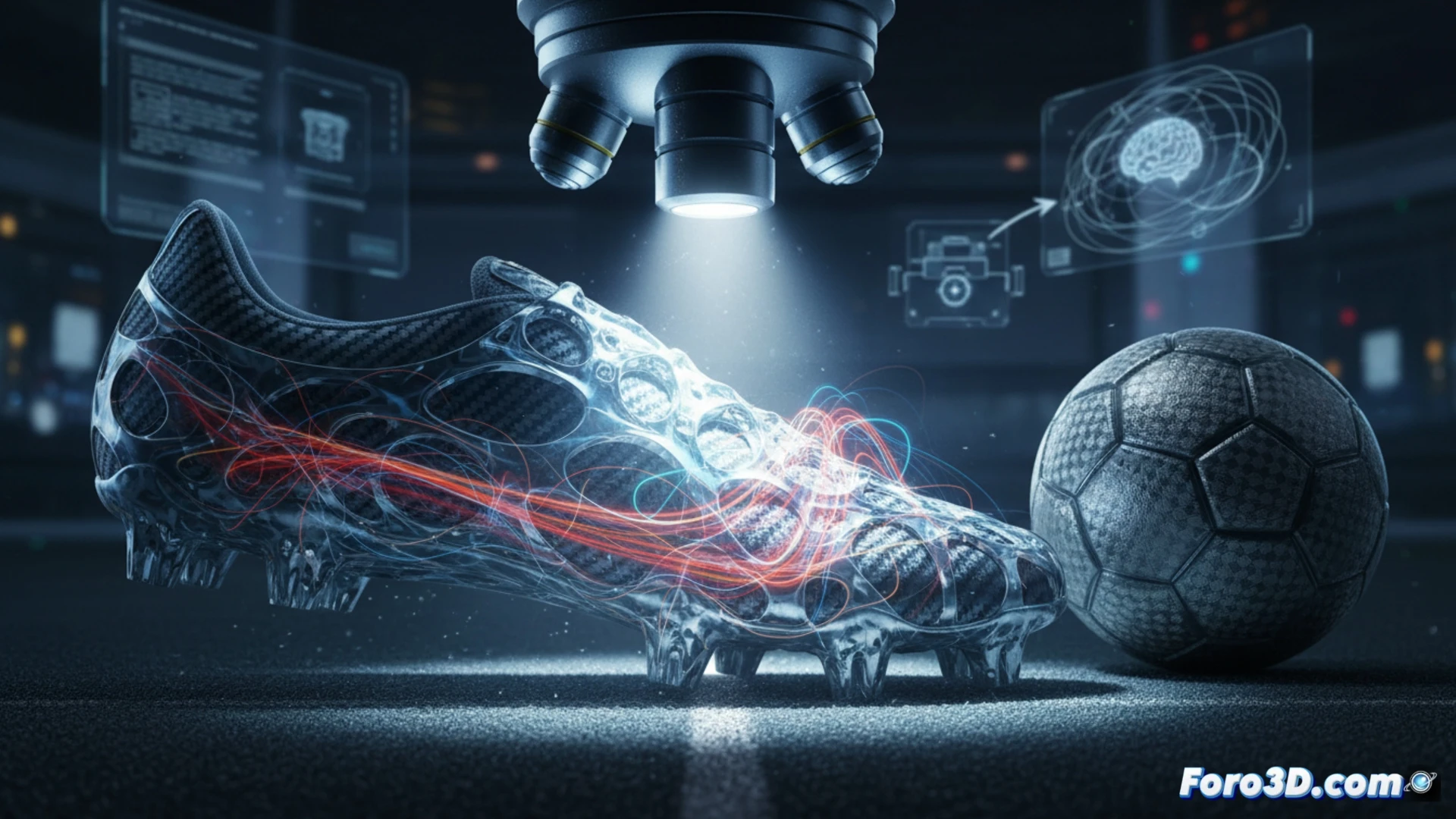
3D Scanning and CFD: Quantifying the Invisible Texture 🧬
Measuring micro-roughness no longer relies on obsolete mechanical probes. Today, structured light scanners and confocal microscopes generate point clouds with sub-micrometer resolutions. By applying waveform filters to the polygonal mesh, engineers extract parameters such as Ra (arithmetic mean roughness) and Rz (maximum profile height) directly from the 3D geometry of a soccer ball or a shoe sole. This data feeds Computational Fluid Dynamics (CFD) simulations where, instead of assuming a smooth surface, each micro-groove is modeled. The results reveal how a roughness of 50 microns on a soccer ball can delay the boundary layer separation point, reducing aerodynamic drag by 2%, or conversely, how excessive texture on a spike sole increases static friction by 15%, improving reaction time at the start.
The Grip Paradox: Between Control and Resistance ⚖️
Athletic micro-roughness poses a design dilemma: maximize grip without increasing forward resistance. In time trial cycling, a laser texture on the handlebars can improve control on wet curves but increases the drag coefficient. The current solution lies in generative parametric modeling, where algorithms optimize surface topography for each discipline. The future of sports equipment is not in smooth surfaces, but in intelligent textures sculpted by 3D data.
As a 3D surface designer, how could you replicate the micro-roughness of an athlete's skin or a ball to optimize grip and aerodynamics without compromising current sports regulations.
(PS: Reconstructing a goal in 3D is easy; the hard part is making it not look like it was scored with a Lego figure's leg)