Microsoft has made a quantum leap in semiconductor manufacturing with Majorana 2, a chip that introduces topological qubits a thousand times more reliable than its predecessor. This breakthrough is not just an achievement in quantum physics; it is a milestone in 3D microfabrication, where the combination of new materials, such as topological insulators, and AI-assisted design has overcome the limits of traditional lithography. The promise of a practical quantum computer by 2029 is now based on a radically different wafer architecture.
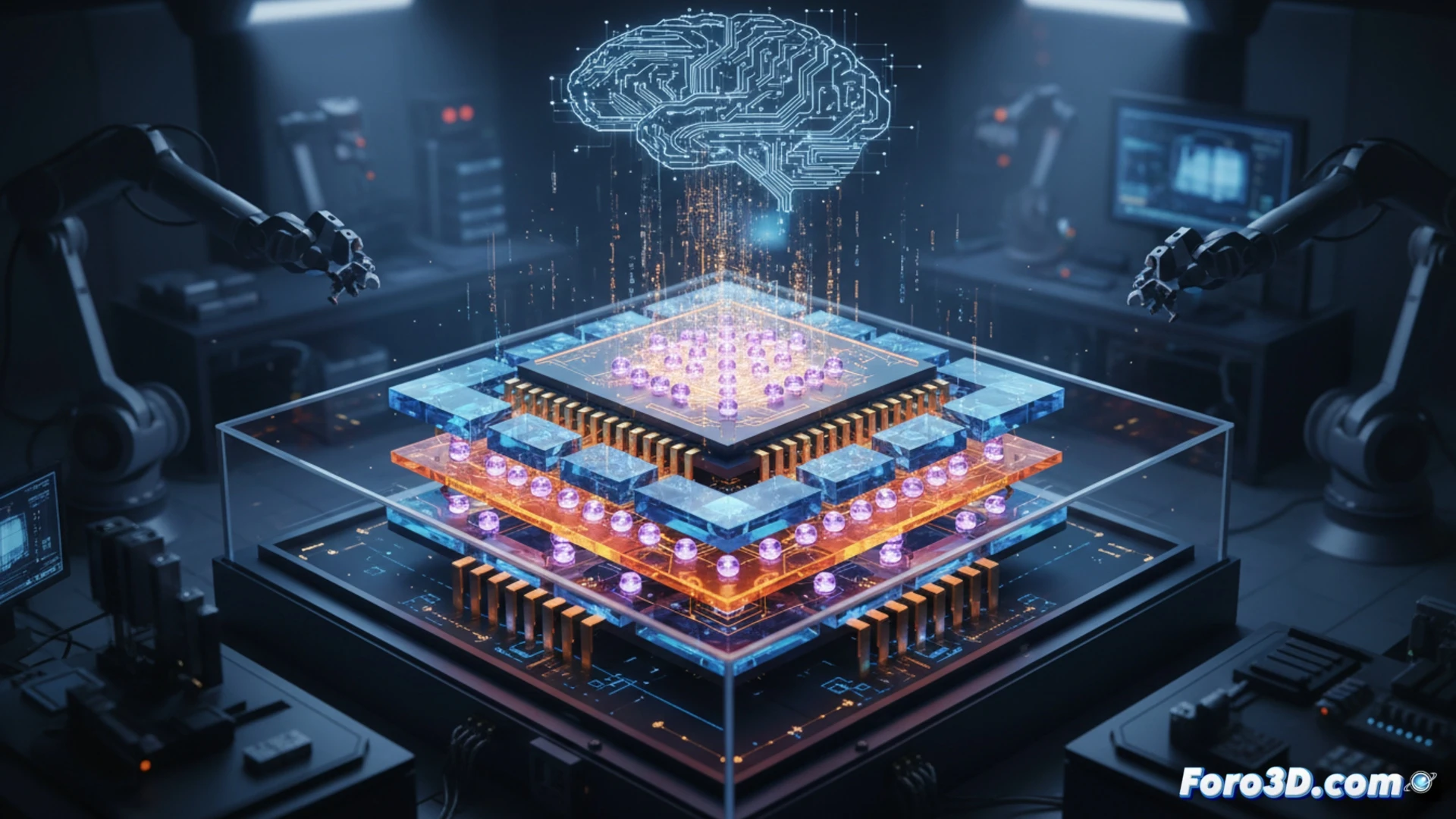
Topological architecture: the new paradigm in qubit lithography 🧬
The heart of Majorana 2 lies in exploiting Majorana fermions, particles that inherently protect quantum information. From a 3D modeling perspective, the chip's structure is no longer based on silicon transistors, but on semiconductor nanowires coupled to superconductors, forming a topological network. AI played a critical role by simulating millions of atomic configurations to identify the exact point where the material becomes topologically protected. This contrasts with electron beam lithography processes, which struggle against noise and decoherence; here, stability is achieved at the material level, not through error correction. The resulting wafer is a 3D map of Majorana islands, where information flows without dissipation.
From 3D simulation to the reality of 2029: a roadmap with no shortcuts 🚀
Microsoft's announcement is not an empty promise, but a visualizable 3D roadmap. We have modeled the chip's evolution: from the current 8 topological qubits on a test wafer, through the integration of quantum logic in 2027, to the goal of one million qubits in 2029. Each step requires atomic-level manufacturing precision that only AI can manage. For the public, this is not just a technical milestone; it is the gateway to molecular simulations for new drugs, optimization of energy grids, and climate models that are impossible today. Useful quantum computing is no longer a dream; it is an engineering project with a delivery date.
How does the introduction of topological qubits in the Majorana 2 chip affect lithography and layer deposition processes in 3D semiconductor microfabrication
(PS: 180nm are like relics: the smaller they are, the harder to see with the naked eye)