A story that shouldn't be fiction...
Vladimir Putin and Volodymyr Zelensky spent seven days in Finnish Lapland, under forty centimeters of snow and temperatures of forty degrees below zero. Finland, which survived Russian invasions without surrendering or provoking, offers a setting where extreme cold forces a physical honesty that no diplomatic protocol can sustain. The goal: to break the ice that no summit had managed to melt.
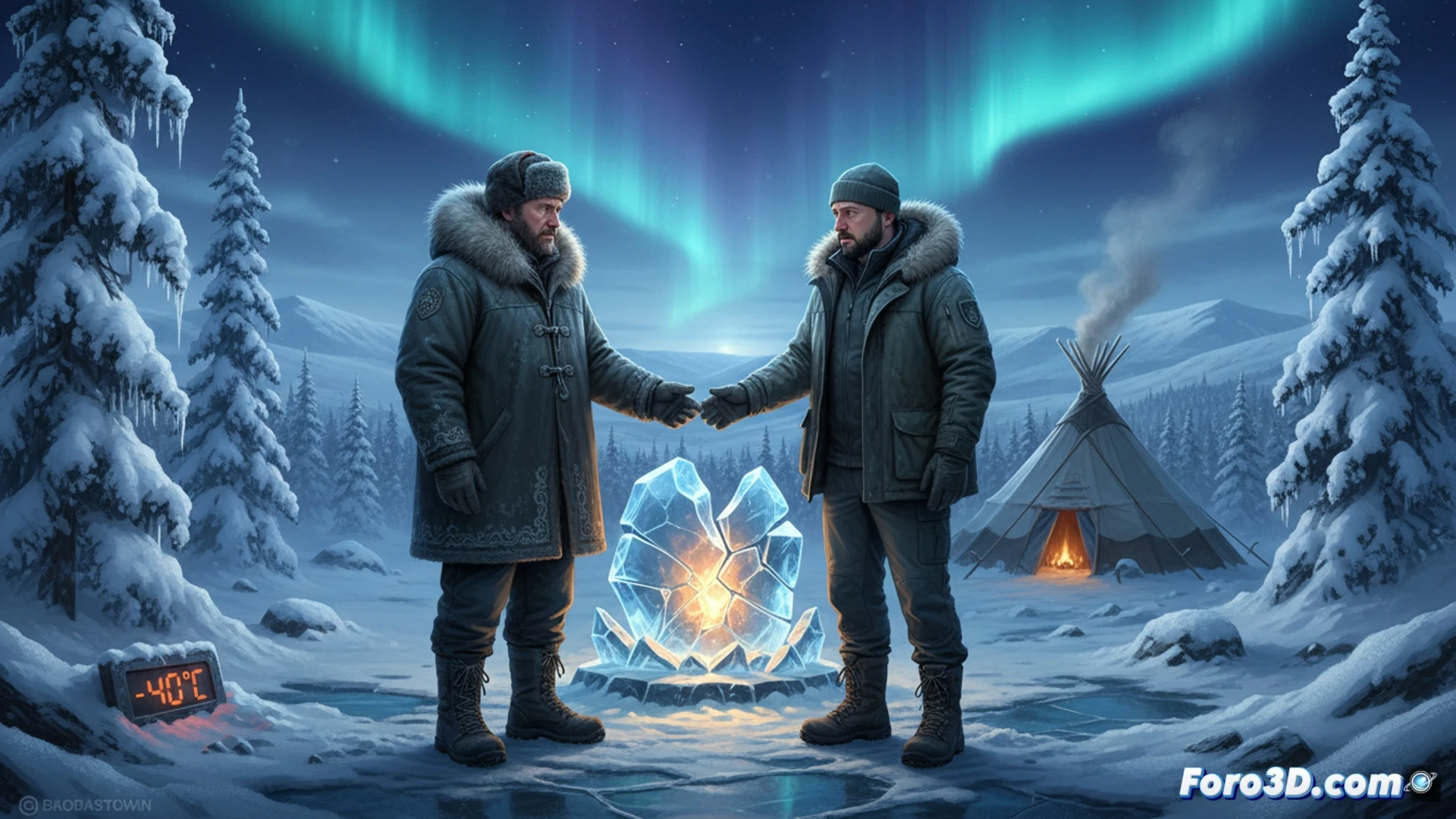
❄️ Vladimir Putin and Volodymyr Zelensky. Seven days in Finnish Lapland
Vladimir Putin and Volodymyr Zelensky. Seven days in Finnish Lapland. In winter. With forty centimeters of snow. 🌨️
🇫🇮 Why Finnish Lapland
Because Finland has a unique history with Russia. It was invaded, resisted, survived, and built a relationship of coexistence without surrendering or provoking. The Finns understand something about living alongside Russia that no one else in the world understands quite the same way. And because the Lapland winter is a force of nature that negotiates with no one. Forty below zero doesn't distinguish between empires and resistances. Extreme cold has a very specific quality: it forces immediate physical honesty. You can't pretend you're not cold. You can't project power when your fingers are numb. 🥶
🎒 The weight they carry
Putin arrives carrying the weight of a man who made a huge decision and has spent years unable to admit, even to himself, that the consequences exceeded any calculation. A man shaped by the KGB, who learned that showing vulnerability is the most dangerous mistake one can make. Zelensky arrives carrying the dead. Not as a metaphor. As a real and daily weight of someone who makes decisions every day knowing that some people will die because of them or because they weren't made. A man who was a comedian ten years ago and whom history turned into a symbol without asking his permission. They are probably the two most impossible men to sit together in the world right now. That's precisely why. 💔
🤐 The first two days: hostile silence
There is no real conversation. They communicate the bare minimum for basic logistics. Their gazes are long and unyielding. At night they sleep in separate but nearby cabins. They can see each other's light. Neither sleeps well. The silence between them is so dense that the Finnish guide, a man of few words by nature, tells them on the second day with complete naturalness: "I've led bears and wolves along the same path. They also took time to get used to each other." Both look at him. The guide is already looking at the map. 🐺
❄️ The third day: what extreme cold does
They go for a walk when the thermometer reads minus thirty-eight. The guide insists it's necessary, that staying inside with that cold for days is psychologically destructive. Twenty minutes in, the heating element in Putin's right boot fails. A minor technical detail with potentially serious consequences at that temperature. Zelensky notices it before the guide does. For a second worth more than any diplomatic summit, he has a completely human choice before him. He says it. He warns the guide. Putin looks at him. He says nothing at that moment. But something crosses his expression that has no name in diplomatic language. That night, for the first time, the lights in the two cabins go out at the same time. 🥾
✨ The fourth day: the aurora borealis and what breaks
The aurora appears at night, unexpectedly intense. Green and white moving across the absolute black of the Lapland sky. Both come out of their cabins without coordinating. They meet outside looking up. Putin says something in Russian. Almost to himself. Zelensky, who understands Russian perfectly even though he has refused to use it publicly since the invasion, understands what he says. Putin has said: "My mother told me about this once." Zelensky replies in Ukrainian: "Mine too." The two languages are close enough for each to understand the other. It's the first time they speak to each other in their own languages. Without interpreters. Without protocol. And they talk about their mothers under the aurora borealis like two men their age, not like two leaders at war. 🌌
🍵 The fifth day: the impossible conversation
Sitting inside, with hot tea, what no peace process has managed to provoke occurs. They don't talk about territories. They don't talk about security guarantees or NATO membership. Putin talks about the Soviet Union. Not with political nostalgia but with something more complicated: the feeling of having grown up in an order that suddenly disappeared, that the ground shifted under his feet when he was forty, that what followed was chaos and humiliation and that he experienced it as something personal. Zelensky listens. And he says something Putin didn't expect. He says his generation also lost ground. That they grew up in a country that didn't yet exist, that they had to build an identity almost from scratch, that this too is a loss, albeit of the opposite sign. Two different losses from the same historical moment. Putin says he hadn't thought of it that way. It is probably the most honest sentence he has spoken in twenty years. 🫖
😢 The sixth day: the real limit
And then comes the moment when shared humanity collides with reality. Zelensky says the names of some cities. Mariupol. Bucha. He says them slowly, without accusation in his tone, just as names of places that existed and are no longer what they were. Putin doesn't respond for a long time. When he speaks, he doesn't deny. But he doesn't assume either. He says something that is both truth and evasion: that history will judge, that wars have their own logic that surpasses the people who start them. Zelensky looks at him and says: "History doesn't give the dead back to their families." There is no possible answer to that. The silence that follows is different from all the previous ones. It's not hostile. It's the silence of two people who have reached the edge of something neither can cross yet. 🕊️
👋 The seventh day: the farewell in the snow
Before the vehicles that will take them in opposite directions arrive, they are both outside, in the snow, waiting. Putin looks at the forest. He says without looking at Zelensky: "This shouldn't have happened." He doesn't specify what. The war. The meeting. The last three years. Everything. Zelensky says: "No." A single word. In Russian. It is the first and only time in seven days he voluntarily uses Russian. The vehicles arrive. They separate without a handshake. Without gestures for any camera because there are none. 🚙
🚫 What doesn't change
The war doesn't end. Political positions don't shift. Armies remain where they are. Sanctions remain. Each one's allies continue to push in their directions. The world doesn't know this happened. 🔁
✅ What does change
In a technical negotiation on humanitarian corridors weeks later, the Russian representative accepts a condition he had systematically rejected for months. No one in either delegation understands why this time was different. In Lapland, the Finnish guide clears the two cabins. In Putin's, he finds on the table a half-finished glass of tea. In Zelensky's, he finds the empty glass. He doesn't know why that seems important to him. But he remembers it for years. 🫖
🌠 The aurora borealis doesn't understand wars. It has been lighting up the snow for thousands of years without asking anyone's permission. And it will continue to do so when all those who today decide on maps and borders are gone. That, in some way, is the most hopeful thing of all. ✨