The recent court order to appraise the jewelry found in former President Zapatero's office places the authenticity and value of the objects at the center of the investigation. This process, supervised by the Police and executed by the Ansorena jewelry store, is a critical step in the chain of custody of the evidence. For the public, the question is clear: was there improper use of luxury goods? The answer depends on a flawless technical workflow that guarantees the integrity of each piece from the moment of discovery.
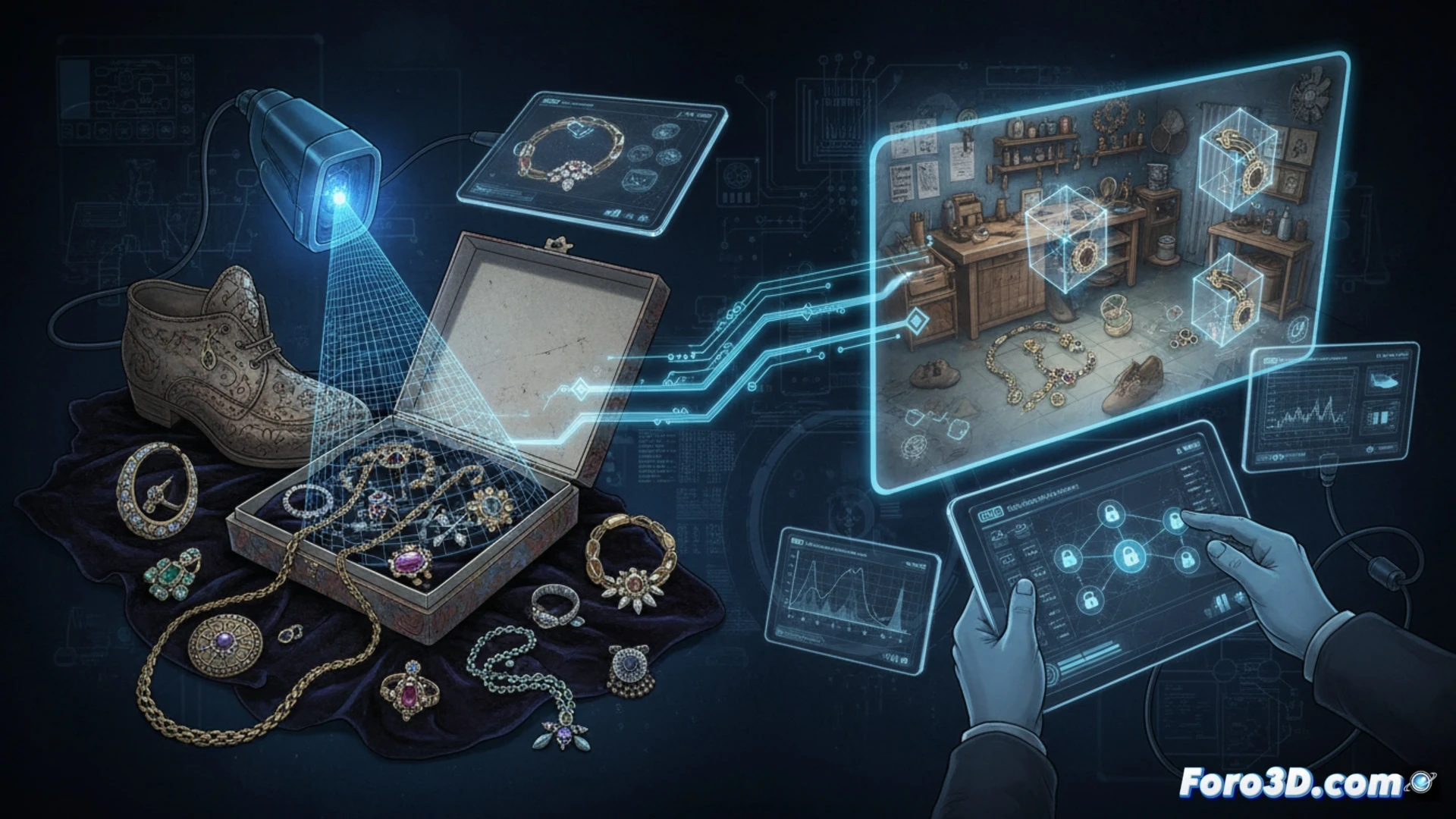
3D Documentation: scanning, photogrammetry, and chain of custody 🔍
In a modern forensic pipeline, the first step is capturing the context. A 3D scan with a handheld scanner (such as an Artec or Faro) would record Zapatero's office, fixing the exact position of each piece of jewelry relative to the furniture and documents. Subsequently, high-resolution photogrammetry of the individual pieces (rings, necklaces) allows for obtaining digital models with realistic texture, essential for the appraisal. These models are integrated into a digital twin of the scene, where the chain of custody can be simulated: who touched each object, in what order, and how it was transferred to the judicial safe. The advantage is that digital evidence does not degrade, unlike physical jewelry which can be scratched or lost.
Beyond the shine: transparency as proof 💎
3D technology is not only useful for measuring carats or purity; its true value is transparency. By digitally reconstructing the discovery, any judge or expert can examine the scene from any angle without needing to handle the original evidence. In a case where public opinion suspects irregularities, this forensic pipeline acts as an incorruptible witness. Justice advances not only because of the value of the jewelry, but because the documentation methodology demonstrates that there was no tampering. In the end, the truth is written in pixels and polygons.
Since the authenticity of the seized gems depends on parameters such as cut and internal inclusions, what specific challenges does 3D scanning of precious metals and diamonds pose to avoid optical artifacts and guarantee the digital chain of custody?
(PS: don't forget to calibrate the laser scanner before documenting the scene... or you might be modeling a ghost)