The concept of floating cities, conceived as self-sufficient habitats on the high seas, faces a critical challenge: structural instability. When an urban mass moves over water, any failure in weight distribution or hull strength can trigger a catastrophe. Here we analyze the factors that lead a floating city to collapse, using 3D simulation models to anticipate disaster before it occurs.
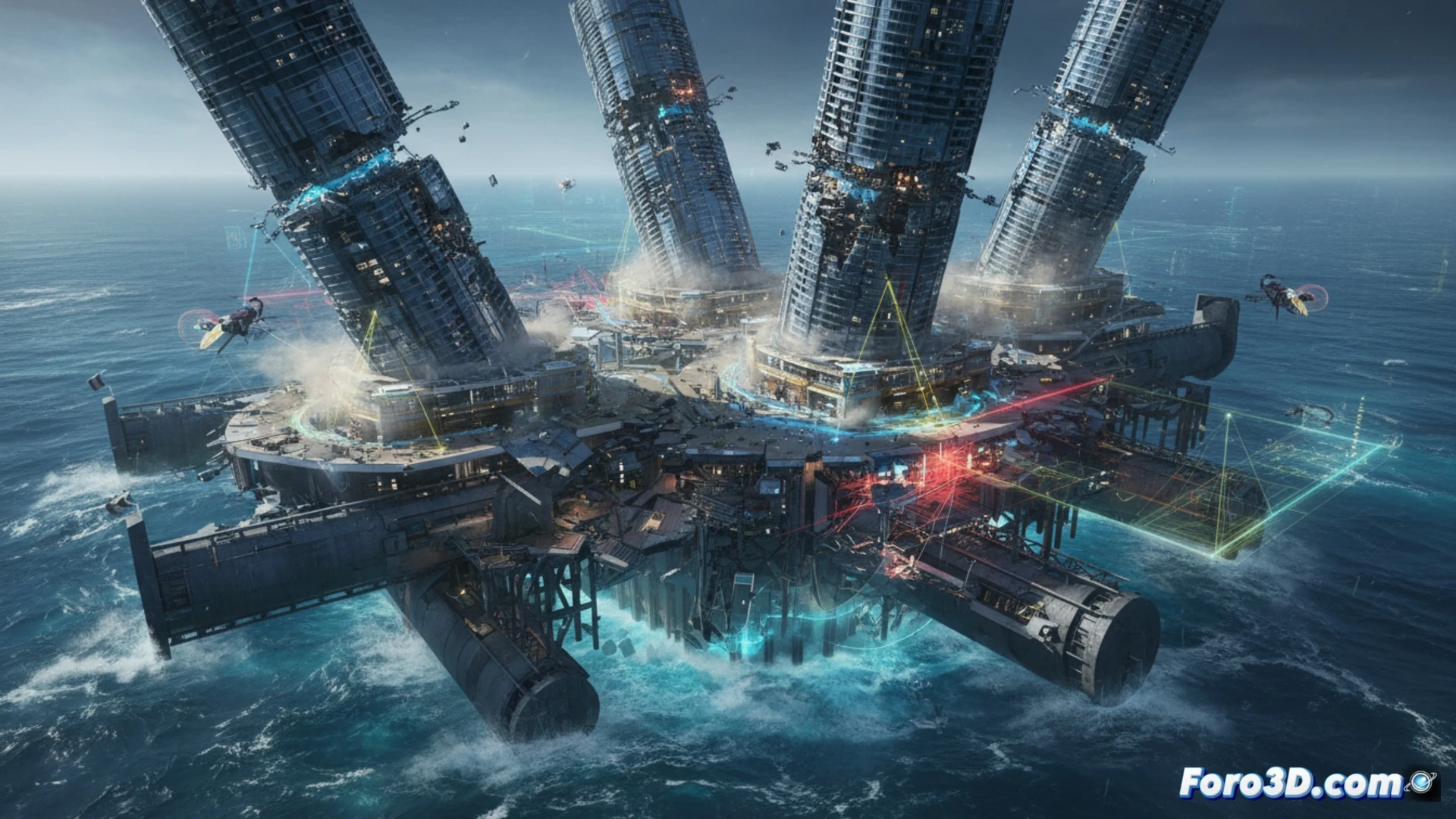
Modeling Structural Failure and Extreme Waves 🌊
3D simulation allows us to break down the problem into quantifiable variables. First, we evaluate the structure's center of gravity and its metacenter; an incorrect relationship generates an irreversible capsizing moment. Second, we model the impact of extreme waves, such as a 30-meter wave, which applies torsional forces on the flotation pillars. The visualization shows how stress concentrates at the joints of the housing modules. Finally, we simulate a massive load shift, where the movement of the population to a single sector causes a dangerous list. The result is a cascade of failures: bulkhead rupture, progressive flooding of compartments, and finally, the partial sinking of the platform.
Lessons for Catastrophe Prevention 🛠️
The graphical representation of the catastrophe is not only for cinema; it is a vital tool for emergency engineering. Identifying critical stress points allows for reinforcing the structure in key areas, such as the connection nodes between modules. Additionally, progressive flooding simulation helps design automatic gate systems and vertical evacuation routes. In a real scenario, these models predict the time available before total collapse, offering a critical window for response. The instability of a floating city is not a myth, but a calculable risk that 3D technology helps us mitigate.
Which finite element simulation parameters are most critical for predicting progressive collapse in a floating city subjected to extreme wave and structural fatigue conditions?
(PS: Simulating catastrophes is fun until the computer crashes and you are the catastrophe.)