Kapton, a polyimide film developed by DuPont, is a critical material in the aerospace and electronics industries due to its exceptional thermal and dielectric resistance. However, it suffers from a degradation known as Kapton instability, which manifests as cracking, delamination, or loss of insulating properties under extreme thermal cycling and radiation. This phenomenon compromises the integrity of components such as satellite cables or thermal shields.
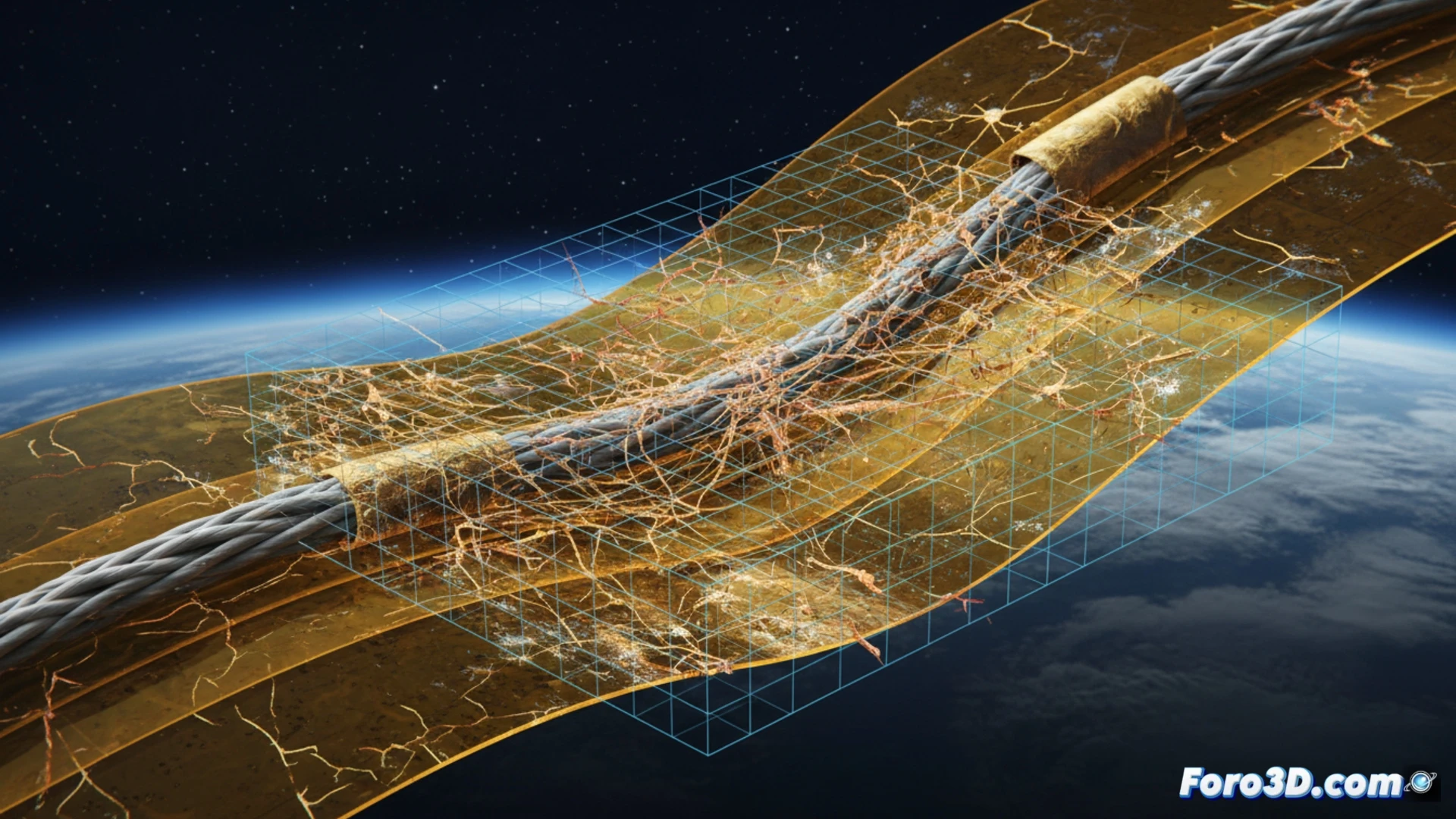
Fatigue modeling in Kapton using 3D simulation 🔬
Material fatigue simulation allows addressing Kapton instability from a predictive approach. Tools such as ANSYS Mechanical or COMSOL Multiphysics model the viscoelastic behavior of polyimide under combined stress: thermal (from -269°C to 400°C), mechanical (vibrations), and chemical (oxidation by atomic plasma). 3D visualizations reveal the distribution of residual stresses, strain concentration points, and the evolution of microcracks in complex geometries, such as thin layers in flexible circuits. Finite element analysis (FEM) allows adjusting parameters such as coating thickness or curing temperature to delay failure nucleation.
Implications for the design of resilient materials 🛡️
Understanding Kapton instability through 3D simulation not only optimizes its lifespan in space missions or high-performance devices but also drives the development of new polyimides with greater fatigue resistance. The ability to predict failures at early stages reduces prototyping and physical testing costs, transforming simulation into an indispensable tool for materials engineers. The future challenge is to integrate multiscale models that capture chemical degradation at the molecular level within macroscopic stress analysis.
Considering Kapton's reliance in long-duration space missions or microelectronics subjected to extreme thermal cycling, how is the evolution of microdeformation and fatigue crack nucleation in polyimide modeled when exposed to ionizing radiation and vacuum simultaneously?
(PS: Material fatigue is like yours after 10 hours of simulation.)