The instability of a dock is not a sudden event, but the culmination of a silent degradation process. Factors such as saline corrosion, cyclic material fatigue, and seabed scour compromise structural integrity. This article analyzes how 3D simulation allows visualizing the progressive collapse of these concrete and steel giants, offering a key tool for preventing port disasters.
Technical Analysis of Failure: Scour and Material Fatigue ⚙️
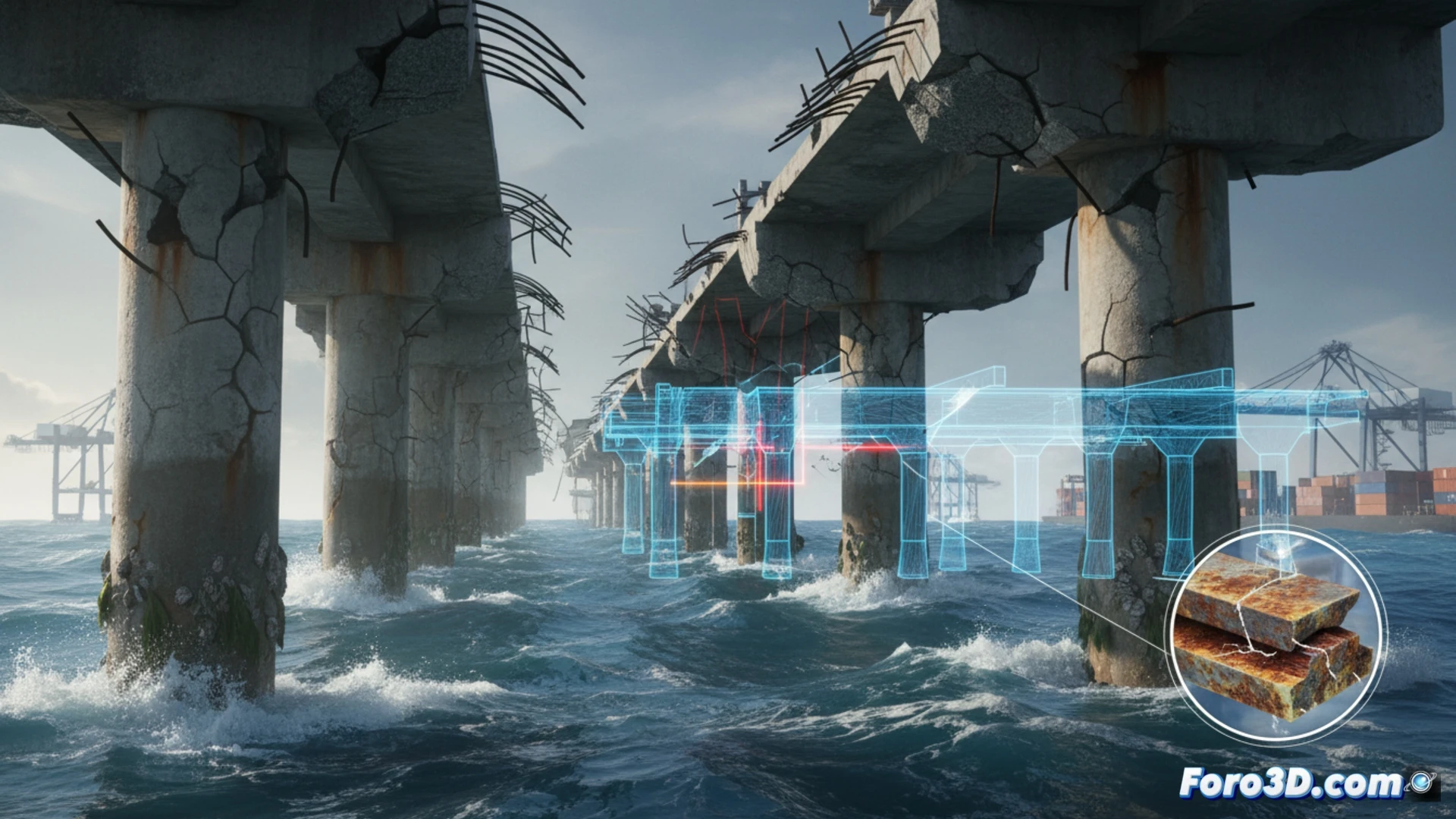
The main trigger of instability is scour, where marine currents erode the seabed around the piles, eliminating the friction necessary for vertical stability. Added to this is the fatigue of the reinforcing steel, which after decades of load and unload cycles from waves and machinery weight, develops microcracks. In a parametric 3D model, we can replicate these effects: we gradually reduce the pile section by 15% to simulate corrosion and remove the substrate layer at the base. The result is a collapse sequence where the top slab tilts, the transverse beams give way, and the gantry crane traffic derails, generating a chain reaction that drags containers into the water.
Towards Prevention with Digital Twins 🛰️
Simulation not only documents the disaster but prevents it. Implementing a digital twin of the dock allows real-time monitoring of stress on the piles and seabed depth. Upon detecting an anomaly in vibration frequency (an indicator of lost stiffness), the 3D model projects the collapse scenario at 30, 60, and 90 days. This predictive capability transforms the management of critical infrastructure, allowing scheduling of reinforcements or partial closures before instability becomes a catastrophe. 3D technology ceases to be a mere visualizer and becomes an early warning system.
Can a digital twin accurately predict the exact moment of a dock collapse by identifying micro-deformations invisible to traditional visual inspection?
(PS: Simulating catastrophes is fun until the computer crashes and you are the catastrophe.)