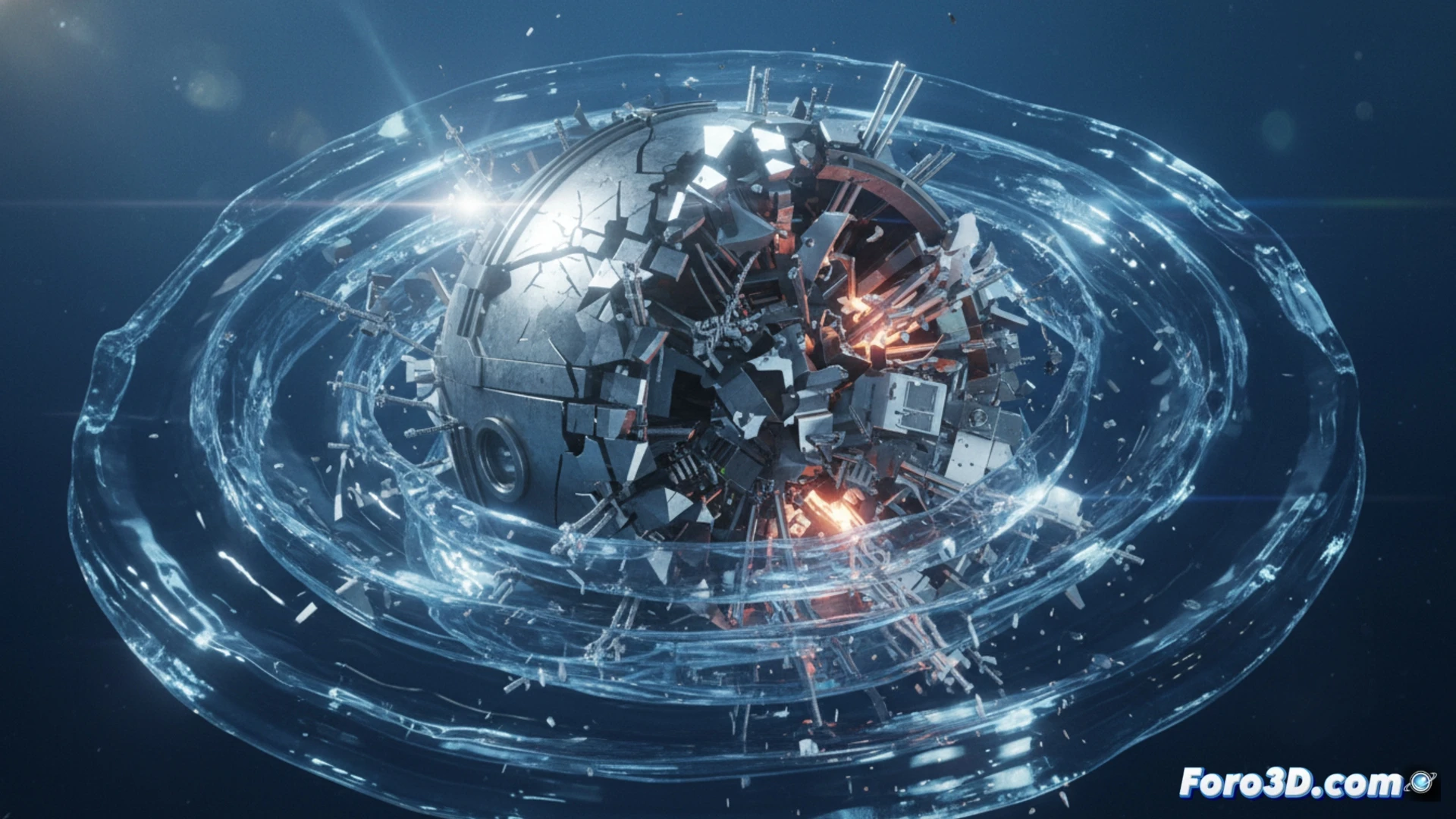
The implosion of a pressure chamber represents one of the most violent phenomena in the engineering of submerged structures. When external pressure exceeds the material's resistance, the failure is not instantaneous but progressive, generating shock waves and plastic deformations. In this article, we analyze the mechanics of hydrostatic collapse through 3D simulations, comparing the results with real cases such as the Titan submersible to understand how digital visualization helps prevent catastrophes. 💥
Mechanics of hydrostatic collapse and structural modeling ⚙️
In a 3D finite element simulation, the process begins with the gradual application of hydrostatic pressure on the external surface of the hull. The model reveals that compressive stresses first concentrate at welded joints and penetration points. Upon exceeding the material's elastic limit, plastic deformation initiates, generating localized buckling. This buckling propagates like a slow-motion crack until the structure loses its integrity. The final implosion produces a shock wave that travels inward at supersonic speeds, compressing the air and generating extreme temperatures that can melt internal components. 3D models allow visualizing this progressive collapse frame by frame, showing how stresses redistribute before total failure.
Visual lessons for safety in naval engineering 🛠️
The 3D simulation of the Titan case demonstrated that the failure did not occur due to a single defect, but from the accumulation of microcracks in the carbon fiber composite under pressure cycles. The animations revealed that the implosion was preceded by detectable acoustic emissions. These models allow engineers to design early warning systems based on strain sensors and high-sensitivity microphones. Graphic visualization transforms abstract concepts of fluid mechanics and material strength into tangible tools to improve safety protocols in submarines and extreme pressure equipment.
What 3D simulation techniques allow for the most accurate representation of catastrophic material fracture and the resulting shock wave in a pressure chamber implosion?
(PS: Simulating catastrophes is fun until the computer melts down and you are the catastrophe.)