A recent incident with an autonomous crane in an automated port has brought a critical issue to the table: position error. When a LIDAR sensor becomes miscalibrated or an encoder fails, the machine loses its spatial reference, risking collisions and material damage. In response, digital twin technology emerges as the most robust solution to simulate, detect, and correct these deviations in real time, preventing a minor software glitch from turning into a logistical disaster. 🏗️
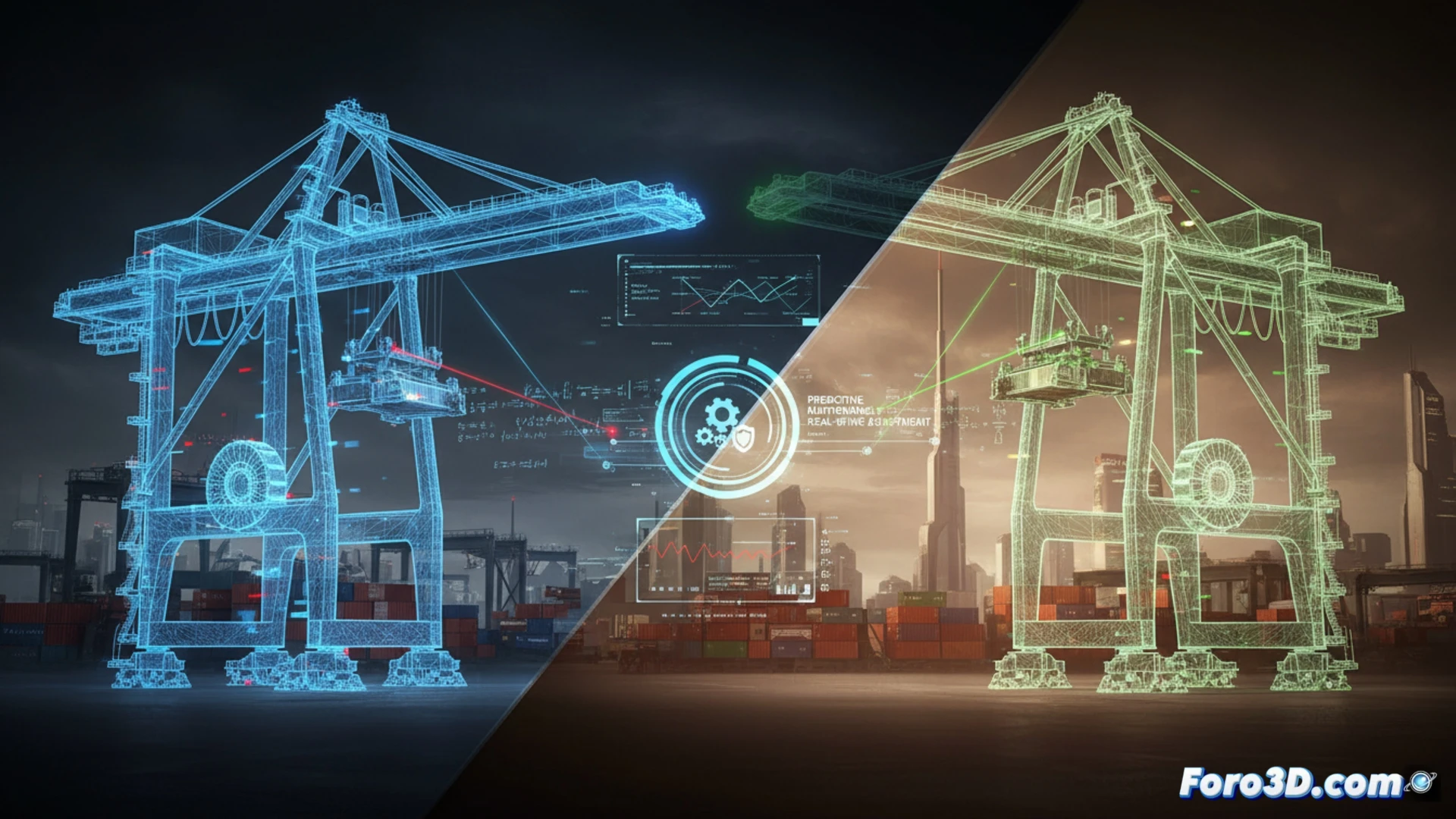
Data Flow and Sensory Synchronization in the 3D Model 🔄
The digital twin of an autonomous crane is not a simple static 3D model; it is a living replica fed by a triad of sensors. The LIDAR scans the environment to map obstacles and containers, while high-precision GPS (RTK) provides absolute location. The encoders on the hoist and travel motors report the actual movement of each axis. This data flow is integrated into a simulation engine (such as Unity or Unreal Engine) that updates the virtual position of the model millimeter by millimeter. If the digital twin detects a discrepancy between the commanded and actual position (for example, a 5 cm offset on the rail), the system can stop the operation or recalculate the trajectory before a collision occurs, functioning as a predictive safety twin.
Predictive Simulation as a Barrier Against Deviation ⚡
The key to success lies in the predictive capability of the digital twin. Instead of waiting for the error to materialize in the physical world, the 3D model runs parallel simulations of the planned trajectory. If the twin detects that, with the current sensor data, the crane would deviate into an exclusion zone or collide with a stack of containers, it sends an emergency stop alert to the real machine's PLC. In automated warehouses and smart ports, this architecture is already reducing unplanned downtime by 30%, demonstrating that a position failure is not the end of operations, but the beginning of an intelligent correction.
How can a digital twin correct positioning errors in autonomous cranes without relying exclusively on expensive GPS sensors in port environments with electromagnetic interference?
(PS: don't forget to update the digital twin, or your real twin will complain)