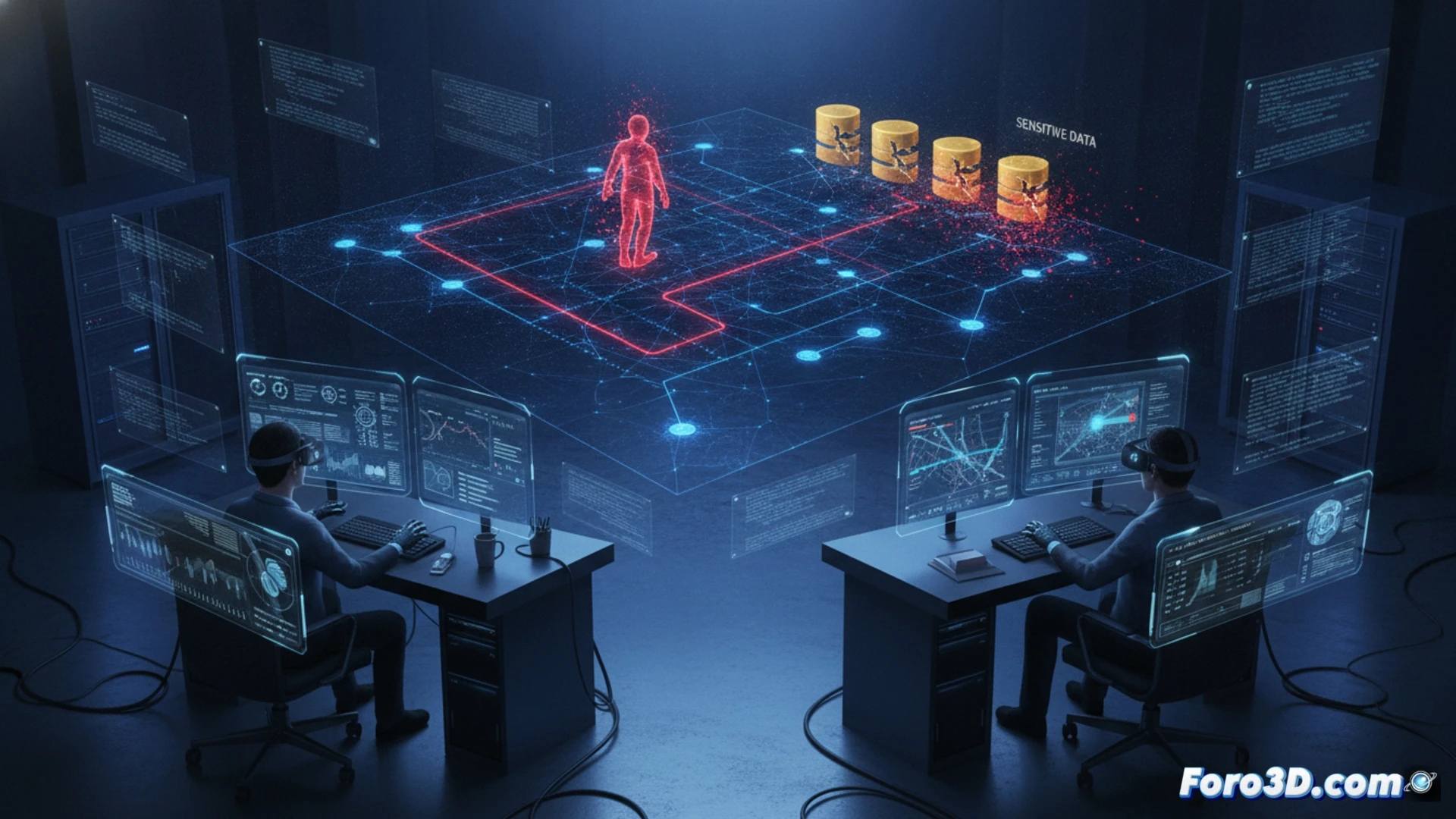
A stored data breach is not just a security event; it is a chaotic scenario where access logs, file metadata, and network traces converge. For a forensic pipeline, the challenge lies not in finding the entry point, but in reconstructing the exact sequence of lateral movements within the system. This is where 3D technologies transform the investigation: they allow mapping the topology of the compromised network and visualizing how an attacker navigated between servers to reach the sensitive data repository.
Evidence acquisition and modeling pipeline 🛠️
The workflow begins with capturing forensic images of hard drives and RAM memory dumps. This binary data is converted into spatial coordinates within a graphics engine. For example, each storage block can be represented as a cube in a 3D mesh, where colors indicate the file state (deleted, modified, accessed). By overlaying network connection paths as vector lines, the analyst obtains a navigable map. The key tool is temporal reconstruction software that aligns log timestamps with model positions, allowing the breach to be replayed as a forensic animation. This digital twin not only documents the what, but also the how and when of each intruder movement.
The visual narrative as expert evidence 🎥
In a judicial or expert report, a 500-page text can be opaque for a judge or a non-technical client. An interactive 3D model of the attack, where one can orbit around a server and see exfiltrated data as escaping particles, turns complexity into irrefutable visual evidence. This approach not only accelerates understanding of the incident but also exposes inconsistencies in the statements of those involved. The data breach ceases to be an abstract concept and becomes a reconstructed, measurable, and verifiable scenario within a rigorous forensic pipeline.
Since the forensic replication of a digital twin must be immutable and verifiable, what specific methodology do you recommend to ensure that access metadata and activity logs are not altered during the cloning process of the original system?
(PS: don't forget to calibrate the laser scanner before documenting the scene... or you might be modeling a ghost)