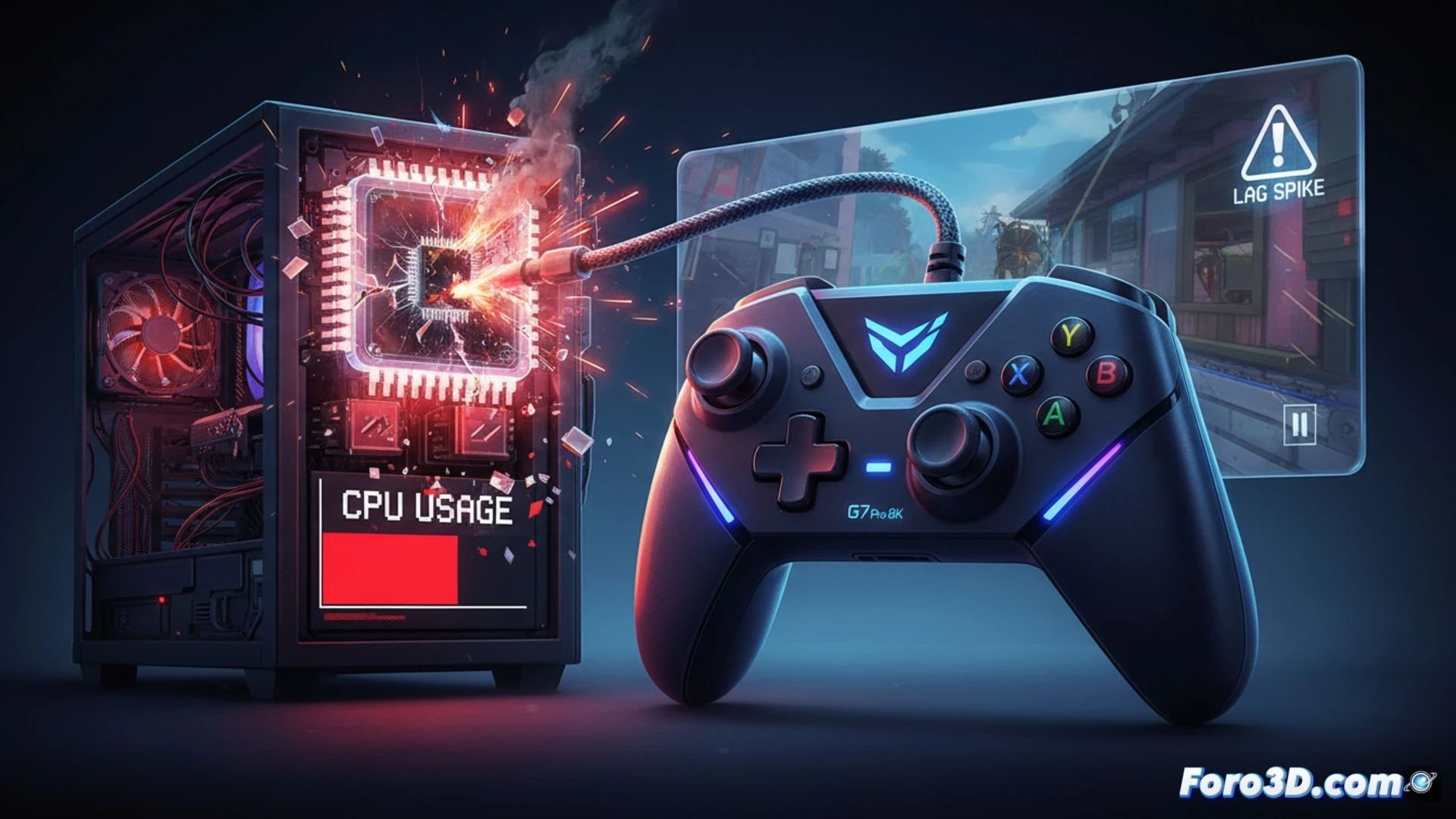
The GameSir G7 Pro 8K hits the market promising an 8,000 Hz polling rate, translating to near-instantaneous input response, ideal for competitive shooters. However, this performance leap has a hidden cost that isn't on the 90-euro price tag, but in your processor's clock cycles. If your system isn't top-of-the-line, this peripheral could become an unexpected bottleneck, slowing down the game instead of improving it.
The polling paradox: when speed saturates the bus 🧠
To understand the problem, you have to look at the hardware workflow. A standard controller sends data at 125 Hz (every 8 ms). The GameSir G7 Pro 8K does it 64 times faster, forcing the CPU to interrupt its main job (rendering the 3D scene) to process that torrent of inputs. On systems with modern high-frequency processors, this load is trivial. But on computers with low-power or older-generation CPUs, each interrupt steals processing time from critical tasks like physics simulation or shadow calculation. The result is paradoxical: you pay for less latency, but you get micro-stutters and FPS drops. It's a similar effect to having background rendering while you play.
Real compatibility: a luxury for top-tier systems 🔥
For the 3D hardware user, the lesson is clear. If your PC is a workstation or a gaming rig with a 13th-gen i7 or a Ryzen 7 or higher, the G7 Pro 8K will be a precise tool. But if you're working with a four-year-old laptop or a mid-range system that already struggles to maintain 60 FPS in complex scenes, this controller is not an upgrade, it's an additional burden. For 90 euros, you access a niche technology, but only if your CPU can handle the traffic. Otherwise, the standard 1,000 Hz mode of the controller remains the most sensible option to avoid compromising system performance.
Given that the GameSir G7 Pro 8K demands an 8,000 Hz polling rate, what real impact does this ultra-low latency have on the performance of a mid-to-high-end CPU during real-time 3D modeling sessions versus its use in competitive gaming?
(PS: Your CPU heats up more than the Blender vs. Maya debate)