The promise of the smart home clashes with the reality of latent risks. At Foro3D.com, we analyze a critical scenario: a methane gas leak from a connected appliance. We model in 3D the progression of flammable gas inside a closed kitchen, identifying stratification patterns, hot spots for ignition, and the structural collapse caused by a deflagration. This article breaks down each phase of the disaster, from the technical failure to the explosion.
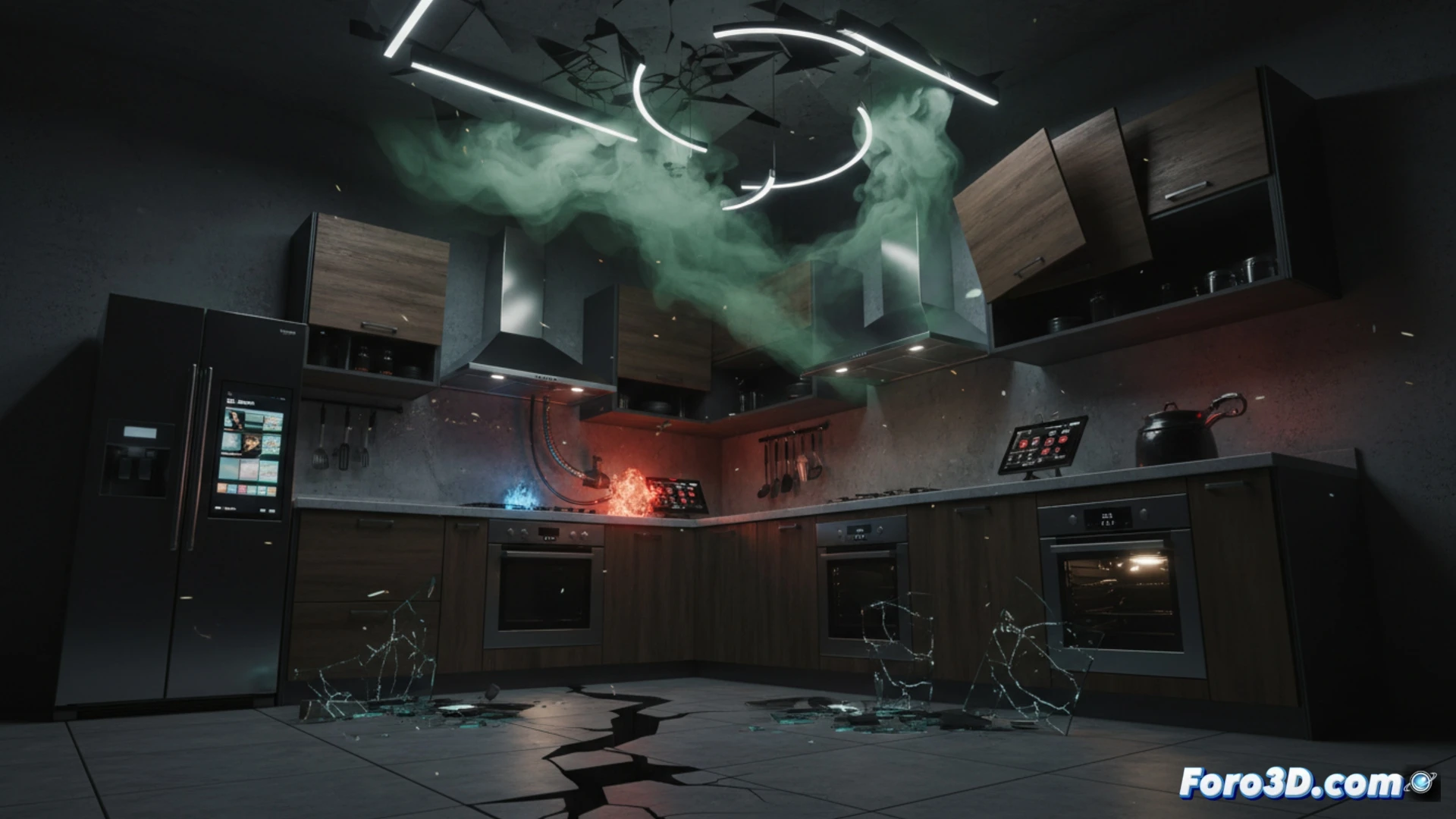
3D Modeling of Dispersion and Ignition Points 💥
Using computational fluid dynamics (CFD) simulations integrated into Blender, we recreate the leak originating from the joint of a defective smart valve. The gas, lighter than air, rises and accumulates in the false ceiling and behind built-in appliances. The model reveals two critical zones: the gas oven pilot light and the electrical relay of the range hood. After 45 seconds of continuous leakage, the gas concentration reaches 5% of the kitchen's volume, the lower explosive limit. The 3D visualization shows how a 0.2 millijoule spark at the relay triggers a supersonic pressure wave that deforms drywall and projects fragments of ceramic glass. The MQ-2 gas sensors, represented in the simulation, fail in their response due to a 12-second calibration delay, enough time for the cloud to reach the ignition point.
Structural Lessons and the Role of Prevention 🛡️
Beyond graphical realism, the 3D simulation forces us to rethink passive safety. The model shows that automatic shut-off systems (solenoid valves) installed on the supply pipe reduce the mass of released gas by 78%, preventing the explosive concentration. However, the visualization also shows that, without forced cross-ventilation, residual gas remains trapped in dead corners for minutes. The catastrophe is not inevitable; it is a matter of designing emergency protocols and sensor redundancy. At Foro3D.com, we believe that modeling the disaster is the first step towards making the smart home a truly safe place.
How can the dispersion of methane gas from a leak in a smart kitchen be modeled in 3D, and what simulation parameters are crucial for predicting the ignition point and the propagation of deflagration in a closed domestic environment?
(PS: Simulating catastrophes is fun until the computer melts down and you are the catastrophe.)