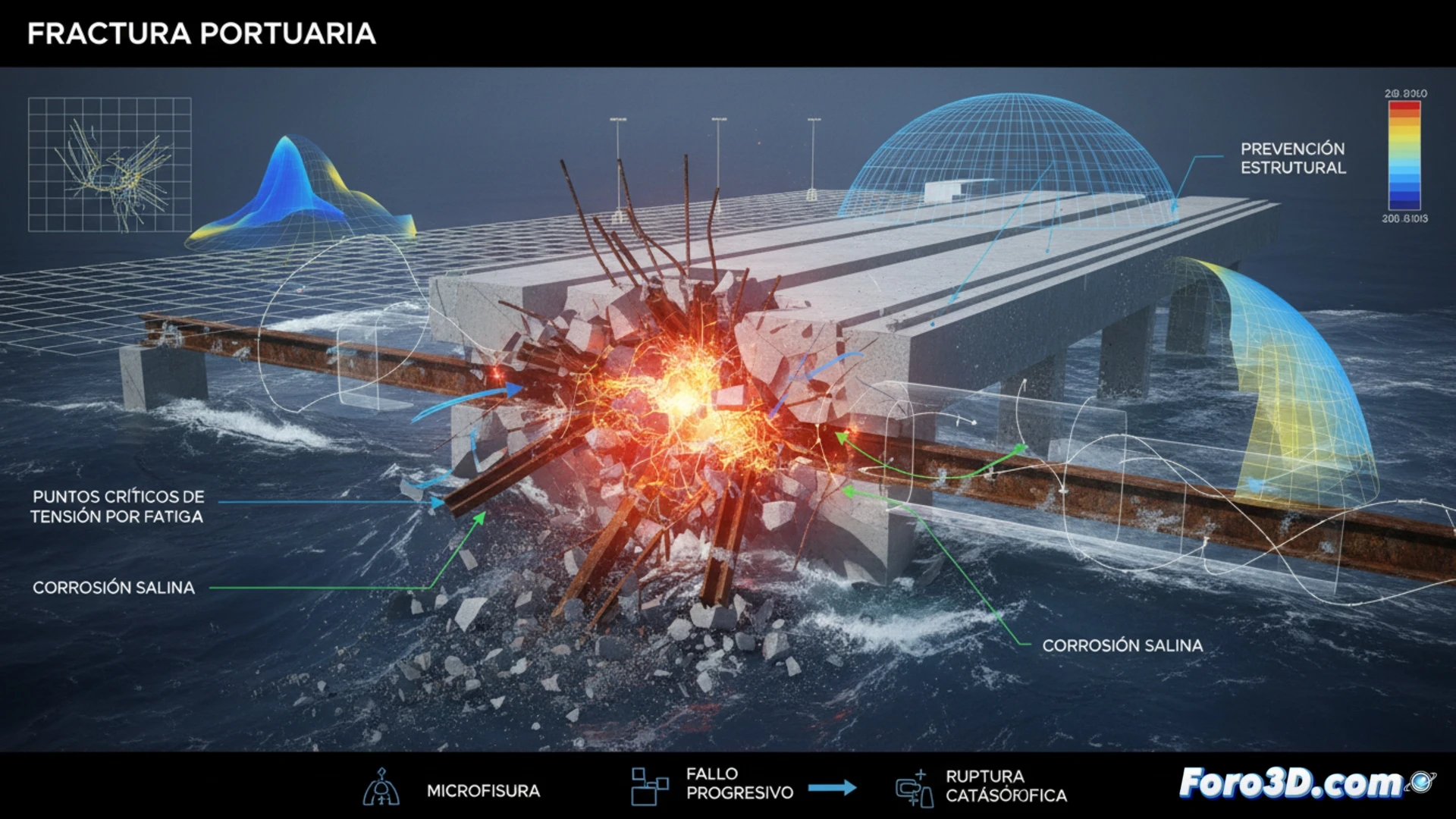
Port Fracture is not just a hypothetical scenario; it is a latent risk in infrastructures subjected to extreme load cycles and saline corrosion. This article analyzes the collapse of a docking platform using parametric 3D modeling and finite element method (FEM) simulation. We virtually reconstruct the failure sequence, from the initial microcrack to the catastrophic rupture, identifying the critical stress points where material fatigue exceeded the elastic limit.
Technical Reconstruction: Stress and Strain Mapping 🛠️
In the simulation, we modeled the structure with ASTM A36 steel and reinforced concrete, applying cyclic loads equivalent to storm waves and gantry crane traffic. The FEM analysis revealed that the main stress concentrator was located at the welded joint between the pile and the mooring beam. There, the accumulated plastic deformation exceeded 0.2% after 15,000 cycles, initiating a crack that propagated through hydrogen embrittlement. The 3D visualization allowed us to observe how the load redistribution failed when the second pile gave way, triggering a domino effect. The deformation curves showed a maximum displacement of 45 mm before total collapse, a value that exceeds the original design tolerance by 300%.
Virtual Lessons for Port Resilience 🌊
The virtual reconstruction not only documents the disaster but also proposes tangible improvements. By modifying the design with stiffeners at critical joints and increasing the thickness of the concrete cover in the splash zone, the simulation predicts an extended service life of 60%. This exercise demonstrates that prevention is not an expense but an investment in operational continuity. Modeling chaos before it occurs is the only way to ensure that ports do not fracture under pressure.
What 3D simulation techniques allow for more accurate anticipation of fracture patterns in docks subjected to cyclic fatigue, and how are they integrated into structural prevention protocols?
(PS: Simulating catastrophes is fun until the computer melts down and you are the catastrophe.)