The breakage of a golf club during a swing is not a random accident, but rather the culmination of a process of mechanical fatigue that can be visualized with millimeter precision in a 3D environment. In this article, we break down the structural failure of the club shaft using finite element analysis (FEA), identifying the exact point of stress concentration and the propagation of the microcrack up to catastrophic fracture. We analyze how cyclic loads, combined with incorrect impact angles, degrade the integrity of the material.
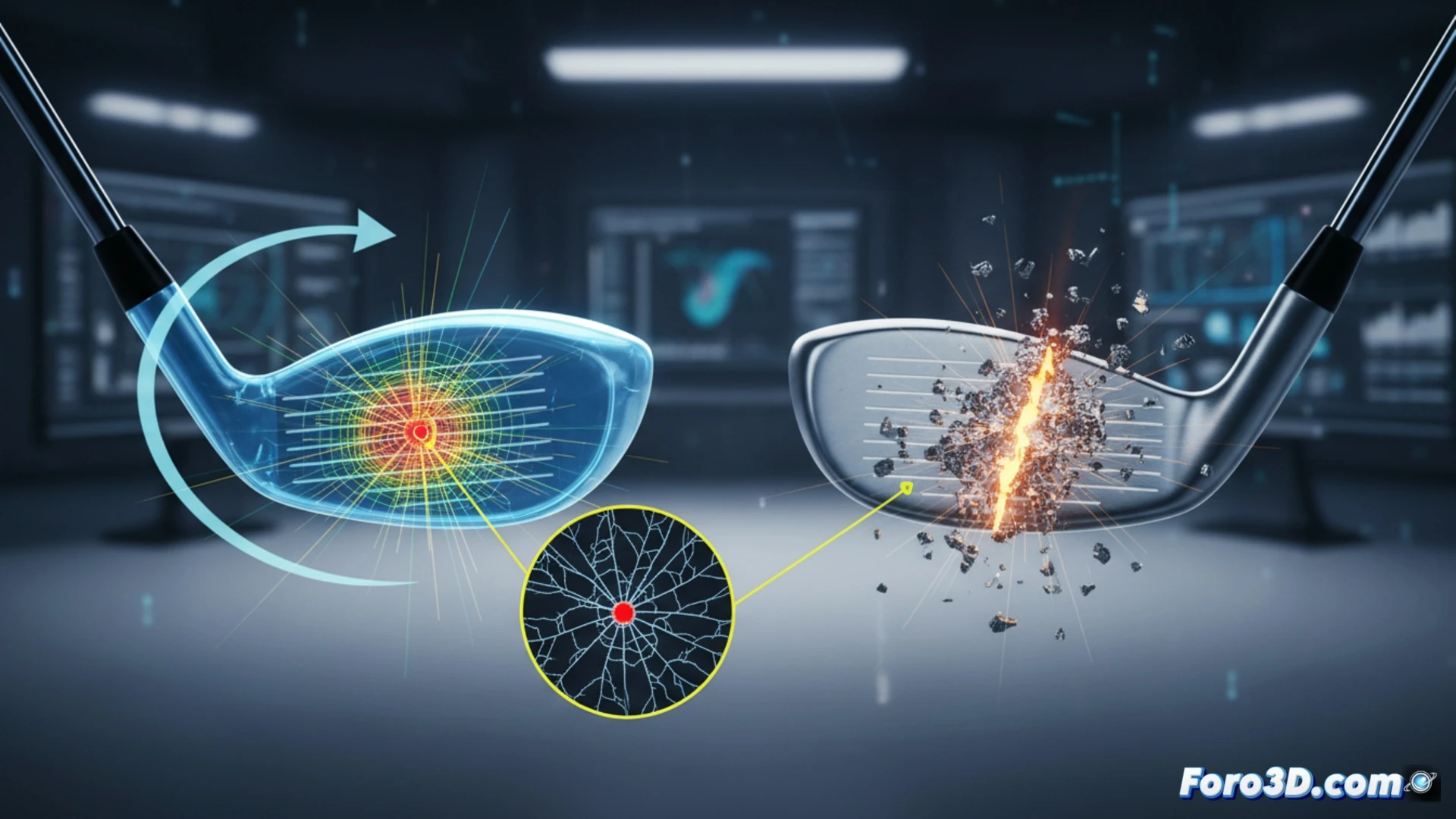
FEA Simulation: Stress Concentration and Crack Propagation 🏌️
Our 3D model focuses on the transition zone between the grip and the shaft, where bending and torsional stresses reach their peak during the downswing. By applying a cyclic load of 30 Nm with a frequency of 1.5 Hz, simulating 500 swings, the FEA software reveals an accumulation of localized plastic deformations. In the case of graphite, the anisotropy of the composite material generates internal delamination before visible fracture; in steel, the failure manifests as a fatigue crack that advances from the outer surface inward. An impact angle of 5 degrees out of the optimal plane multiplies the Von Mises stress at the support point by 3, accelerating crack nucleation. Cross-sectional visualization allows seeing the progress of the crack cycle by cycle, until the remaining section can no longer support the maximum load.
Prevention through Vibration Analysis and Design 🔧
Beyond simulation, monitoring the natural frequency of the club can anticipate its failure. A healthy shaft vibrates at a characteristic frequency; when a microcrack appears, this frequency shifts and the damping changes. Integrating a virtual sensor into the 3D model allows predicting this deviation. To extend the service life, we recommend avoiding impacts with the ground and choosing a shaft with a stiffness profile that better dissipates torsional vibrations, reducing the accumulated cyclic load at the critical break point.
As a simulation engineer, which specific fatigue failure criterion do you consider most relevant for predicting breakage in the neck of a golf club during a swing, and how do you model the variability in impact force between an amateur and a professional swing in the finite element analysis?
(PS: Material fatigue is like yours after 10 hours of simulation.)