The fracture of a loom is not just a point of physical breakage, but an opportunity for digital reconstruction. When a historic piece of textile machinery deteriorates, the 3D model becomes the key tool to document its current state, analyze cracks and deformations, and visualize what the original structure looked like. This process allows preserving the industrial legacy beyond physical collapse. 🧵
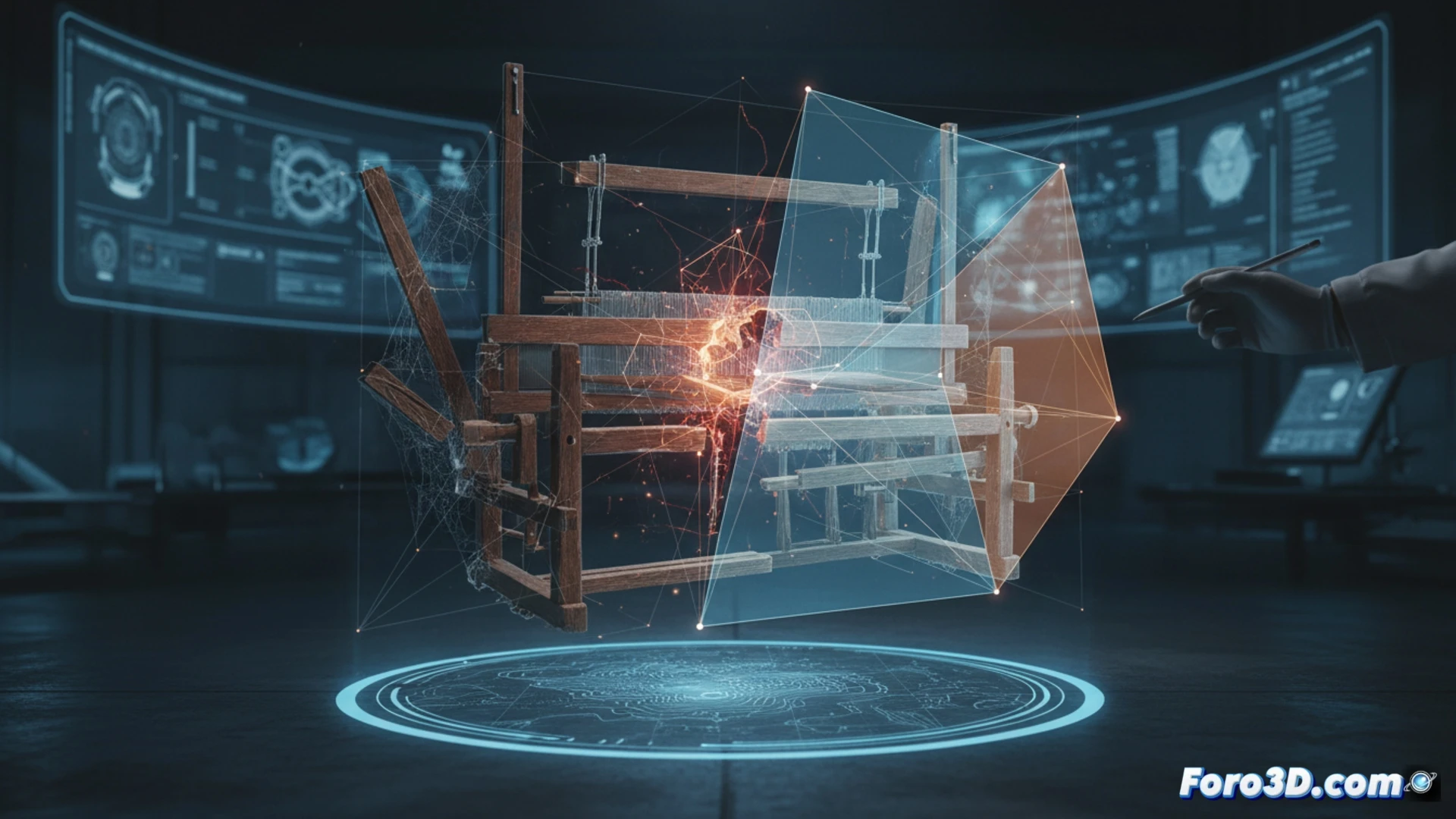
Technical workflow for reconstruction from the fracture 🔧
The process begins with capturing the ruin through photogrammetry, taking between 80 and 150 high-resolution photographs of the loom fragments, paying special attention to the fracture zones that reveal the direction of structural stresses. These images are processed in reconstruction software such as RealityCapture or Agisoft Metashape to generate a point cloud and a detailed polygonal mesh. The critical stage is retopology and inverse simulation: using tools like Blender or ZBrush, the missing piece is modeled based on historical references and the morphology of the broken edges. To validate the reconstruction, a structural stress analysis is applied to confirm that the digital model mechanically fits with the original fragments.
The fracture as an archive and the loom as a witness 🕰️
The fracture of a loom tells us the story of its use and abandonment. Each crack is a record of wear, load, and the passage of time. Digitally reconstructing this object is not just a technical exercise of filling gaps in a 3D mesh; it is an act of historical interpretation. By modeling the broken loom, we not only save its form but preserve the tactile memory of a textile industry that defined entire communities, allowing future generations to observe it in its original state.
What specific photogrammetry or 3D scanning methods do you recommend to accurately capture the broken threads and fabric structure of a damaged textile piece without causing additional physical stress?
(PS: Reconstructing ruins is like doing a puzzle without knowing how many pieces are missing. But at least you can make up the missing ones.)