Space wave fracture is a theoretical concept that describes the critical point where a disturbance in the space-time continuum loses its coherence and tears apart. Unlike a simple wave, this fracture implies a discontinuity in the metric of the universe, similar to a crack in ice but in the very geometry of the cosmos. This phenomenon, observable in high-energy simulations, allows scientists to study the limits of general relativity and quantum mechanics in extreme environments.
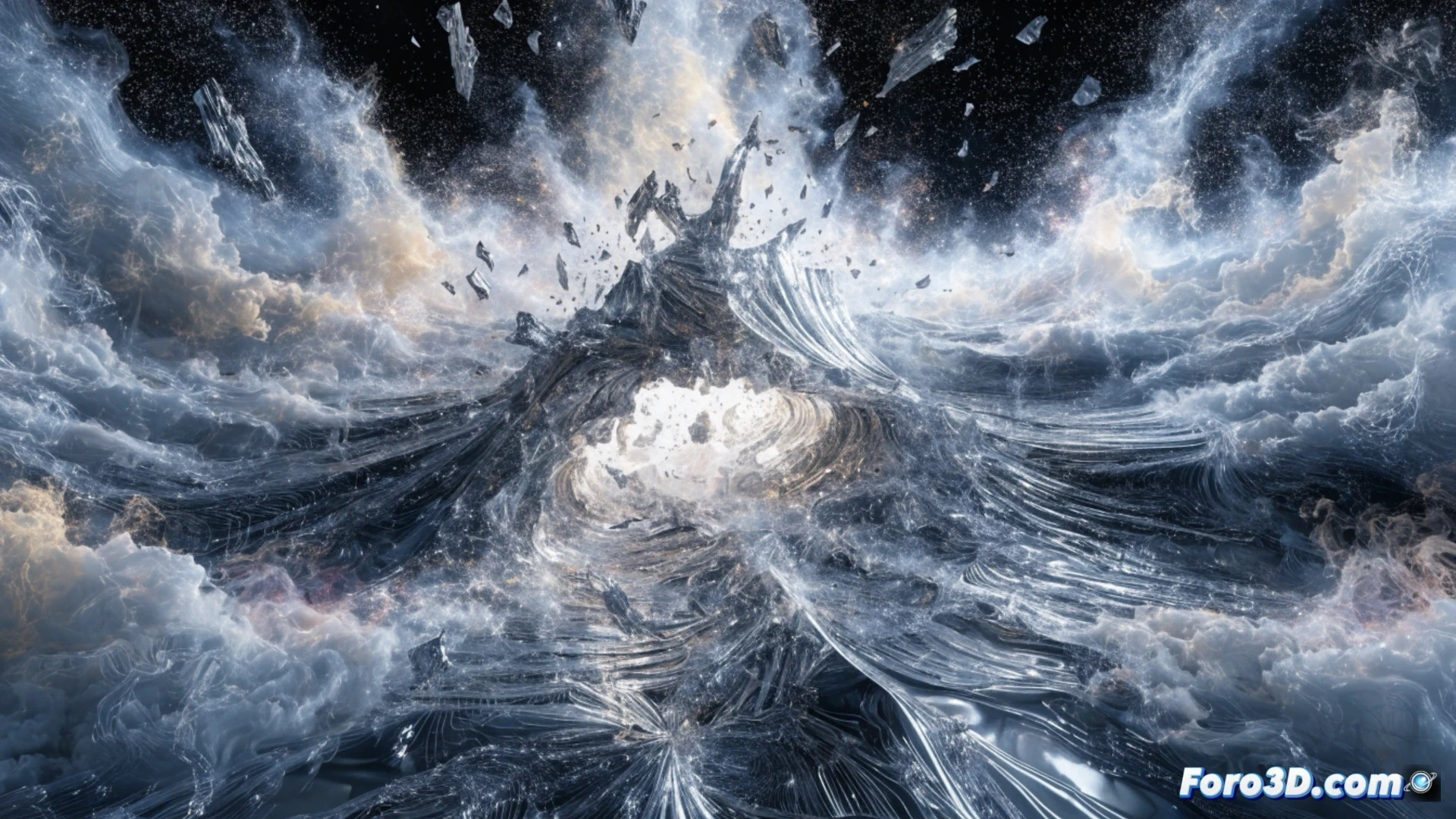
3D Modeling of Discontinuities in the Cosmic Fabric 🌌
To represent this phenomenon in a scientific visualization environment, dynamic meshes are used to deform a base plane simulating the curvature of space-time. The process begins with a sinusoidal wave traveling through a grid of control points. Upon reaching a threshold of gravitational tension, the mesh breaks: vertices separate and open edges are generated simulating the fracture. Shaders apply a color gradient from blue (low energy) to incandescent white (breaking point), while particles emitted from the crack represent Hawking radiation or interstellar plasma jets. The key is to animate the wave propagation and the subsequent retraction of the fabric, creating a visual loop that illustrates the instability of the quantum vacuum.
The Visual Language of the Invisible 🔭
The true power of these visualizations lies not only in physical realism, but in their ability to translate abstract equations into sensory experiences. By observing a space wave fracture in 3D, the viewer does not just see a simulation; they witness the fragility of space. This type of representation is vital for science communication, as it converts concepts like Weyl tension or background radiation into images that anyone can interpret, bringing frontier astrophysics closer to the general public.
What real-time 3D visualization tools allow for the most accurate representation of the anisotropy of the metric tensor during the collapse of space-time in a space wave fracture?
(PS: fluid physics for simulating the ocean is like the sea: unpredictable and you always run out of RAM)