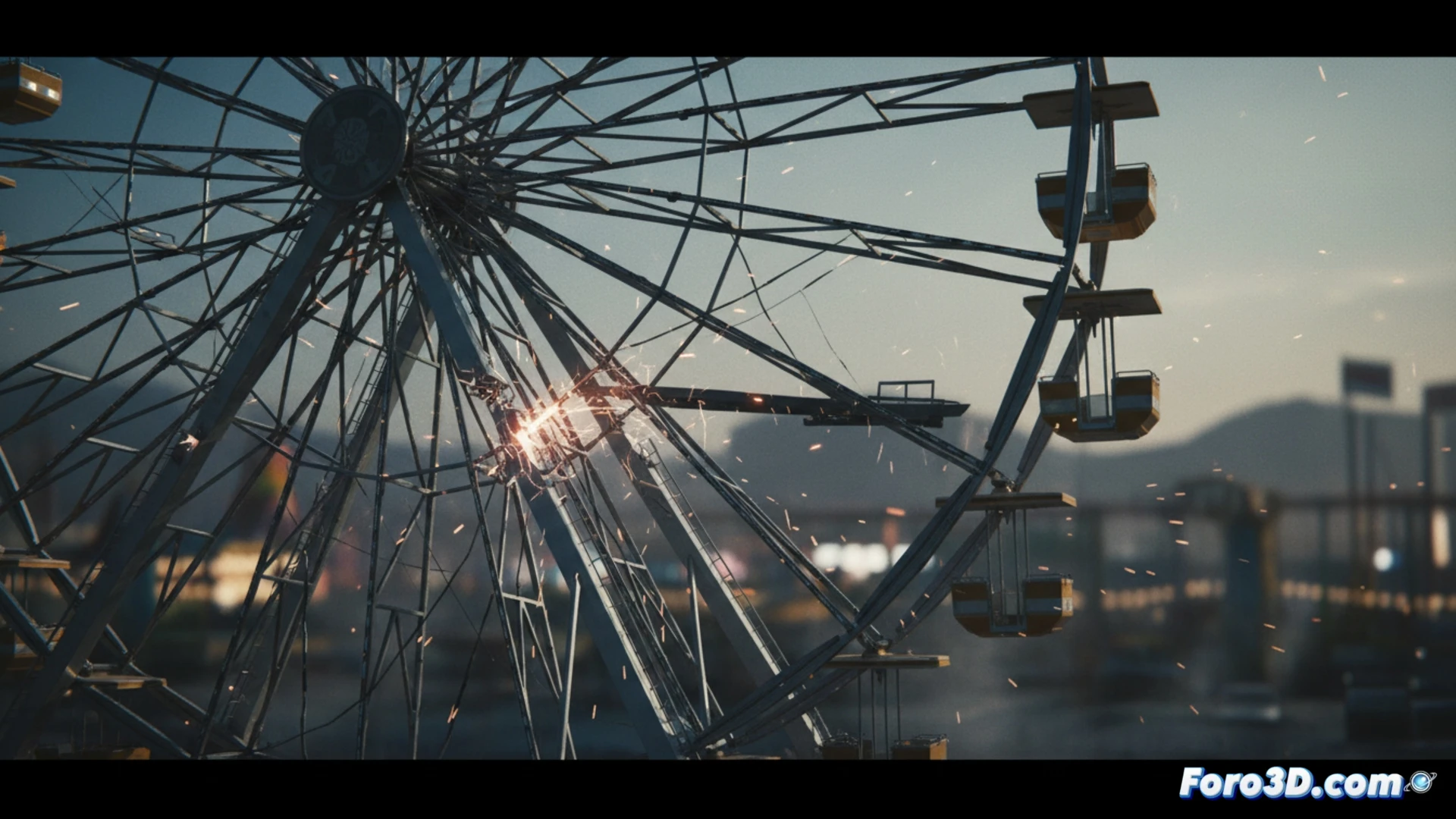
The structural failure of a Ferris wheel is not a simple accident; it is a cascade of accumulated stresses that exceed the material's fatigue limit. In the field of disaster simulation, 3D modeling allows us to dissect this phenomenon millimeter by millimeter. From the initial microcrack in an axle to the plastic deformation of the frame, reconstructing the fracture in a virtual environment is the key to understanding how an attraction becomes a death trap.
Technical analysis: Material fatigue and digital twins ⚙️
To recreate the fracture, a digital twin of the Ferris wheel is used, fed with historical load data and rotation cycles. Finite element analysis (FEA) software calculates the stress distribution at critical points such as bearings and connecting spokes. By simulating the propagation of a crack due to cyclic fatigue, the exact point of collapse initiation is identified. This process allows visualizing how stress corrosion or a defective weld amplifies the failure, offering a precise forensic map of the fracture sequence that no manual calculation could reveal.
Virtual lessons for real safety 🛡️
Beyond recreating the disaster, 3D simulation becomes a prevention tool. By introducing variables such as wear from use or extreme weather conditions, engineers can predict the remaining useful life of each component. This approach transforms the Ferris wheel from a simple mechanism into an intelligent system capable of alerting about its own deterioration, establishing a new standard of predictive inspection that saves lives before the metal breaks.
How to accurately model the propagation of a fatigue crack in a Ferris wheel axle to predict the exact point of collapse in a 3D simulation?
(PS: Simulating disasters is fun until the computer melts down and you are the disaster.)