The fracture of a mine represents one of the most devastating events in the extractive industry, combining geotechnical failures with immediate human consequences. This technical article explores how 3D reconstruction can break down the collapse process, from crack propagation in the rock mass to the total collapse of galleries. We will analyze modeling tools to simulate stresses, identify failure points, and visualize rescue scenarios in confined environments.
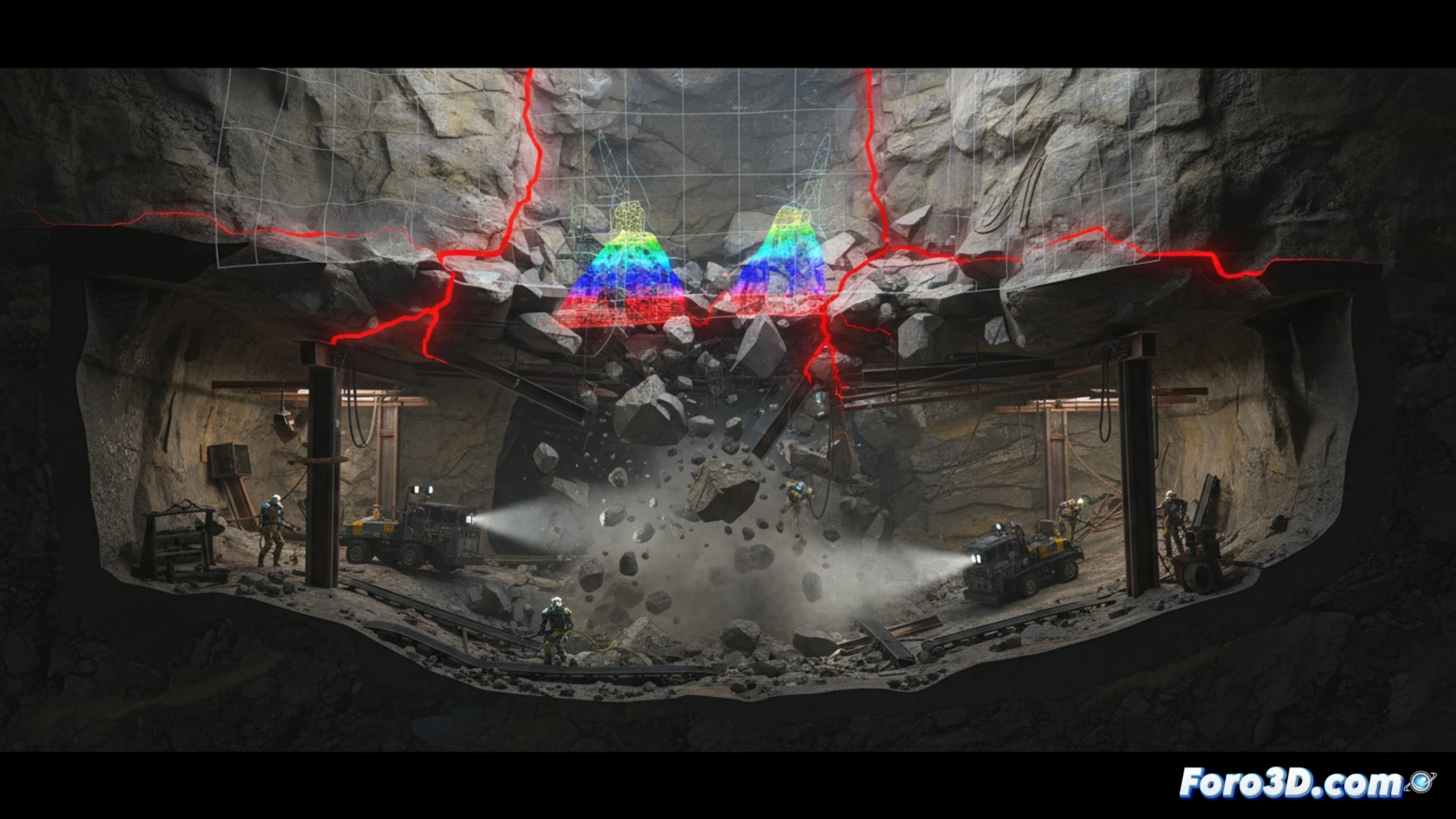
Geotechnical Modeling and Phases of Structural Collapse 🏗️
The mining fracture process is modeled in three key phases: initiation, propagation, and collapse. In the first, zones of weakness are identified through analysis of shear and tensile stresses in the ground, using seismic data and discontinuity maps. The second phase simulates crack propagation using finite element software such as FLAC3D or Abaqus, where failure surfaces are visualized in real time. Finally, the collapse is represented with interactive particles that recreate the flow of debris and the deformation of supports, allowing evaluation of the integrity of pillars and beams. The comparison of the terrain before and after the incident is achieved through LiDAR point clouds and photogrammetry, generating 3D meshes that reveal subsidence and displacements of the rock mass.
Rescue Visualization and Preventive Safety 🚨
Beyond the catastrophe, the 3D model allows planning evacuation routes and locating trapped machinery, such as drills or haul trucks, by overlaying layers of structural data. By recreating the collapse step by step, emergency teams can practice shoring and extraction protocols without real risk. This simulation also exposes the fragility of certain excavation designs, driving improvements in stress monitoring and early warning systems. Ultimately, 3D mining fracture simulation not only documents the disaster but transforms error into visual lessons that save lives.
How can 3D simulation of mining fractures improve the accuracy of planning underground rescue routes in the face of an imminent collapse?
(PS: Simulating catastrophes is fun until the computer crashes and you are the catastrophe.)