Metamaterials are artificial structures designed to exhibit mechanical properties not found in nature, such as negative stiffness or extreme absorption capacity. However, their behavior under fatigue and fracture is critical for real-world applications. 3D simulation allows visualizing how cracks propagate at the microstructural level, revealing weak points in the network of beams and nodes that compose these architectures.
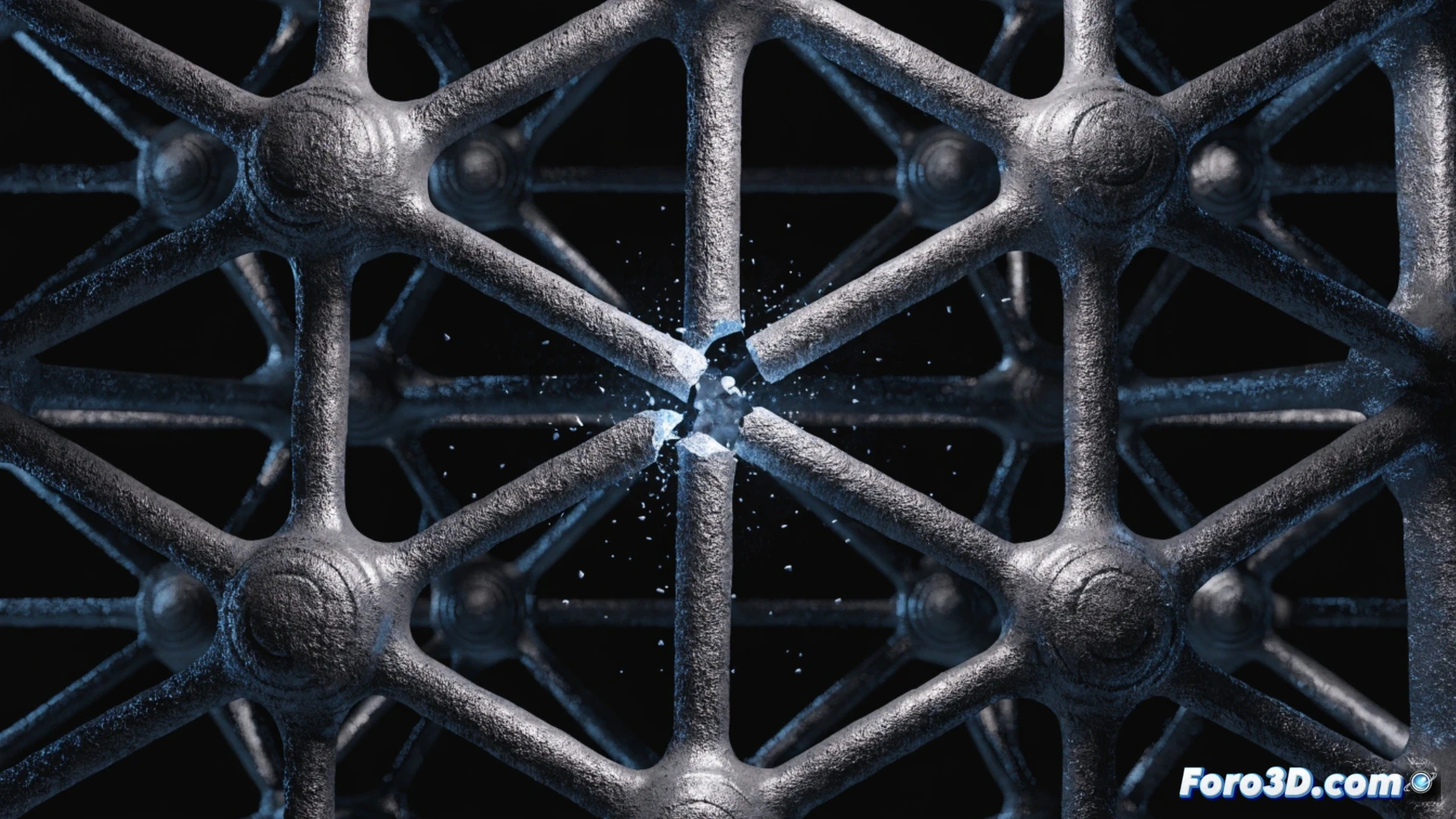
Modeling Crack Propagation in Metamaterial Networks 🧬
To simulate fracture, nonlinear finite element methods integrating cohesive damage criteria are employed. Each unit cell of the metamaterial is discretized into a high-resolution 3D mesh. When load cycles are applied, algorithms calculate stress concentration at the joints. When the local stress exceeds the critical threshold, mesh elements are removed to represent the crack. The generated renders show failure patterns that follow lines of lowest structural density, often bifurcating into multiple fronts.
The Dilemma Between Strength and Lightness ⚖️
The fracture of a metamaterial is not a simple tear, but a cascade of local collapses. By observing the simulation animation, one can see how the internal geometry dictates the crack path, sometimes stopping it at reinforced nodes. This analysis is vital for designing armor or acoustic panels that sacrifice controlled zones without catastrophic failure. 3D simulation thus becomes a tool for predicting the service life cycle before manufacturing.
How can 3D simulations predict the initiation and propagation of cracks in the microstructure of a metamaterial without compromising computational accuracy when modeling its complex geometric patterns?
(PS: Material fatigue is like yours after 10 hours of simulation.)