The collapse of a monumental-scale reflective surface not only implies the loss of an expensive asset but also triggers a cascade of structural failures that can compromise an entire technological complex. Recently, our team has addressed the modeling of a massive fracture in a solar concentration heliostat, using finite element analysis tools. The objective was to recreate the exact moment of the break to understand whether the origin was microscopic material fatigue or an unforeseen dynamic overload, such as a microseism or an assembly defect.
Crack propagation and stresses in composite materials 🔬
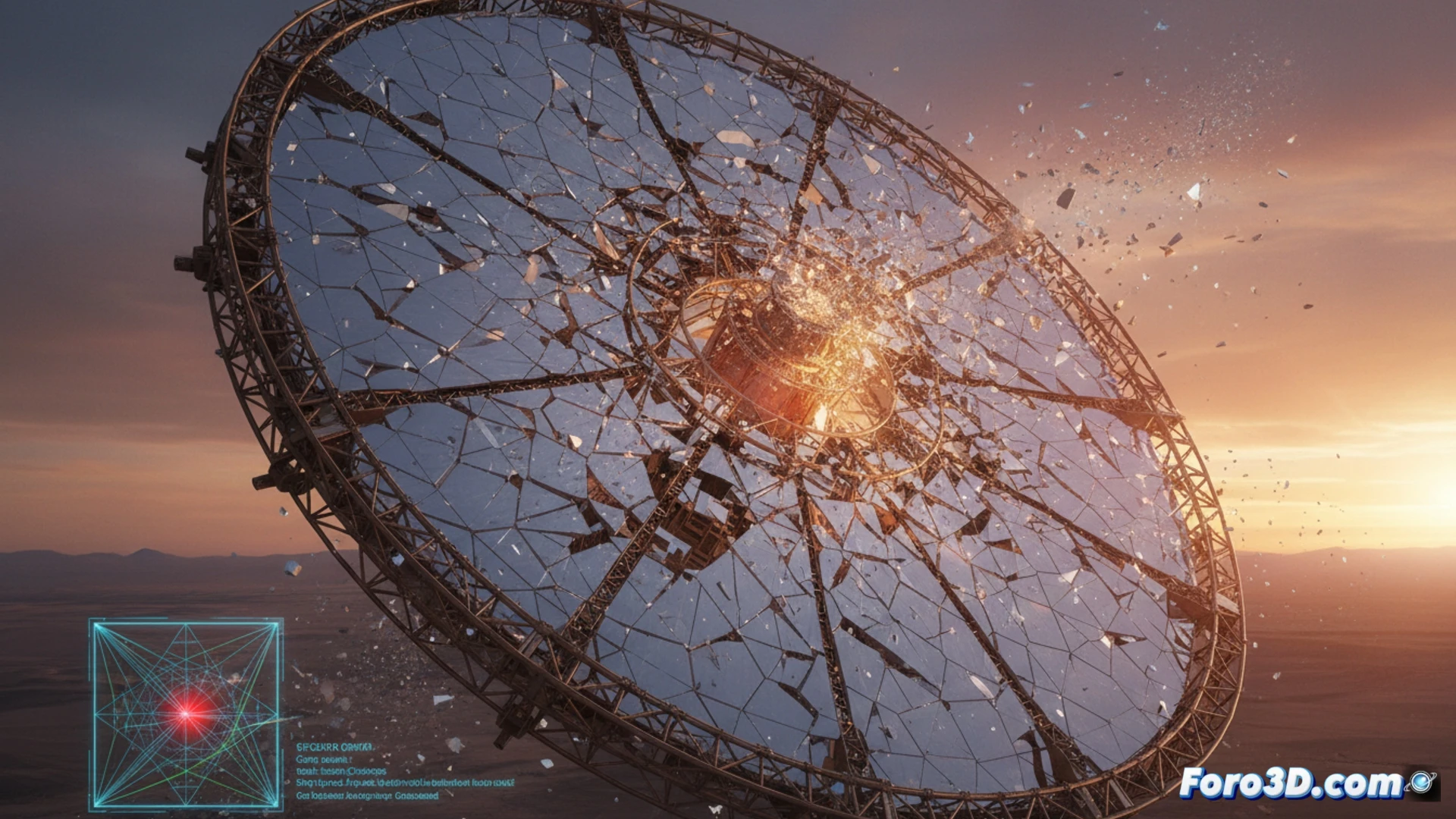
The simulation focused on a 12-meter diameter low thermal expansion glass panel, supported by a steel structure. Using a high-density mesh, virtual microcracks were introduced at the peripheral anchor points. The results revealed that the fracture was not instantaneous but propagated in three phases: a slow subcritical crack over 48 hours, followed by a sudden acceleration upon reaching the toughness threshold. The 3D reconstruction showed how the shock wave generated a star-shaped fracture pattern, typical of a release of energy accumulated by cyclic thermal fatigue, ruling out an external impact as the main cause.
Lessons from the simulation for future design 🛠️
The 3D model allowed visualizing that the failure originated from a deficient weld in the support frame, a detail that visual inspections did not detect. The technical conclusion is clear: preventing catastrophes in giant mirrors depends not only on the thickness of the glass but also on active stress monitoring at the interface between the reflective material and its frame. Implementing real-time strain sensors and designing more flexible expansion joints could absorb stresses before they become an irreversible fracture.
What physical parameters and boundary conditions are essential to accurately model the fragmentation and projection of glass in the 3D simulation of a giant mirror during its catastrophic collapse?
(PS: Simulating catastrophes is fun until the computer crashes and you are the catastrophe.)