The fracture of an industrial warehouse is not a sudden event, but the culmination of a silent degradation process. In this technical article, we address the digital reconstruction of an incident that occurred in a logistics warehouse, where material fatigue failure and cyclic overloading caused a progressive collapse of the slab. Using digital twins, we analyze the stress distribution to identify weak points and propose structural reinforcement solutions.
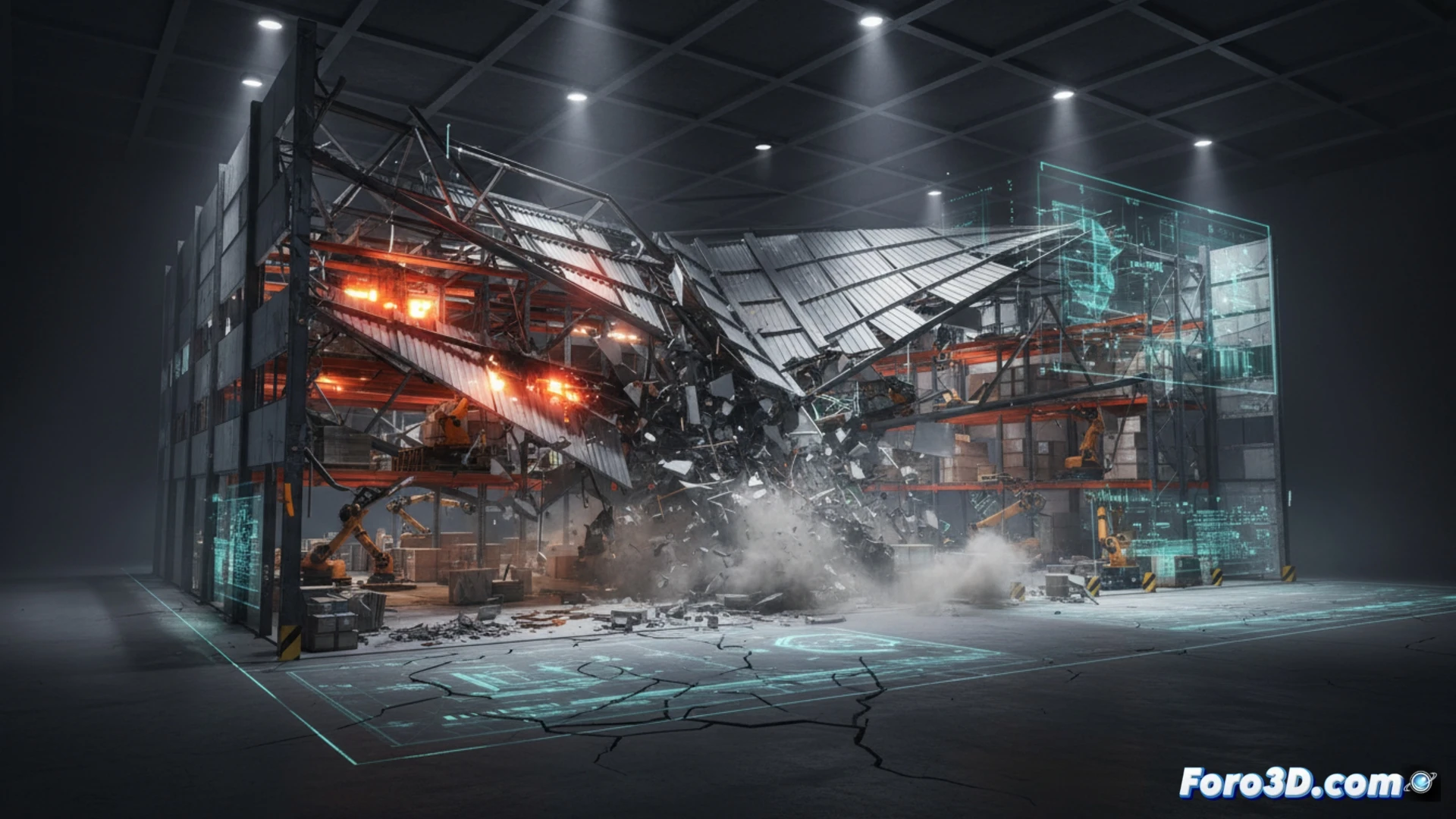
Digital Twin and Stress Analysis in Progressive Collapse 🏗️
To recreate the scenario, we modeled the warehouse in finite element software. We assigned real mechanical properties to the steel and concrete, considering the load history of the last ten years. The simulation revealed that the fracture began in a secondary beam near the loading dock, where accumulated fatigue exceeded the elastic limit. The collapse was progressive: when the first beam gave way, the load was redistributed to adjacent supports, which were not designed to withstand that increase. The digital twin allowed us to visualize the domino effect in real-time, showing how a small initial crack can trigger a catastrophic chain failure. The data obtained suggest that installing transverse reinforcements and monitoring with strain sensors could have prevented the incident.
Lessons for Prevention and Safe Evacuation 🚨
Beyond engineering, the 3D simulation forces us to reflect on the fragility of our infrastructures. Visualizing evacuation routes within the virtual model showed that, during the collapse, two of the three exits were blocked by debris. This underscores the need to design safety protocols that contemplate structural failure scenarios. Digital reconstruction not only serves to understand what failed, but also to train emergency teams and redesign warehouses with structural redundancy, ensuring that, even under extreme fatigue, human life is protected.
How can 3D simulation of material fatigue predict the exact point of collapse in an industrial warehouse before visible cracks appear?
(PS: Simulating catastrophes is fun until the computer crashes and you are the catastrophe.)