The explosion of a cylinder is not a random event, but the culmination of a mechanical degradation process known as material fatigue. When a tank or pipe withstands repeated pressure cycles, internal stresses generate microcracks that grow silently. 3D simulation allows visualizing this phenomenon in real time, identifying critical points where stress concentration exceeds the elastic limit, anticipating collapse before it occurs in the real world.
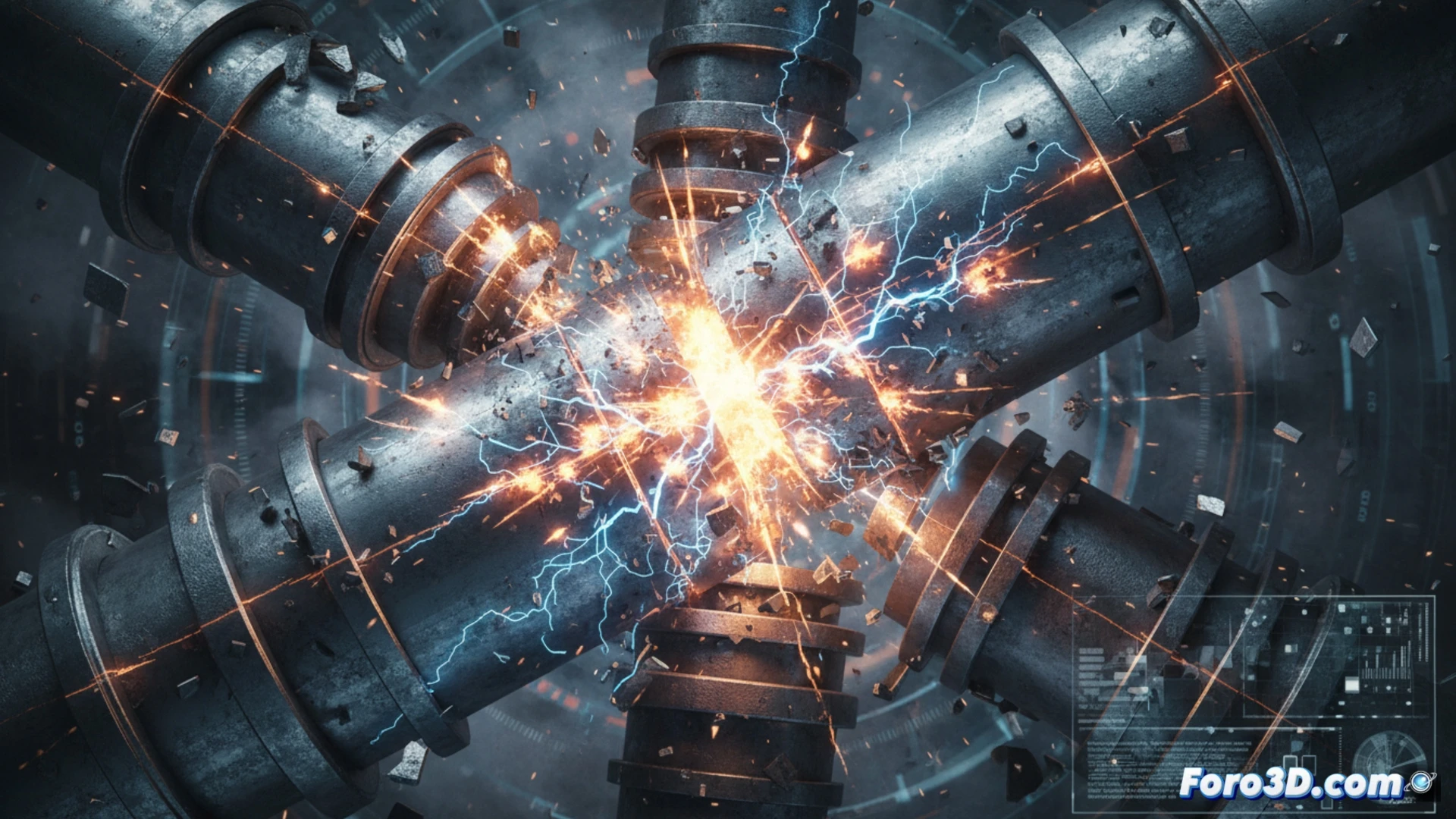
Fracture mechanics and crack propagation in cylindrical geometries 💥
In a cylinder subjected to internal pressure, the circumferential stress is twice the longitudinal stress, making the side wall the most vulnerable point. Using finite element method (FEM), we can model crack initiation at an inclusion or surface defect. As the load cycle progresses, the crack propagates following the direction of maximum principal stress. 3D simulation reveals how the crack bifurcates and accelerates, reducing the resistant cross-section until internal pressure exceeds the remaining strength, causing catastrophic explosion. This analysis is critical for designing inspection intervals in industrial pressure vessels.
Predicting failure to save lives and assets 🔧
The petrochemical and gas transportation industry has documented cases where the lack of predictive modeling led to devastating explosions. Simulating fatigue in cylinders not only allows optimizing wall thickness or selecting more resistant alloys, but also helps schedule preventive replacements. By visualizing in 3D the exact point of crack nucleation, engineers can design monitoring sensors in those areas. Current technology turns simulation into an indispensable safety tool, transforming fatigue theory into a barrier against disaster.
As an engineer, when modeling the propagation of a fatigue crack in a cylinder subjected to cyclic pressure, which mesh parameters and boundary conditions do you consider critical for accurately predicting the point of catastrophic failure and the dynamics of the resulting explosion in the 3D simulation?
(PS: Material fatigue is like yours after 10 hours of simulation.)