The recent structural failure of a rocket manufactured using 3D printing has reopened the debate on the reliability of additive manufacturing in aerospace environments. Initial analyses point to a premature fracture in the nozzle cone, suggesting a classic case of material fatigue. Unlike subtractive processes, 3D printing introduces anisotropy and microporosities that act as stress concentrators under extreme cyclic loads.
Modeling Load Cycles and Stress Maps 🔥
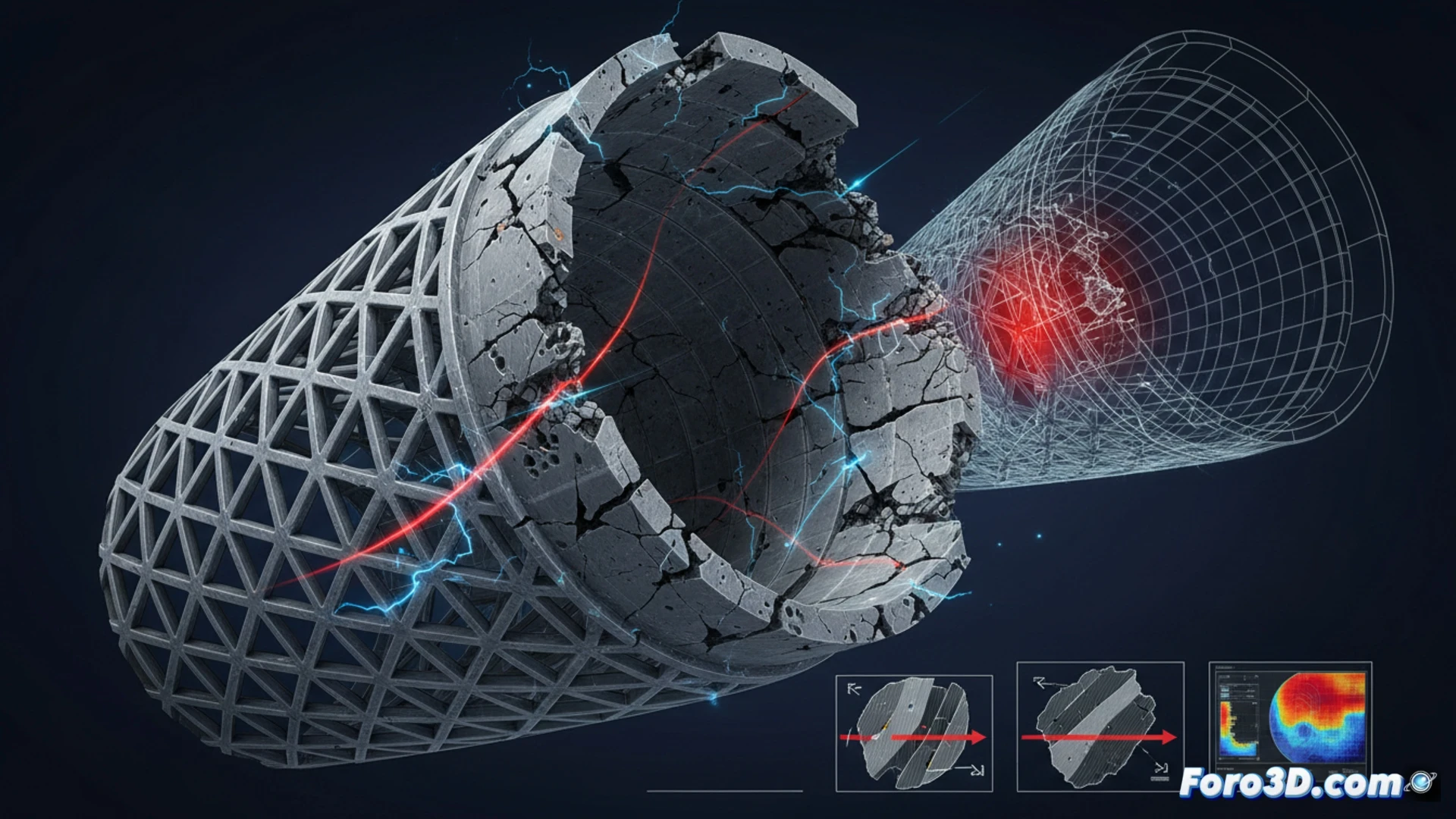
To understand the failure, engineers turn to finite element method (FEM) simulations that replicate the pressure and temperature cycles during launch. In these simulations, hot spots are identified where the Von Mises equivalent stress exceeds the material's yield strength. The visualization of the stress map reveals a critical concentration at the joint between the body and the injector, precisely where the crack originated. The simulation also allows comparing the expected lifespan of a conventional aluminum alloy against a sintered Inconel 718 powder, showing that the lack of homogeneity in the print layer reduces fatigue resistance by 40% under thermal vacuum conditions.
Lessons for Additive Fatigue Simulation ⚙️
This incident underscores the need to integrate cumulative damage models specific to printed materials. The simulation must not only predict plastic deformation but also the nucleation of microcracks at unfused grain boundaries. Incorporating post-process computed tomography data allows for better model calibration. The future of aerospace design depends on validating these digital twins with physical tests, closing the loop between predictive simulation and the reality of failure.
Considering the anisotropy and porosity parameters inherent to 3D printing, how should fatigue life prediction models be modified to detect catastrophic failures like that of the rocket before they occur under real load conditions?
(PS: Material fatigue is like yours after 10 hours of simulation.)