Kinetic facades represent an advancement in adaptive architecture, but their constant movement exposes materials to cycles of repetitive stress. This article analyzes how mechanical fatigue, induced by vibrations and thermal changes, causes microcracks at anchor points. Through 3D stress simulation, we identify fracture thresholds in alloys and composites, offering parametric solutions to extend the system's lifespan without sacrificing its dynamic aesthetics.
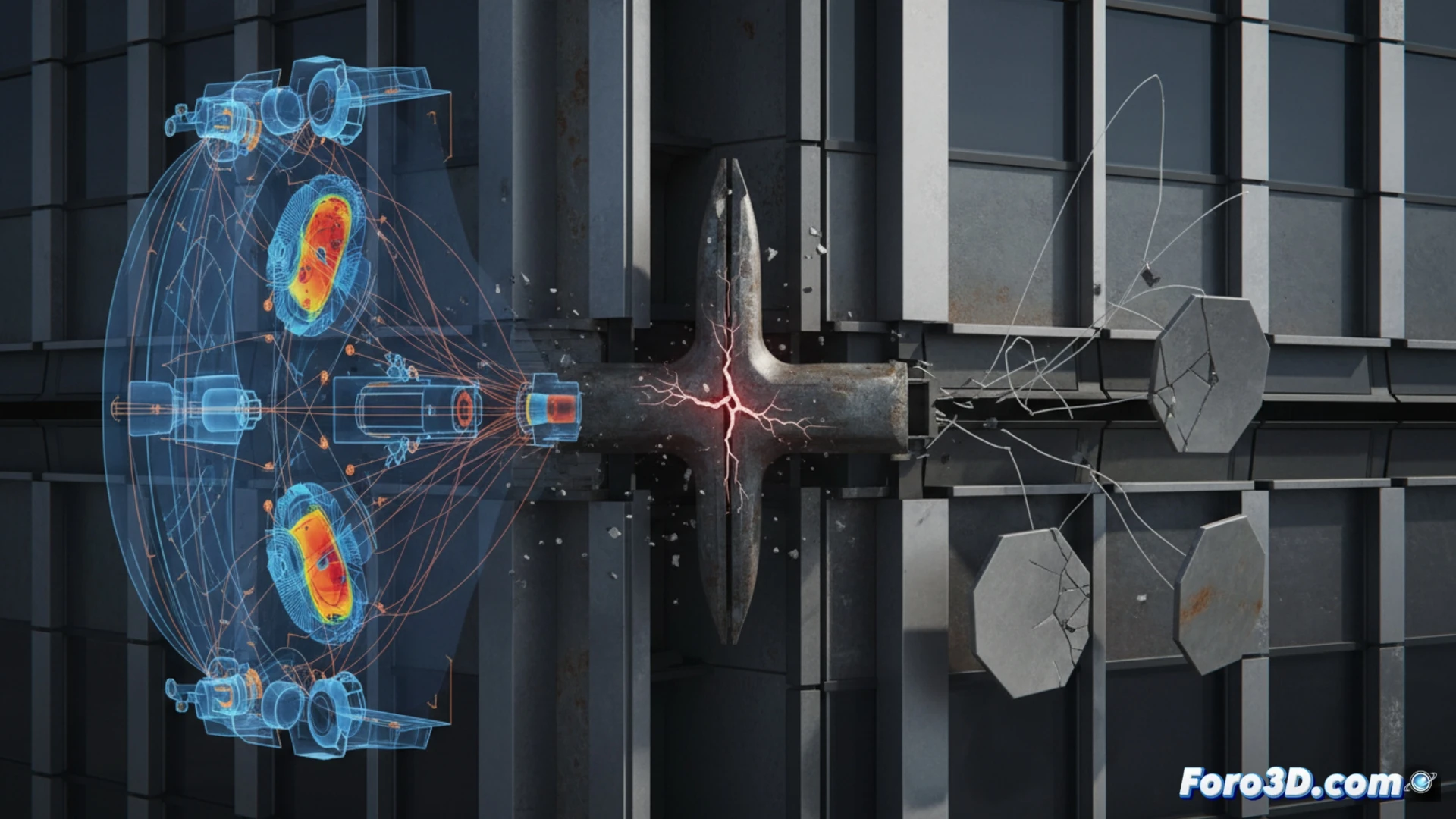
Modeling Critical Points in Mobile Shading Systems 🔧
Numerical analysis using finite elements reveals that hinges and supports of kinetic panels concentrate up to 40% more stress than the rest of the structure. Simulations in ANSYS and Abaqus demonstrate that cyclic bending fatigue, combined with corrosion from ambient humidity, accelerates crack nucleation in aluminum and stainless steel. A design with smooth curvature radii and elastomeric joints is recommended to distribute the load. Data indicates that a cycle of 10,000 daily movements reduces tensile strength by 15% annually if a shot peening surface treatment is not applied.
Resistance or Movement? The Dilemma of Parametric Design ⚖️
The paradox of kinetic facades is that their beauty lies in movement, but this same movement destroys them. An intelligent parametric design must prioritize structural redundancy at pivot nodes and choose materials with high fracture toughness, such as titanium or carbon fiber-reinforced polymers. The solution is not to eliminate kinetics, but to predict its failure through digital twins that adjust operating frequency based on wear, ensuring the architecture breathes without breaking.
Which finite element simulation methodology allows for the most accurate prediction of the fatigue life of actuators and hinges in kinetic facades subjected to non-periodic movement cycles?
(PS: Material fatigue is like yours after 10 hours of simulation.)