False airbag inflation is a critical failure where the system deploys without a real collision, or does so incompletely and asymmetrically. This phenomenon can be due to sensor defects, a short circuit in the control module, or an incorrect chemical reaction in the gas generator. Analyzing this behavior through 3D modeling allows engineers to visualize fabric kinematics and internal pressures in milliseconds, something impossible to capture with conventional cameras.
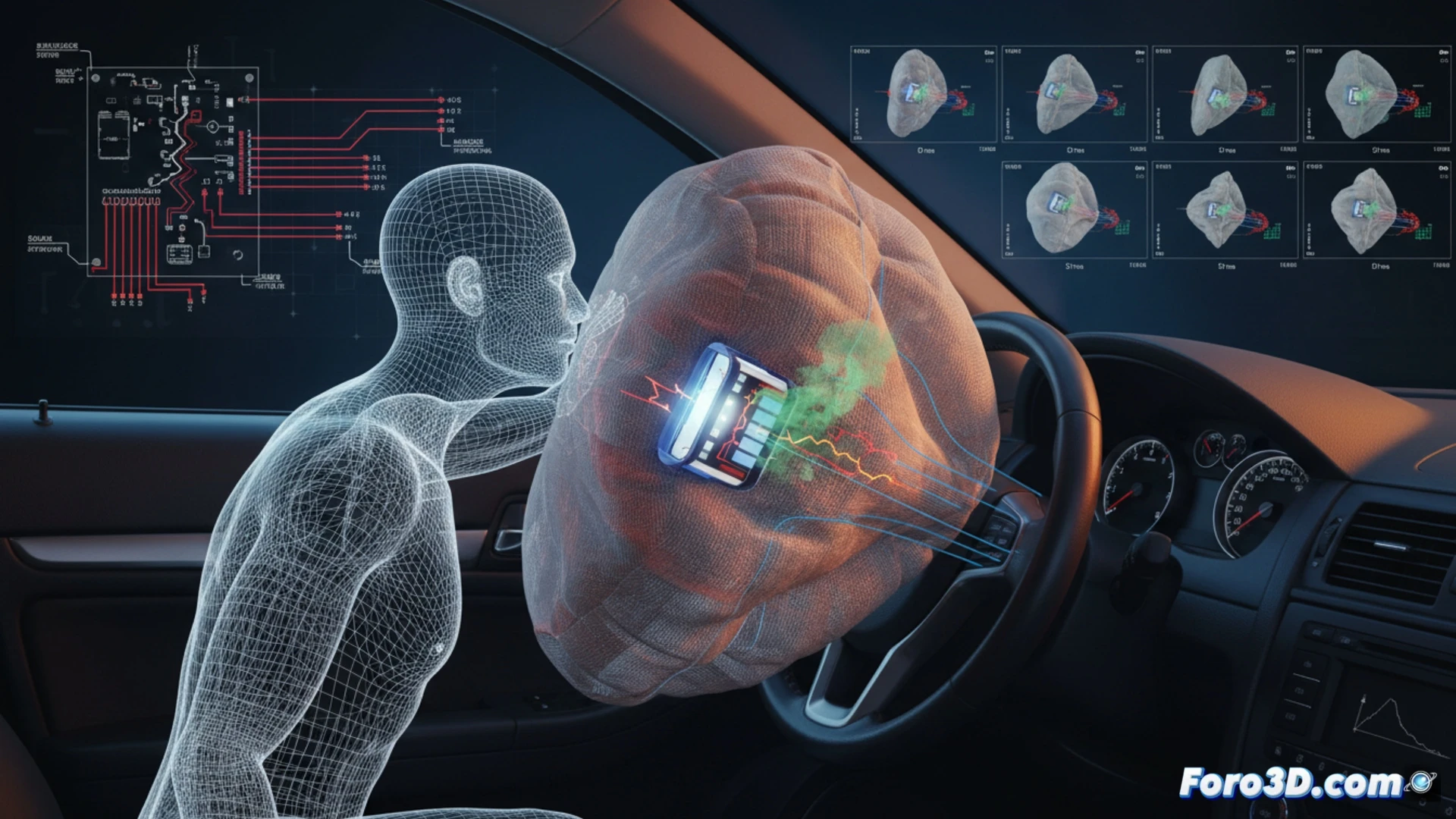
Simulation of pressures and deployment kinematics 🚗
To model a false inflation, a 3D mesh of the folded airbag inside the steering wheel or dashboard is constructed. Finite element simulation (FEM) applies an anomalous pressure curve, for example, a peak of 300 kPa in 5 ms when the nominal value should be 150 kPa. The software calculates how the fabric tears or deploys twisted, impacting the dummy in unforeseen positions. Comparing this data with real accident cases identifies failure patterns in the seam or material stiffness.
Lessons for design and safety 🛡️
3D simulation not only reproduces the failure but also allows testing solutions such as redundant sensors or calibrated vent valves. A false inflation can shatter the windshield or injure the occupant due to uncontrolled force. Therefore, integrating modeling into the prototyping phase reduces costs and saves lives. The industry is moving towards digital twins where each airbag is virtually tested before manufacturing a single unit.
As a simulation engineer, what key parameters of the finite element mesh and the dynamic gas model do you consider critical to accurately replicate an asymmetric false airbag inflation in a 3D environment?
(PS: car electronics are like family: there's always a fuse that blows)