The recent alert about defective hip prostheses has highlighted the fragility of generic designs. Every year, thousands of patients suffer complications from poorly fitted implants or those manufactured with traditional processes that do not guarantee perfect tolerance. 3D technology is emerging as the solution to eradicate these systemic failures, offering absolute control over the device's geometry and biomechanics.
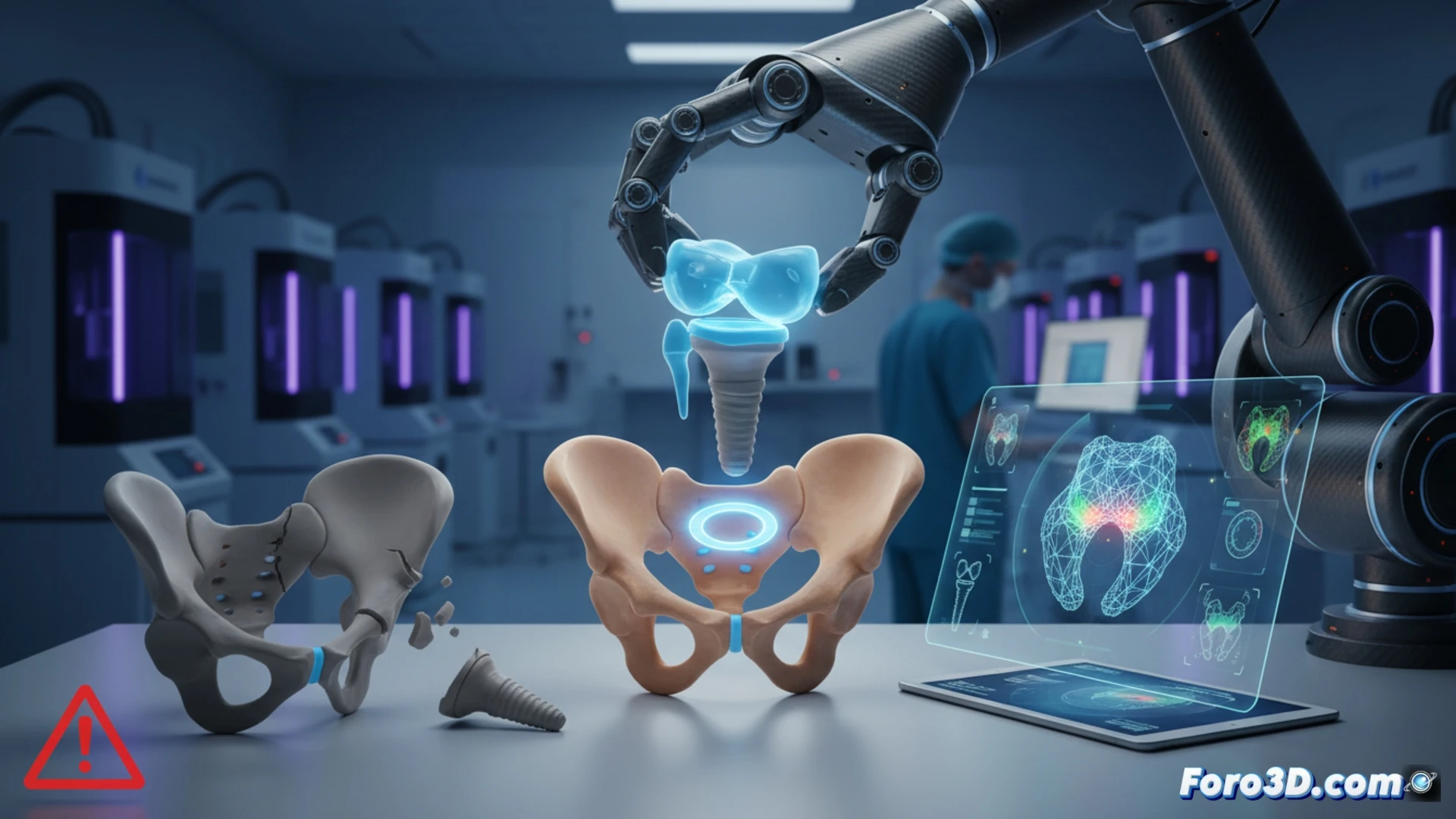
Scanning and CAD: The vaccine against manufacturing error 🦾
The main problem with defective prostheses lies in the lack of personalization. A one-size-fits-all implant cannot adapt to human anatomical variability. Through 3D scanning via computed tomography, the exact morphology of the patient's femur and acetabulum is captured. With this digital model, CAD software allows designing a stem and cup that fit millimetrically. Finite element simulation (FEM) predicts load distribution, avoiding stress points that lead to fractures or premature loosening. This methodology eliminates the margin of error inherent in generic molds and milling.
Additive traceability: Guarantee against the defective batch 🔬
Additive manufacturing in titanium or PEEK not only allows for complex geometries such as porous structures for osseointegration. Its true advantage is digital traceability. Each 3D-printed prosthesis has an immutable record of printing parameters, powder used, and post-processing. If a batch fails, the defective variable is instantly identified, something impossible in mass production. Investing in 3D design is not a luxury; it is the only way to ensure that a hip prosthesis functions exactly like the bone it replaces.
Is it possible to fully customize a hip prosthesis with 3D printing to avoid the structural defects detected in generic designs that have caused massive failures?
(PS: 3D prostheses are so customized they even have a fingerprint.)