The recent error recorded in an agricultural harvesting robot has brought to the table a technical debate that goes beyond a simple mechanical breakdown. From the perspective of 3D modeling and simulation, this failure represents an ideal case study to analyze how the integration of digital twins can anticipate collapses in automation environments. We analyze the causes from the design of the robotic arm to the control logic.
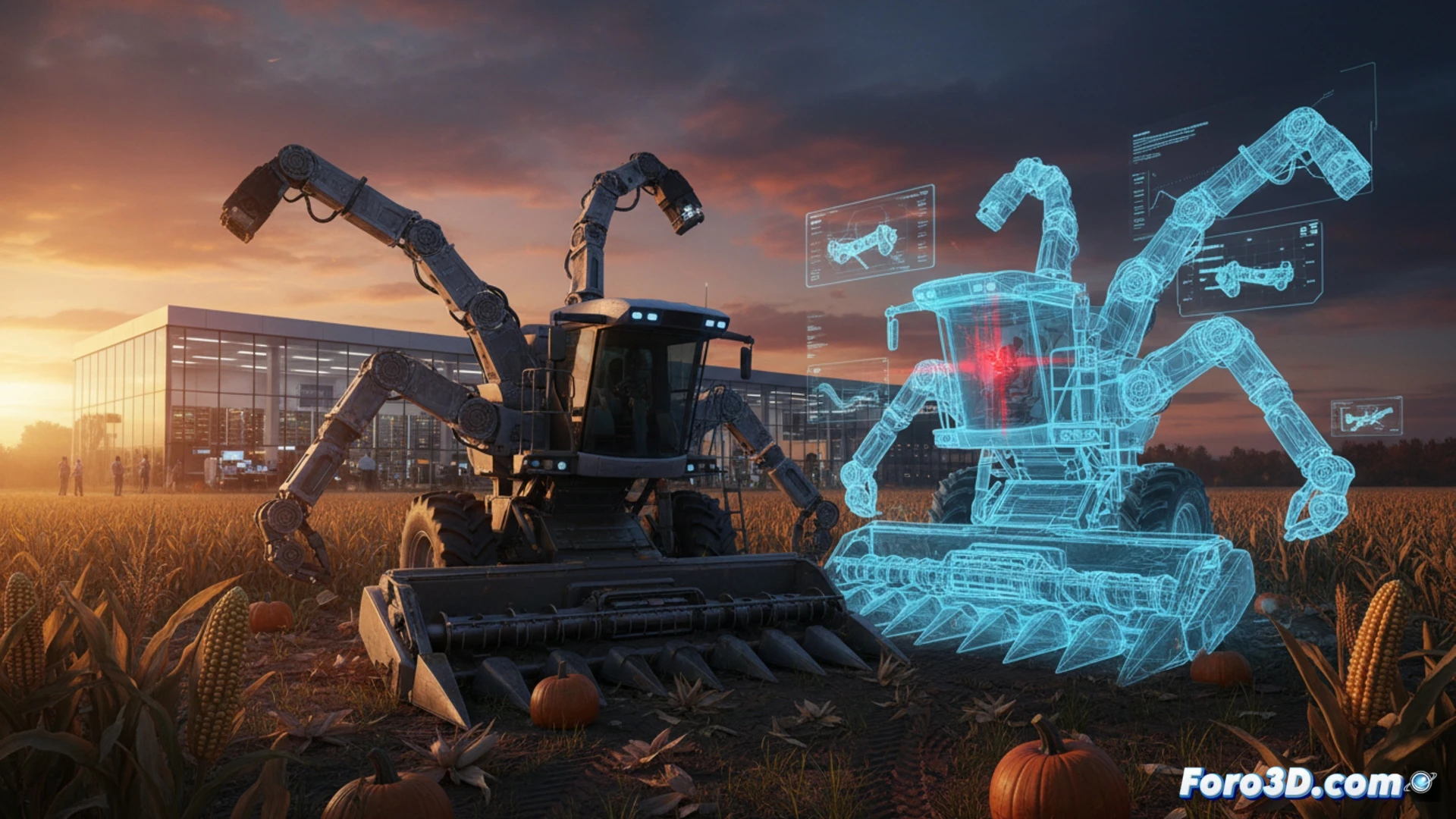
3D modeling and simulation of the error in the articulated arm 🤖
To understand the failure, it is necessary to recreate the scenario in a virtual environment. The harvesting robot typically uses a 6-degree-of-freedom arm with a gripper or blade-type end effector. In the 3D simulation, it is observed that the error manifests as an angular deviation in the shoulder joint during maximum load. The probable causes point to three fronts: first, an erratic reading from the torque sensor on the rotation axis; second, accumulated fatigue in the link material, visible in the FEM mesh; and third, a bug in the trajectory interpolation routine, which causes an unexpected abrupt movement in the inverse kinematics.
Lessons for agricultural automation with digital twins 🌾
This incident reinforces the need to implement real-time digital twins. If the robot's 3D model had been synchronized with telemetry data, the material wear and sensor anomaly would have been detected weeks earlier. The lesson is clear: simulation is not only useful for designing, but also for predicting failures. In agricultural automation, integrating 3D modeling with predictive maintenance is not a luxury, but an operational necessity to avoid crop losses and downtime.
Can a digital twin faithfully replicate the unpredictable conditions of the real field to anticipate failures in harvesting robots, or is its accuracy limited to controlled laboratory environments?
(PS: Simulating robots is fun, until they decide not to follow your orders.)