A recent incident with a surgical cobot has put the medical community on alert. The error, which occurred during a minimally invasive procedure, exposed the limitations of real-time robotic calibration. This failure is not just a hardware problem; it is a critical window into understanding how 3D biomedicine can be the key to patient safety. We analyze the case from the perspective of anatomical modeling and virtual simulation.
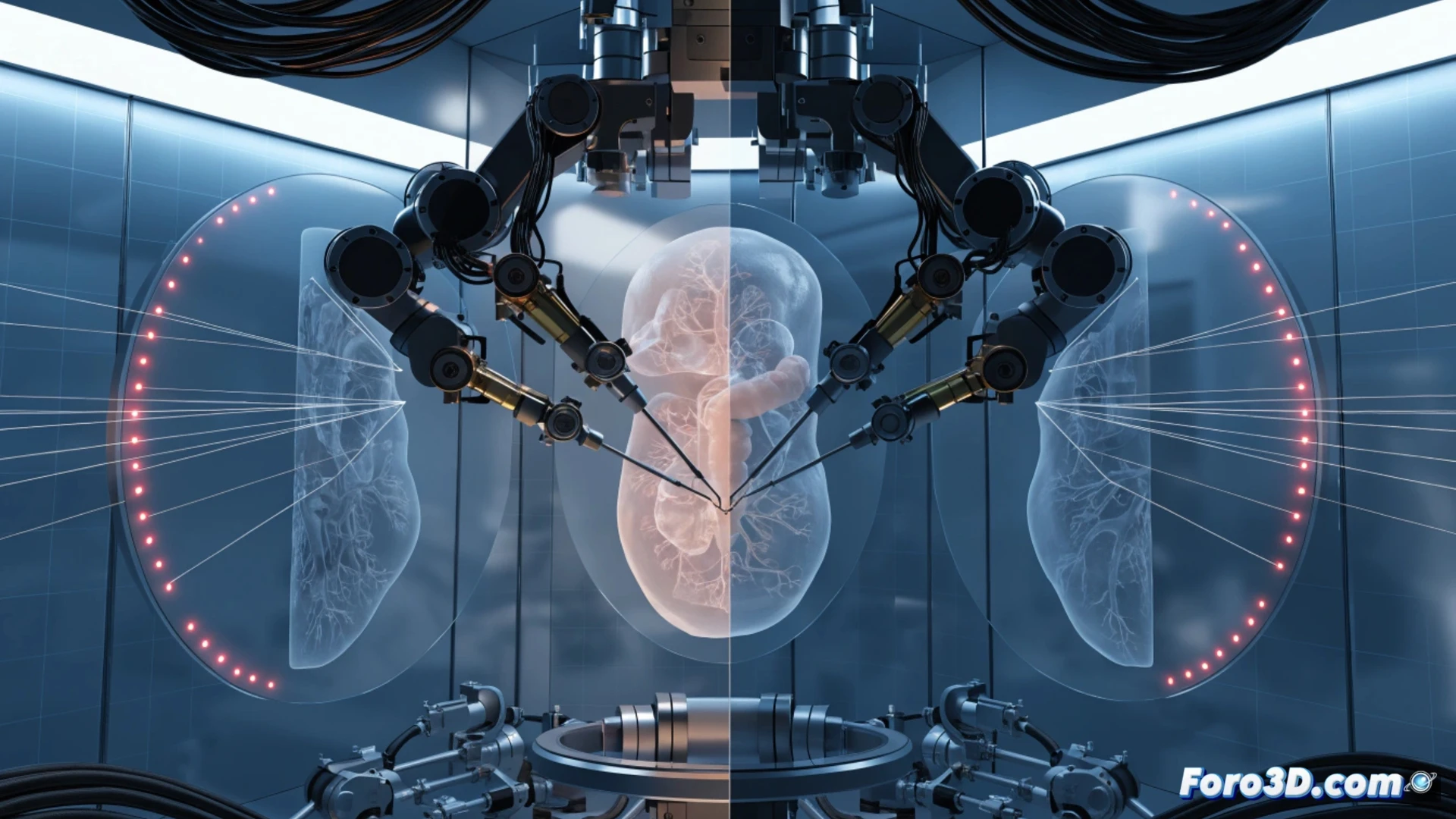
3D Modeling and Robotic Trajectory Planning 🛠️
The root of the failure was located in the deviation of the tool from the intended surgical plane. In 3D biomedicine, the solution involves creating digital twins of the patient. Through segmentation of DICOM images (CT or MRI), an exact 3D model of the area to be operated on is generated. This model allows the surgeon and robotics engineer to simulate the cobot's trajectory before the incision. Trajectory planning in a virtual environment eliminates the risk of collisions with critical structures and allows predicting points of mechanical stress on the robotic arm, mitigating software failures or joint wear.
Error Analysis and the Future of Assisted Surgery 🔬
The incident underscores the need to integrate haptic and visual feedback loops based on 3D data. If the cobot had had a real-time point cloud map, generated by intraoperative scanners, the system would have detected the millimetric deviation and stopped the operation. The lesson is clear: the robot's reliability depends not only on its mechanics, but on the fidelity of the digital model that guides it. Investing in volumetric rendering and stress simulation is more urgent today than ever to prevent a technical failure from compromising a life.
How can additive manufacturing of biomimetic components for surgical cobots minimize the risks of mechanical failure and improve redundancy in critical procedures
(PS: If you 3D print a heart, make sure it beats... or at least doesn't cause copyright issues.)