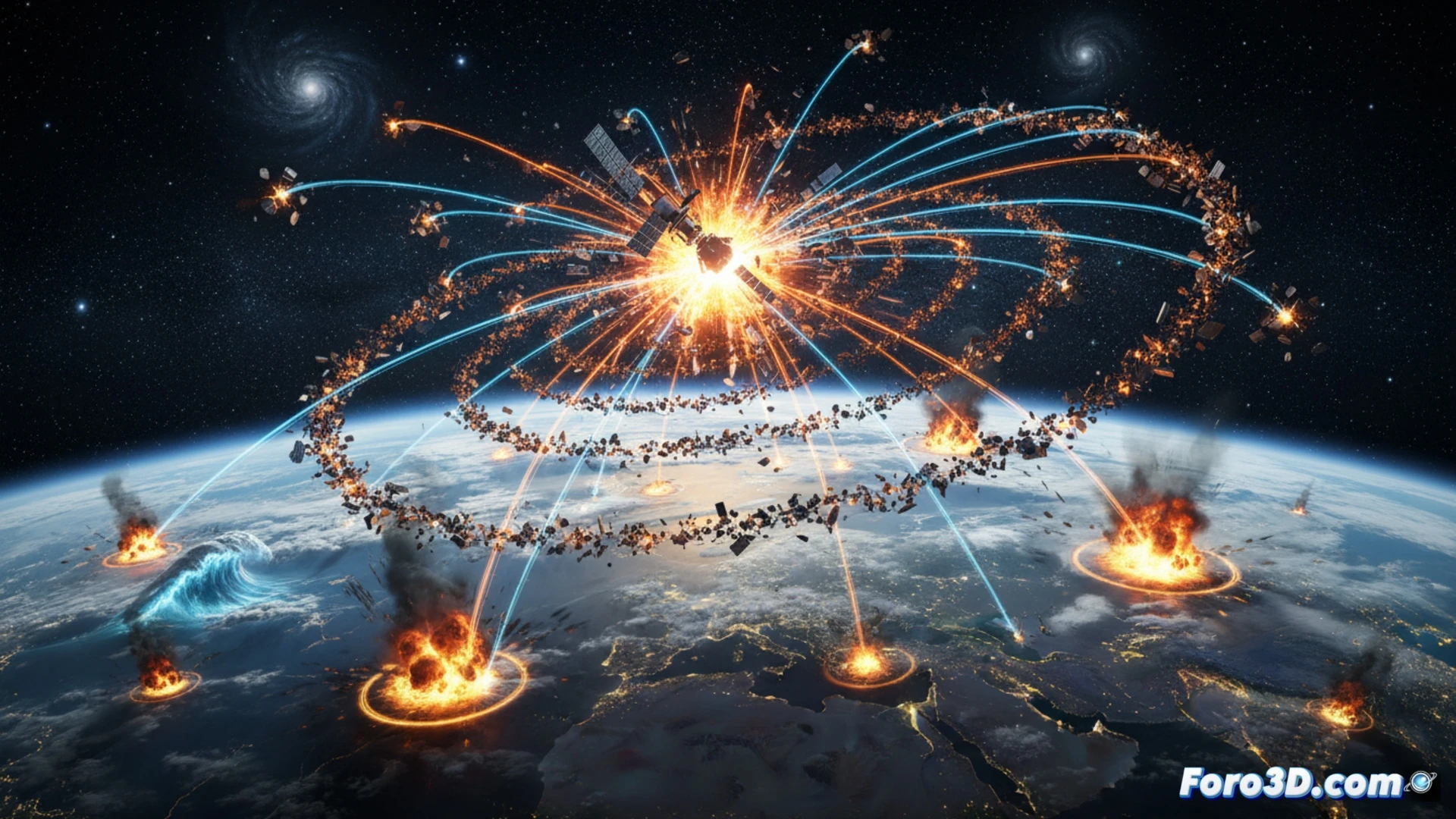
A space failure does not imply a simple satellite blackout; it represents a catastrophic event where orbital infrastructure collapses in a chain, generating debris showers and electromagnetic disturbances. 3D modeling of this phenomenon allows anticipating the trajectory of fragments, calculating the kinetic energy of impacts, and visualizing how a single collision can trigger a cascading reaction on the Earth's surface.
Simulation of impacts and shock waves 🚀
To predict the extent of a space failure, engineers use rigid body dynamics simulation software combined with atmospheric models. In practice, scenarios are recreated where an out-of-control satellite impacts an orbital station; the software calculates the dispersion of fragments at hypersonic speeds. Subsequently, the re-entry of these remains into the atmosphere is modeled, estimating the shockwave generated when breaking the sound barrier. 3D tools allow generating heat maps that show areas with the highest debris density, helping to plan evacuations and reinforce critical infrastructure on the ground.
Visual lessons for prevention 🌍
The 3D visualization of a space failure not only documents the destruction but exposes the fragility of our orbital ecosystem. By observing the animation of a chain impact, policymakers and the public understand the urgency of implementing controlled deorbit protocols. These reconstructions serve as a technical warning: every untracked fragment is a potential catastrophe, and digital modeling is the only tool capable of translating orbital chaos into actionable data before the sky collapses upon us.
Considering that the simulation of orbital collapse must model the debris cascade and the loss of critical services, how could the threshold of irreversibility be quantified, at which a space failure ceases to be a controllable event and becomes an inevitable global catastrophe?
(PS: Simulating catastrophes is fun until the computer crashes and you are the catastrophe.)