When an Edge server goes down, remote rendering and 3D asset synchronization grind to a halt. This failure not only blocks cloud access but also exposes the fragility of our local workstations. The GPU is left with no tasks to process, the CPU waits for instructions, and the RAM accumulates cached data with no destination. We analyze how this technical interruption affects your hardware's performance and what you can do to minimize downtime.
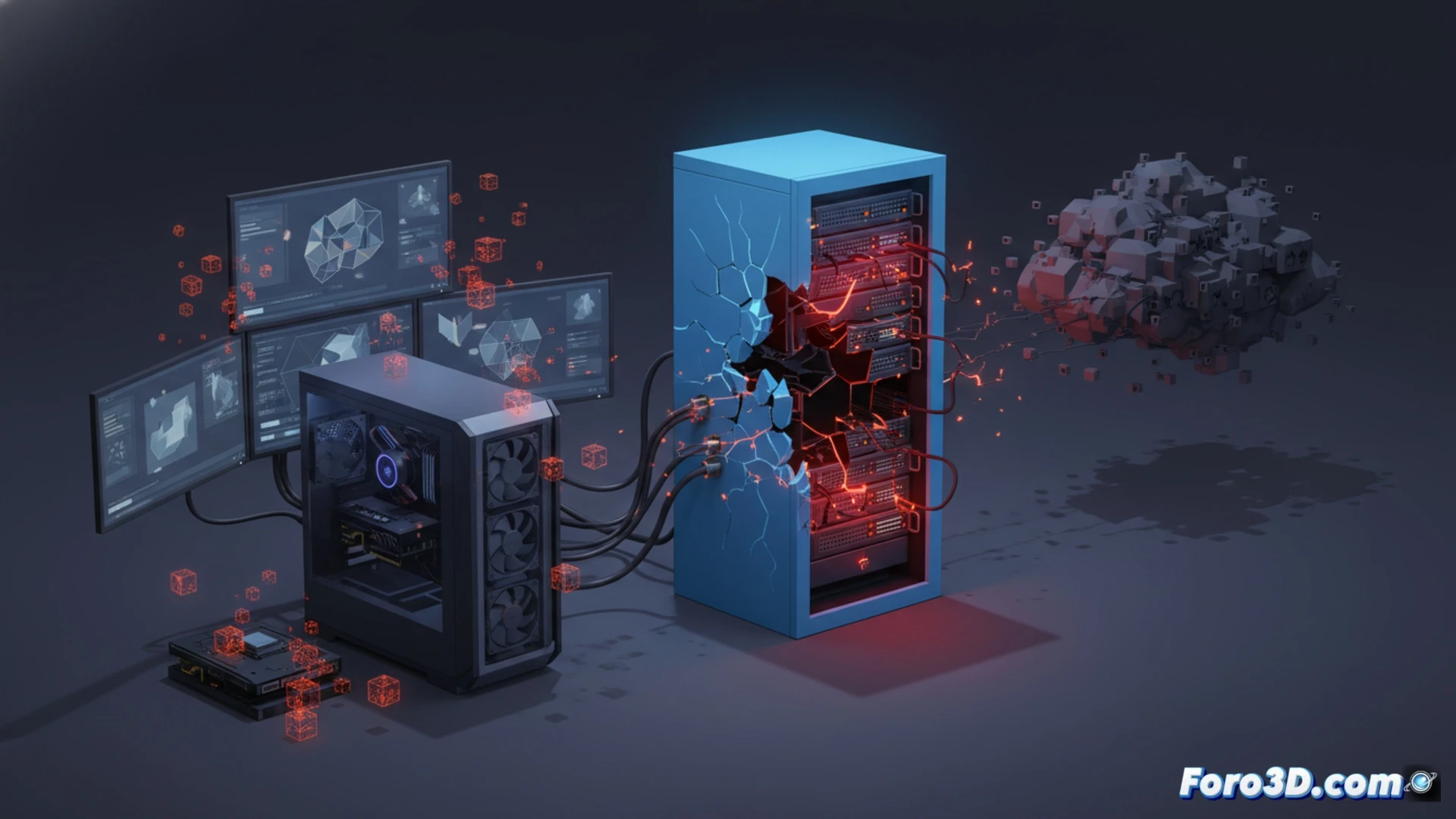
Technical impact on local GPU, CPU, and RAM 🖥️
The reliance on Edge services to download textures or delegate lighting calculations turns the GPU into a critical component during a failure. Without incoming data packets, video memory (VRAM) stagnates with partially loaded assets, and the GPU reduces its frequency due to inactivity. The CPU, for its part, suffers by managing wait queues and connection retries, increasing thread usage without producing useful work. Local RAM fills with zombie processes and temporary data that are not released until the server responds. A prolonged failure can even cause thermal throttling in high-end CPUs by maintaining synchronous workloads without real performance.
Mitigation with hybrid local-cloud configurations 🔧
The solution lies in hybrid architectures that maintain productivity without relying exclusively on the Edge. Configure your workstation with a high-capacity local NVMe SSD to store a complete copy of critical assets. Activate local rendering as a contingency plan using the integrated GPU or a second dedicated card. Use offline queue software that allows working with cached data and synchronizing changes when the server recovers. This way, an Edge server failure ceases to be a single point of failure and becomes a minor delay in your 3D workflow.
It is possible to implement a redundant Edge server infrastructure that guarantees the continuity of remote rendering without compromising real-time performance
(PS: RAM is never enough, like coffees on a Monday morning ☕)