The failure of a gas membrane is not a sudden event, but the culmination of a mechanical degradation process that can be precisely modeled. In the field of material fatigue simulation, this component represents a critical challenge: it must withstand differential pressure cycles while maintaining its structural integrity. 3D analysis allows us to visualize how microcracks originate at points of stress concentration and progress to catastrophic rupture.
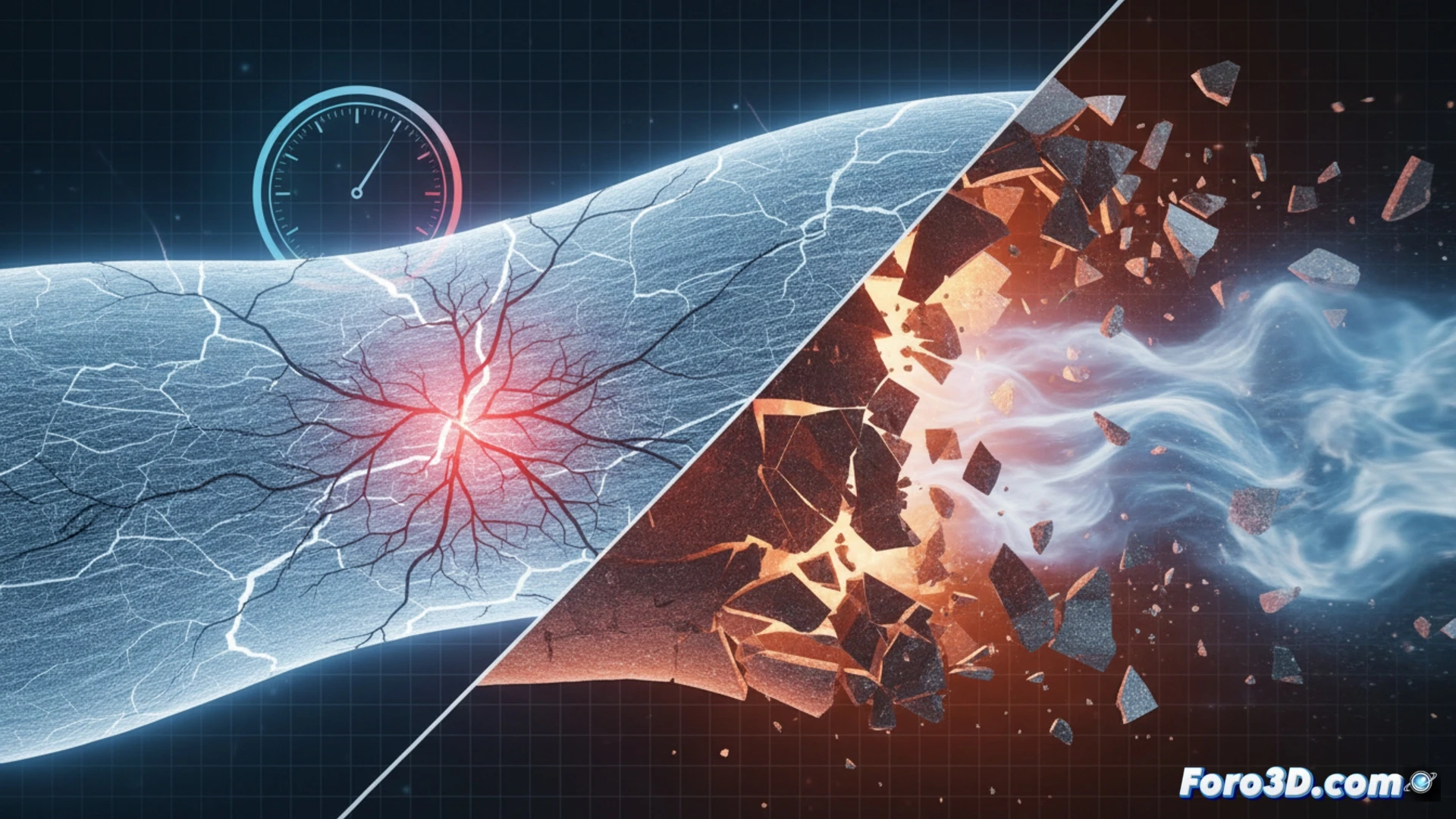
Finite Element Analysis of the Fracture Mechanism 🛠️
FEA simulations reveal that typical failure begins in the anchor zone or at surface defects of the material. When cyclic loads are applied, deformation maps are generated showing progressive bulging of the membrane. The model identifies critical points where the Von Mises equivalent stress exceeds the yield limit, initiating cracks. In composite materials, delamination between layers accelerates propagation, while in metallic ones, accumulated hysteresis reduces service life. Visualizing these patterns in 3D allows predicting the exact mode of collapse before it occurs in service.
Rethinking Design from Virtual Evidence 💡
The ability to observe crack propagation in a virtual environment transforms membrane engineering. Destructive testing is no longer sufficient; simulation offers a digital twin that anticipates failures under extreme conditions. This approach forces a reconsideration of traditional safety factors, integrating cyclic fatigue data to extend component life. In an industry where a leak can halt critical processes, 3D visualization of damage becomes the ultimate tool for prevention.
Is it possible to accurately predict, through 3D simulation, the exact point of fatigue crack nucleation in a gas membrane subjected to cyclic loads, considering variables such as thickness, pressure, and material microstructure?
(PS: Material fatigue is like yours after 10 hours of simulation.)