Forging failure is a critical phenomenon in metallurgy that manifests as a fracture or internal discontinuity during or after the plastic deformation process. Unlike conventional fatigue fracture, this defect originates from a combination of non-metallic inclusions, pre-existing microcracks, and poor stress distribution within the material volume. Understanding its genesis is vital to prevent catastrophic failures in structural components.
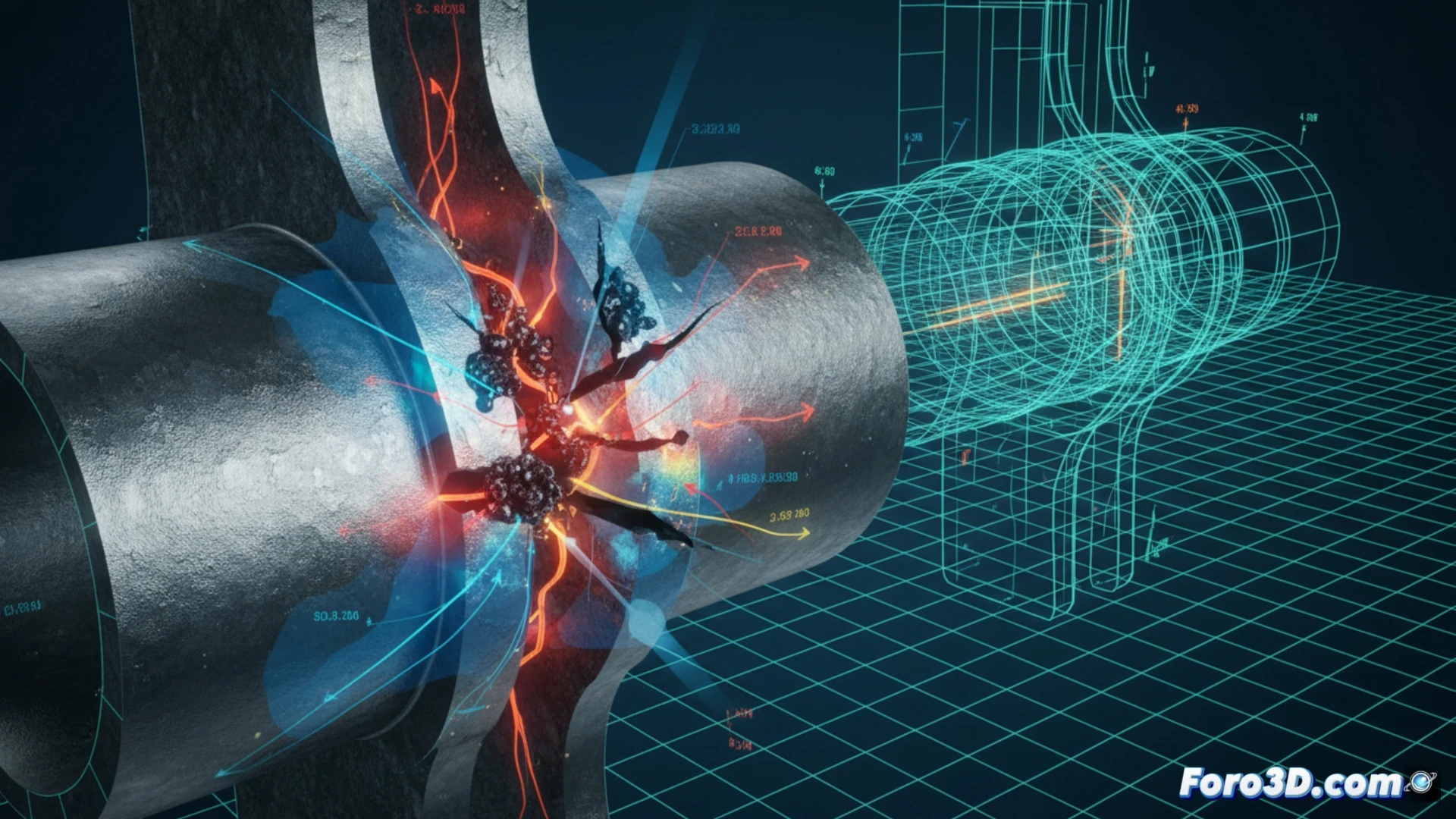
Mechanics of Failure: Inclusions, Cracks, and Stress Concentration 🔧
The main mechanism begins with brittle inclusions, such as oxides or sulfides, trapped during casting. When forging force is applied, these particles do not deform along with the metallic matrix, generating discontinuities that act as stress concentrators. If the material flow is inadequate or the forging temperature is low, internal cracks form that can propagate. Finite element simulation, using software like ANSYS Mechanical or Abaqus/Explicit, allows modeling the stress field around these inclusions. The user can visualize in 3D how the maximum principal stress accumulates at the crack edges, predicting the propagation path before physical fracture occurs. This is crucial for optimizing process parameters, such as strain rate and temperature.
Lessons from Industry: The Cost of Ignoring Simulation 💡
In the automotive industry, a forging failure in a connecting rod or crankshaft can cause engine breakage during operation. In the aerospace sector, a turbine disk with an undetected inclusion can fracture under cyclic loads, causing catastrophic energy release. 3D simulation not only allows predicting the remaining service life but also helps redesign the part geometry to divert stress flow lines away from critical areas. Investing in this virtual analysis is cheaper than facing a product recall or an accident.
Is it possible to detect with 3D simulations the exact moment when an internal microcrack becomes a catastrophic failure during the forging process, and which model parameters are most critical to prevent it?
(PS: Material fatigue is like yours after 10 hours of simulation.)