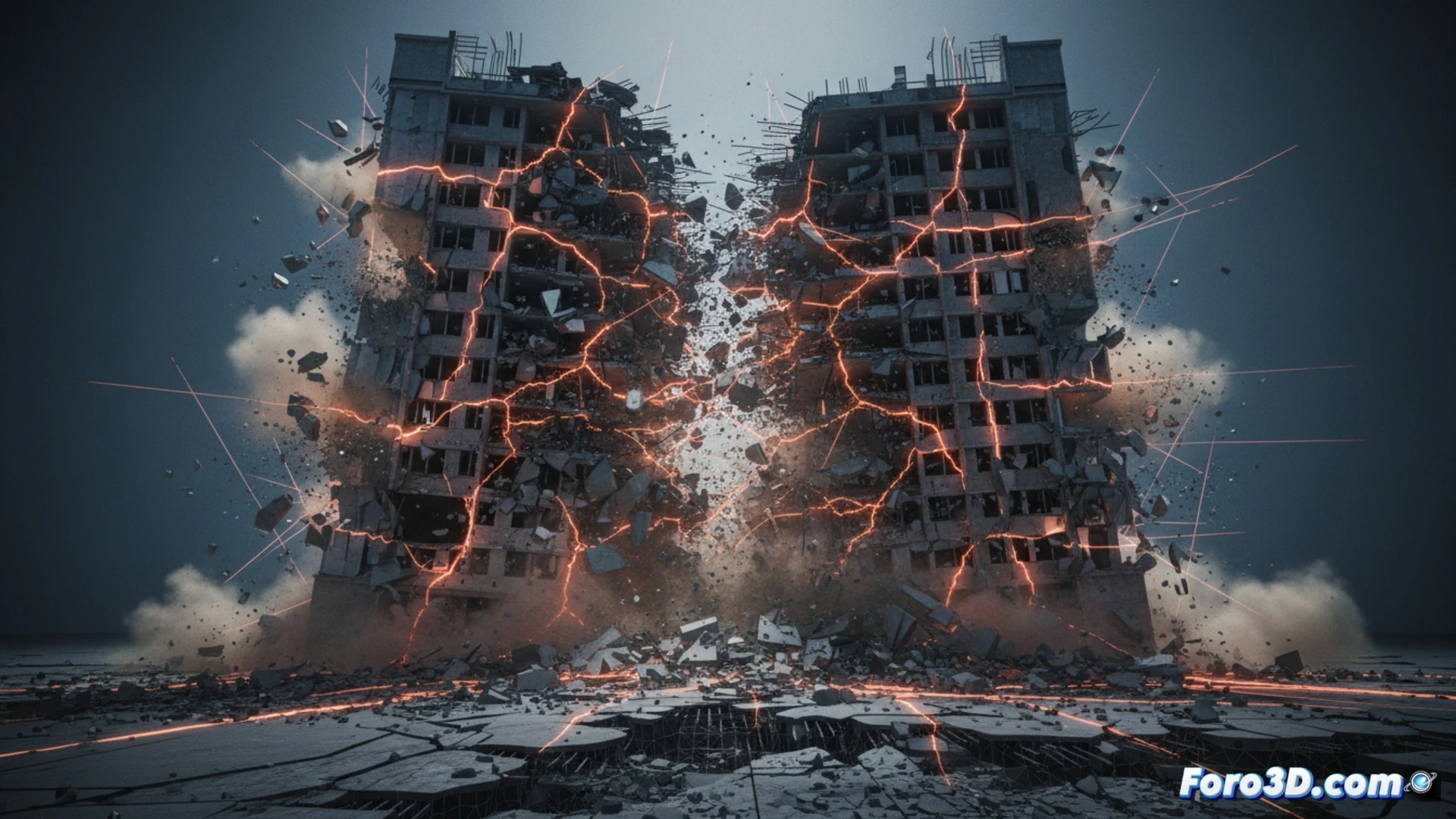
The Constructor Swarm Failure represents a critical geotechnical phenomenon where multiple fracture points activate simultaneously in a structure or terrain, generating a domino effect of collapse. Unlike a single failure, this swarm of fissures propagates non-linearly, saturating materials until they exceed their elastic limit. In the field of 3D simulation, modeling this event requires dynamic meshes and finite element algorithms that capture the interaction between neighboring cracks, allowing visualization of how energy redistributes and accelerates destruction.
Technical Modeling and Finite Element Analysis 🏗️
To represent the Constructor Swarm Failure in a 3D environment, it is essential to define a starting geometry with heterogeneous fatigue properties. The model must include pre-existing weak zones, such as construction joints or geological discontinuities, which act as nucleation cores. During the simulation, each fracture releases stress waves that impact adjacent fissures, creating a fractal branching pattern. Von Mises stress maps allow identifying hot spots where the load exceeds the critical threshold. Animations of the process show the sequence of failures: first microcracks, then coalescence into larger cracks, and finally the catastrophic collapse of the infrastructure, such as a bridge or a high-rise building.
Reflection on the Fragility of the Built Environment 💡
Visualizing the Constructor Swarm Failure in 3D confronts us with an uncomfortable truth: our most solid structures harbor hidden vulnerabilities that only reveal themselves under extreme loads. Each simulated crack is a reminder that structural design must not only resist static forces but also anticipate the chaotic dance of a swarm of fractures. This technical perspective invites us to rethink building codes, prioritizing materials with the ability to redistribute stresses and real-time monitoring systems that can detect the onset of this failure pattern before it becomes irreversible.
Could the 3D simulation of the Constructor Swarm Failure accurately predict the total collapse time of a structure subjected to extreme dynamic loads?
(PS: Simulating catastrophes is fun until the computer melts down and you are the catastrophe.)