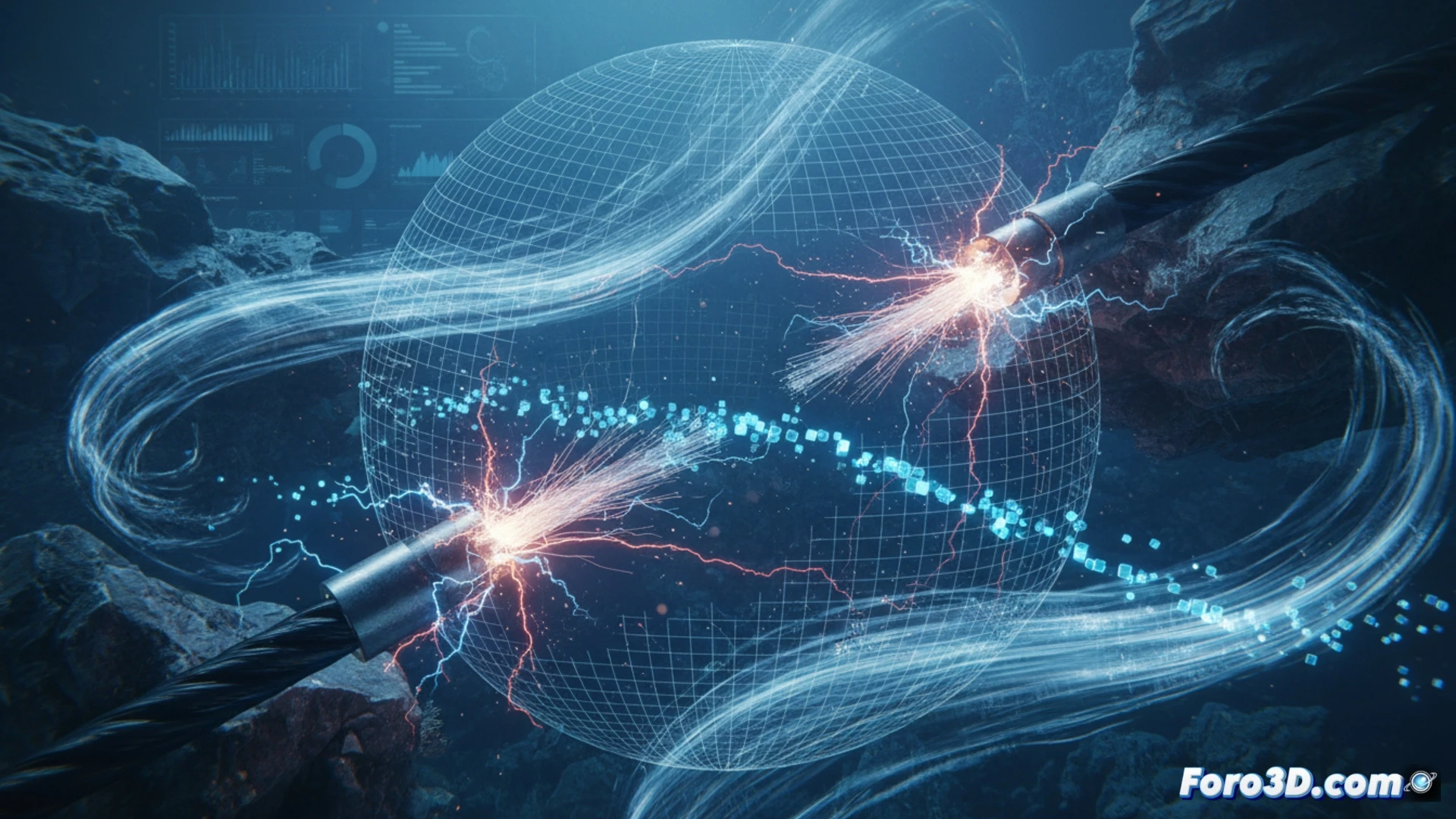
When a fiber optic cable breaks at 4,000 meters depth, 30% of a continent's digital traffic can collapse in seconds. The Submarine Data Fault is not a computer anomaly, but a geological and mechanical catastrophe. 3D modeling of these critical infrastructures allows engineers to simulate tectonic stresses, abyssal currents, and anchor drags, transforming an oceanic blind spot into a predictable digital twin.
Technical Analysis: Digital Twins and Geomechanical Stress Simulation 🌊
The rupture of a submarine cable is rarely random. Current 3D simulations integrate high-resolution bathymetric data with finite element models to replicate cable behavior under stress. Three critical factors are analyzed: cyclic bending fatigue in turbulent current zones, abrasion against rocky beds, and the impact of submarine landslides (turbidites). A digital twin allows visualizing the exact failure point before it occurs, calculating the residual lifespan of the cable. Additionally, alternative repair routes are modeled, evaluating the energy cost of diverting traffic via satellite or redundant cables in real time.
Lessons for Global Network Resilience 🔧
The vulnerability of the internet lies on the ocean floor. Each submarine fault is a reminder that fiber optics is a physical cable exposed to earthquakes and human activity. 3D modeling not only predicts disaster but redefines strategic planning: it allows designing cables with more tolerant curvatures, burying sections in high-risk zones, and prioritizing the repair of critical nodes. The next time your connection fails, remember that a 3D virtual model is already calculating how to prevent the next catastrophe.
Is it possible to predict the exact fracture points in submarine cables through 3D simulations before a catastrophic failure occurs?
(PS: Simulating catastrophes is fun until the computer melts down and you are the catastrophe.)