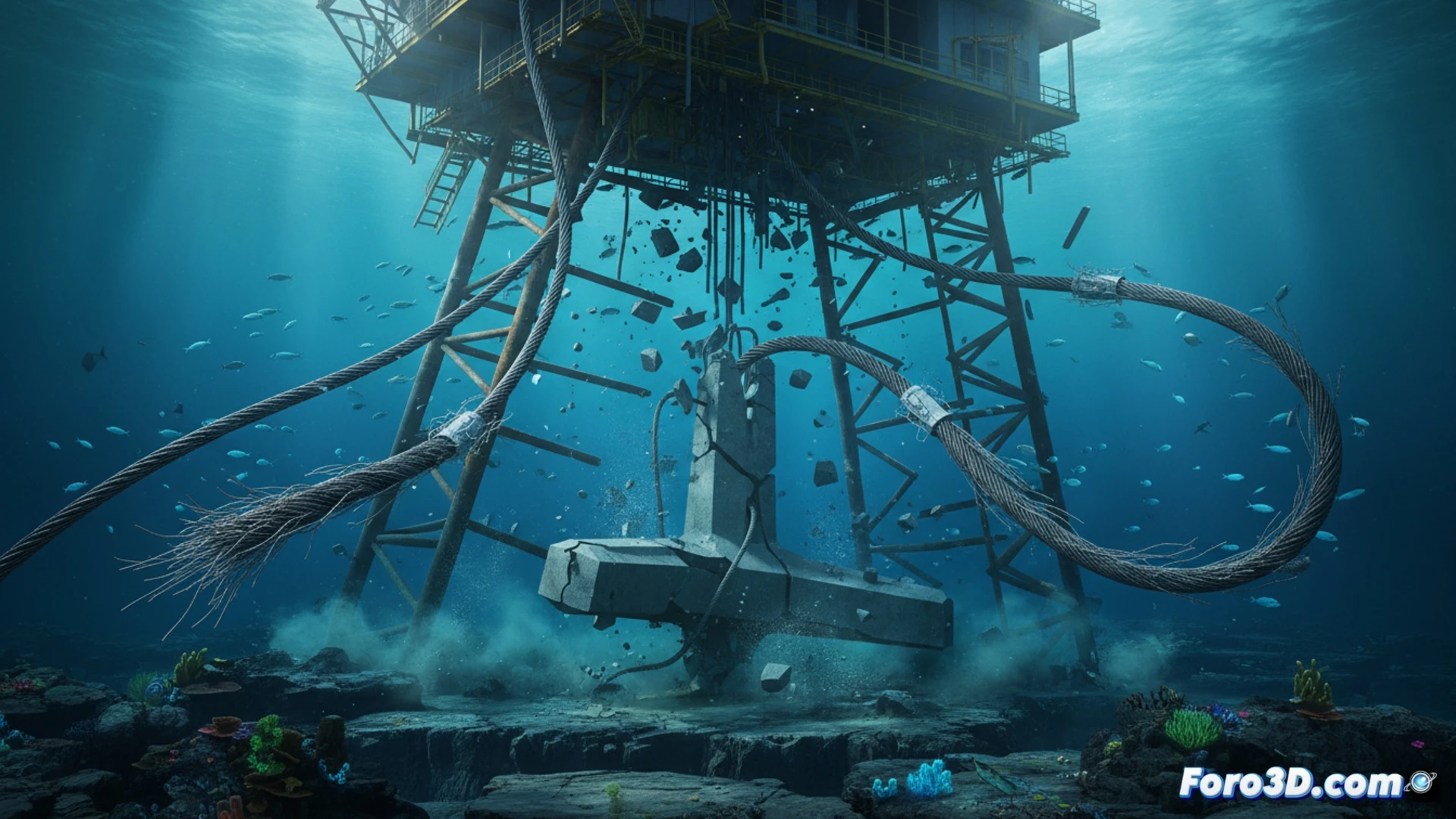
The recent failure of an underwater anchor on an exploration platform has highlighted the need for accurate predictive models. This incident, occurring at a depth of 40 meters, compromised the integrity of the main structure and created a risk of cascading collapse. At Foro3D, we analyze how numerical simulation can anticipate these failures before they occur in the real world.
Technical analysis through stress and fatigue simulation 🔧
We have recreated the failure scenario in a virtual finite element environment, applying dynamic loads equivalent to 3-knot currents and seasonal waves. The 3D model of the anchor, built from high-strength steel, revealed stress concentrations in the shackle weld zone. The cyclic fatigue simulation, run over an estimated 10-year operational life, showed progressive microcracks leading to brittle fracture. Particle flow visualization confirmed that cavitation generated by the current accelerated stress corrosion cracking at the critical point, a factor omitted in the initial design calculations.
Lessons for design using digital twins 💡
The failure was not a random event, but the consequence of an incomplete fatigue model. Implementing a digital twin of the anchor, fed with real-time stress and corrosion sensor data, would have allowed detection of the microcrack months before the collapse. We propose redesigning the joint geometry to better distribute loads and adding ceramic coatings in the weld zone. 3D simulation not only recreates the disaster but gives us the tools to prevent it.
Considering that current predictive models do not fully integrate stress corrosion fatigue under variable hydrostatic conditions, what innovations in 3D simulation would allow anticipating the exact mode of collapse due to underwater anchor failure before it occurs?
(PS: Simulating catastrophes is fun until the computer melts down and you are the catastrophe.)