Plasma detachment, technically known as Coronal Mass Ejection (CME), is the massive expulsion of charged particles from the solar corona into interstellar space. When a CME is directed towards Earth, it can trigger severe geomagnetic storms capable of collapsing power grids, disorienting satellites, and destroying radio communications. In this article, we analyze how 3D modeling allows us to predict its trajectory and mitigate its catastrophic effects.
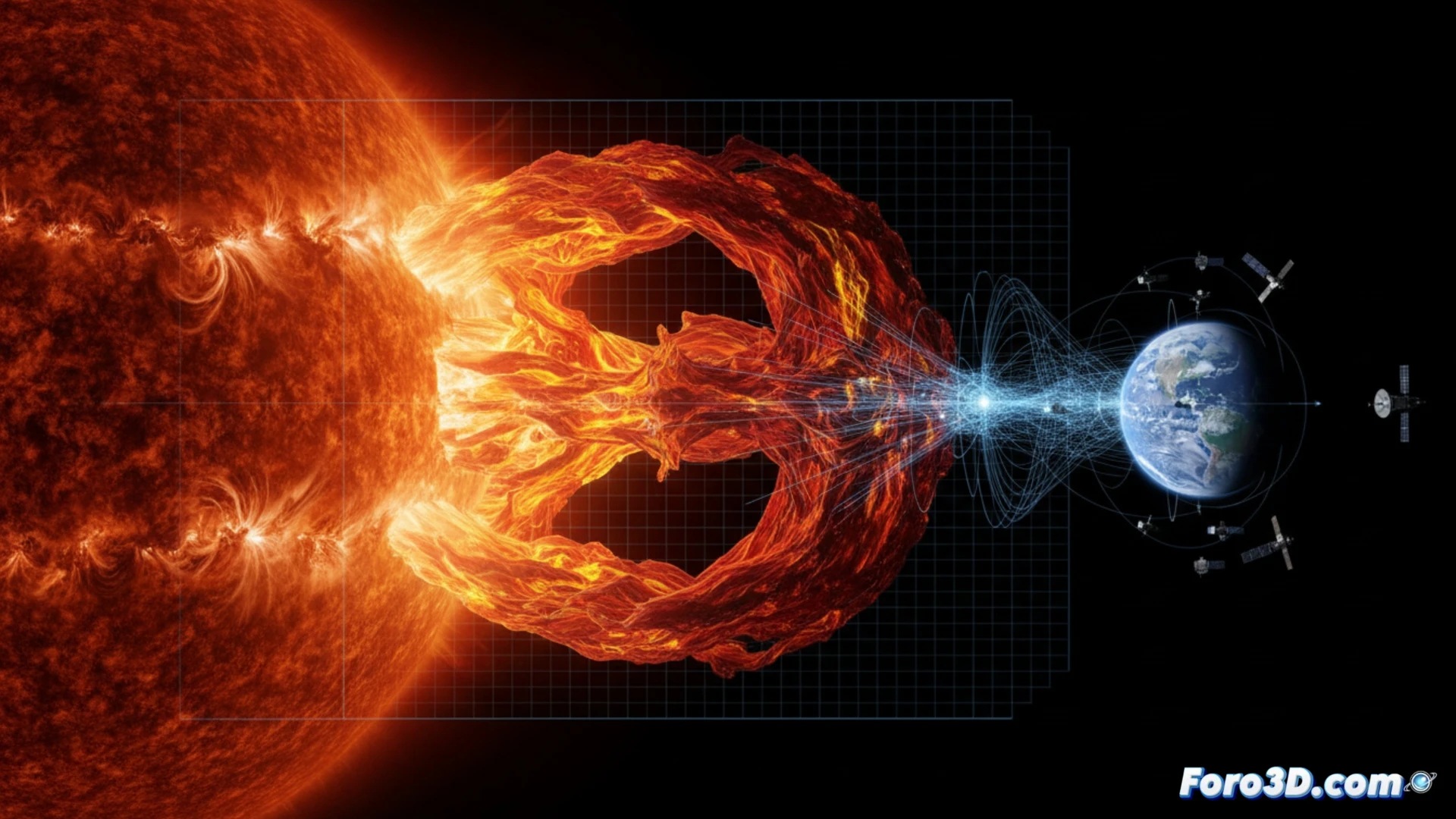
3D Modeling of CME Trajectory and Geomagnetic Storms 🌌
Using real-time data from NASA and NOAA, 3D simulators convert observations from the SOHO telescope into plasma velocity and density vectors. The three-dimensional model calculates the interaction of the shock front with Earth's magnetic field, visualizing compressions in the magnetosphere and induced currents on the surface. These simulations allow generating blackout risk maps with kilometer-scale precision, identifying the most vulnerable high-latitude regions, such as Scandinavia or Canada, where transmission lines suffer catastrophic overvoltages.
The Lesson of the Carrington Event in the Digital Age ⚡
The Carrington Event of 1859 was the most powerful solar storm on record, but it occurred before the electrical era. Today, a similar CME could leave entire continents without power for weeks. 3D simulation not only anticipates the disaster but also allows rehearsing protocols for preventive shutdown of transformers and satellite reorientation. The question is no longer if it will happen, but whether our global infrastructure is prepared to survive the next great plasma detachment.
How does the accuracy of a 3D simulation of a coronal mass ejection influence the prediction of its impact on terrestrial technological systems such as satellites and power grids
(PS: Simulating catastrophes is fun until the computer melts down and you are the catastrophe.)