The explosion of cinnamon dust is not a myth, but a real risk in food industries and domestic kitchens. Unlike conventional explosives, organic dust suspended in the air can detonate with devastating violence upon encountering an ignition source. This technical article reconstructs the dynamics of this phenomenon in 3D, analyzing particle dispersion, the shockwave, and structural damage to understand how to prevent the next catastrophe.
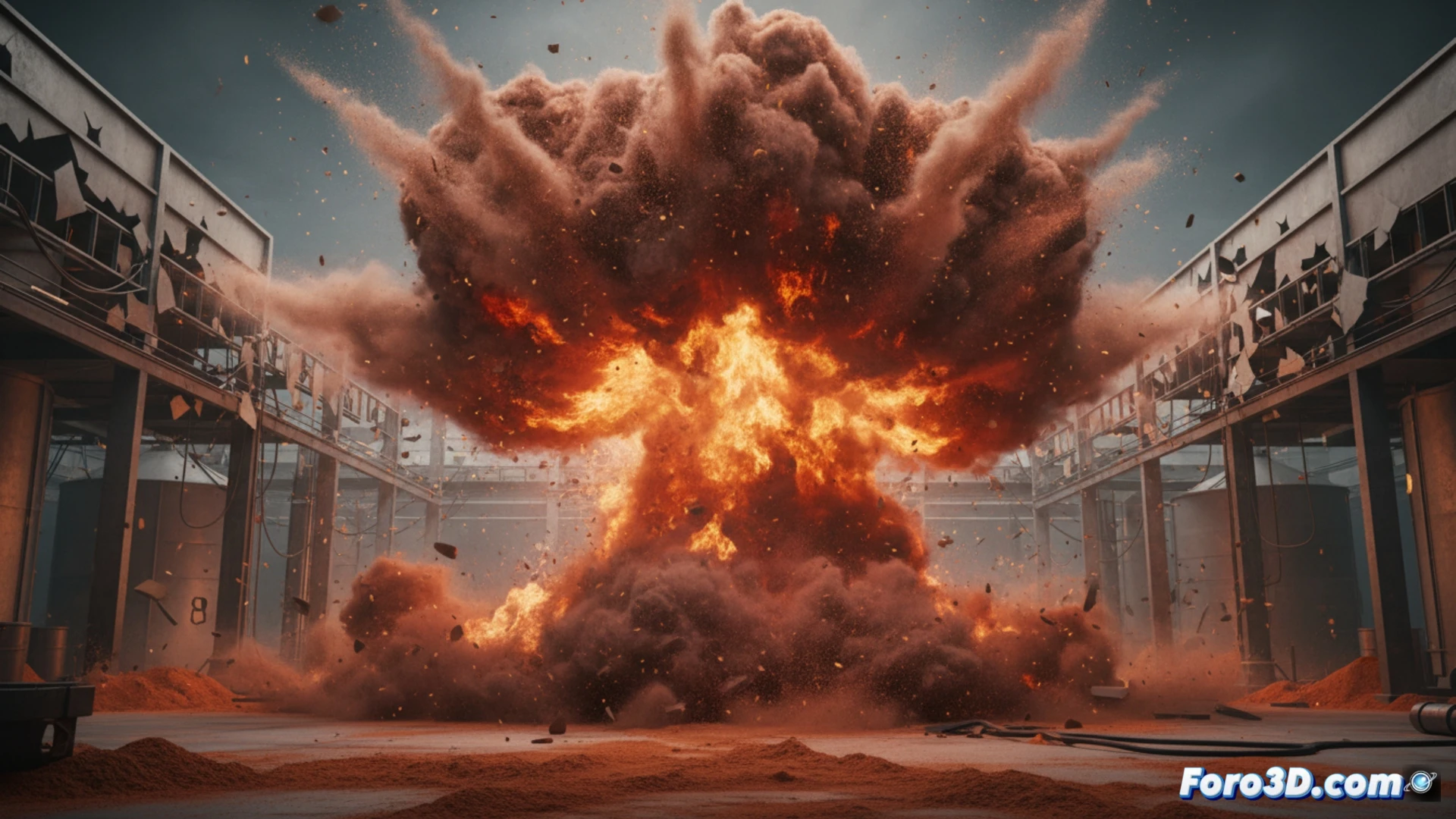
3D Reconstruction of Particle Dynamics and Shockwave 💥
For the simulation, we modeled a storage silo with a cinnamon dust concentration of 50 g/m3, within the explosive range. In the software, the initial ignition generates a flame that propagates through the particle cloud at supersonic speeds. The resulting pressure wave, visualized in deep red meshes, reaches 8 bars in less than 0.2 seconds. Unburned particles act as secondary fuel, creating a domino effect that fractures the concrete walls. The simulation shows that 70% of structural damage occurs within the first 100 milliseconds, a critical data point for the design of ventilation and suppression systems.
Lessons from the Model: Prevention in the Face of Invisible Risk ⚠️
The 3D recreation shows that the greatest danger is not the stored cinnamon, but the invisible cloud that forms during transfer or cleaning. Comparing with the real incident of 2017 in a spice factory, our simulation confirms that a static spark in a poorly sealed duct is enough to trigger the catastrophe. The technical conclusion is clear: inerting with nitrogen and localized extraction systems are not optional, but vital barriers. Modeling these scenarios in 3D allows us to educate operators and designers about a risk that, until it explodes, remains invisible.
Which 3D simulation parameters of cinnamon particles are critical for predicting the flame propagation speed in an industrial environment?
(PS: Simulating catastrophes is fun until the computer melts down and you are the catastrophe.)