The National Museum of Fine Arts opens a retrospective of M.C. Escher, the artist who turned mathematics into visual puzzles. From impossible staircases to hands drawing themselves, the exhibition brings together 150 works that challenge perception. A must-see for those who enjoy losing their bearings without moving from the spot. 🎨
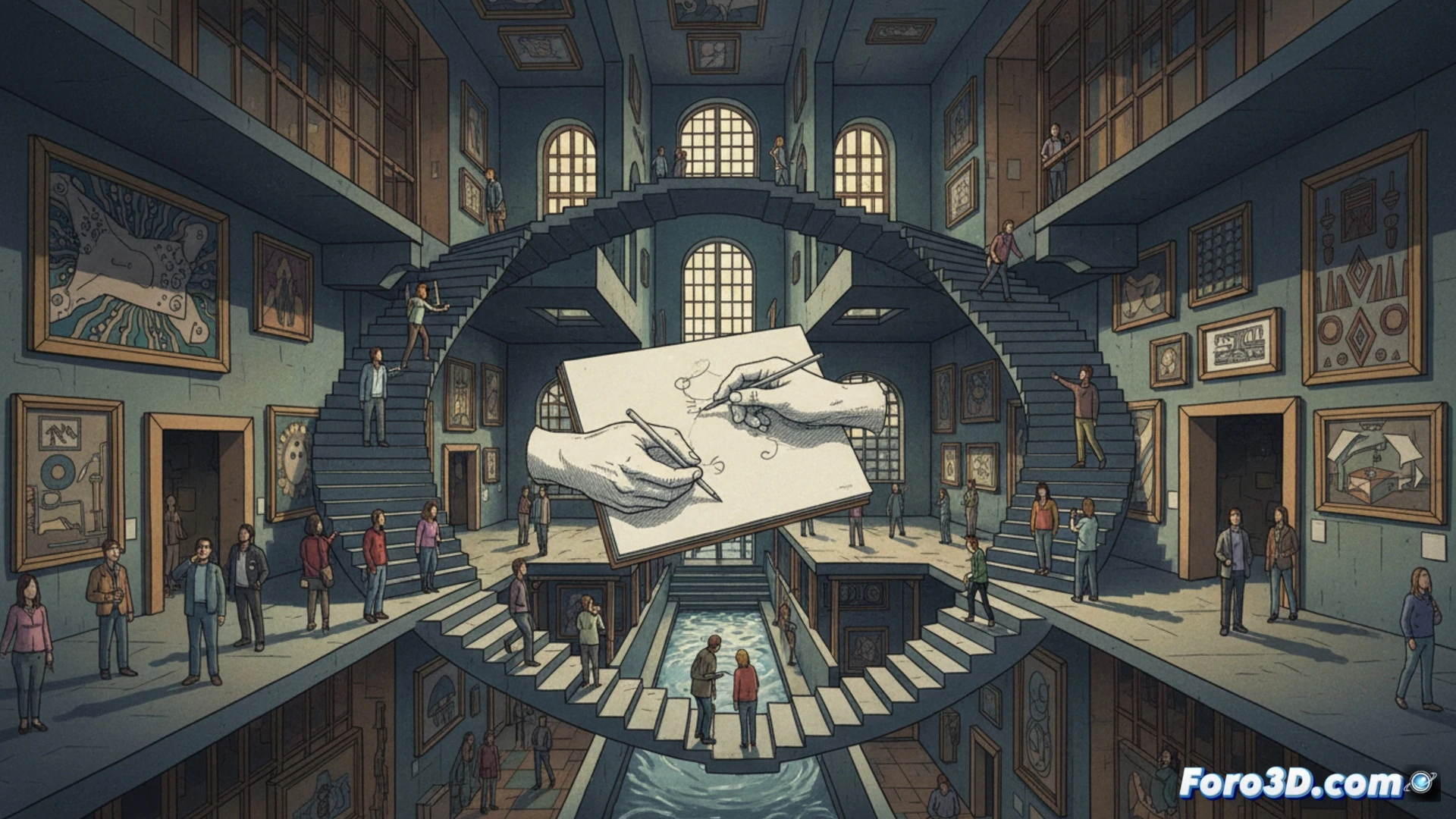
The geometric engine behind optical illusions 🔮
Escher applied principles of tessellation, symmetry, and non-Euclidean projections long before 3D software popularized them. His lithographs, such as Relativity, use multiple vanishing points to create impossible spaces. Today, rendering engines like Blender or Unity replicate these techniques, but the Dutch artist achieved them with ink, a ruler, and a patience that no modern developer possesses.
How not to go crazy setting up the exhibition 🤯
The museum's installers confessed that placing Escher's works is an exercise in humility. Someone tried to align a lithograph of Waterfall with the actual water level, and ended up dizzy. Another swore that an impossible staircase moved when no one was looking. In the end, they decided that visual chaos was part of the installation.