The three-dimensional digitization of a vehicle wheel presents unique challenges due to its complex geometry, variable reflectance, and fine details in the spokes. This article breaks down the technical workflow for accurately capturing the geometry and texture of rims and tires, using structured light scanning or photogrammetry equipment, with applications ranging from reverse engineering to dimensional verification.
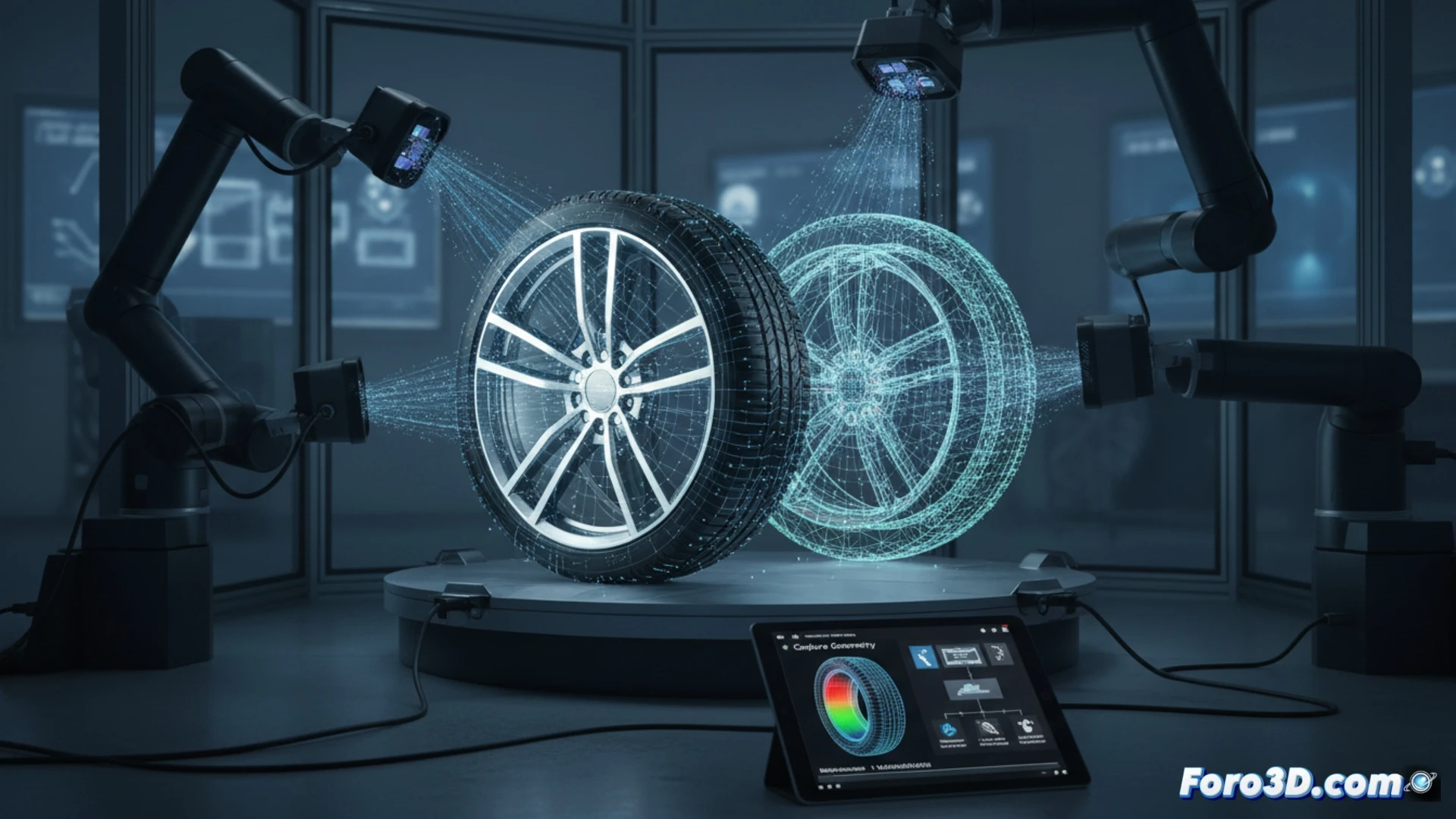
Technical capture and post-processing process 🔧
For a complete wheel, a blue structured light scanner (such as EinScan or Artec models) is recommended to minimize noise on reflective metallic surfaces. Preparation involves dismounting the wheel and applying a matte anti-reflective spray to eliminate specular highlights. The capture should be done in sections: first the front face with the spokes, then the tire, and finally the back of the hub. It is crucial to use target markers to align the shots without losing precision. The resulting point cloud is cleaned in software like Geomagic or MeshLab, removing outliers and closing holes in the geometry. Finally, an optimized mesh is generated with polygon reduction to facilitate 3D printing or CAD analysis.
Practical applications and value of digitization 🎯
3D scanning of wheels enables reverse engineering to manufacture custom spare parts or replicas of classic rims that are difficult to find. In the field of verification, the point cloud is compared with the original CAD model to detect deformations from use or impacts. Additionally, designers can reshape the spokes and modify the offset without needing to create a model from scratch, speeding up prototype development for tuning or competition.
What post-processing strategies do you recommend for correcting dark areas and specular reflections in the 3D scanning of a wheel, without losing detail in the tread reliefs and spokes?
(PS: Scan, remodel, print. And if it doesn't fit, you can always say it's a one-of-a-kind piece.)