Hydraulic erosion is a geotechnical process where water flow, whether from torrential rain or underground currents, detaches and transports soil particles. Unlike wind erosion, its destructive power is silent and rapid. In a matter of hours, it can undermine the foundations of a road or undercut an entire building, becoming the main cause of structural collapses in hillside areas before an earthquake or visible flood occurs.
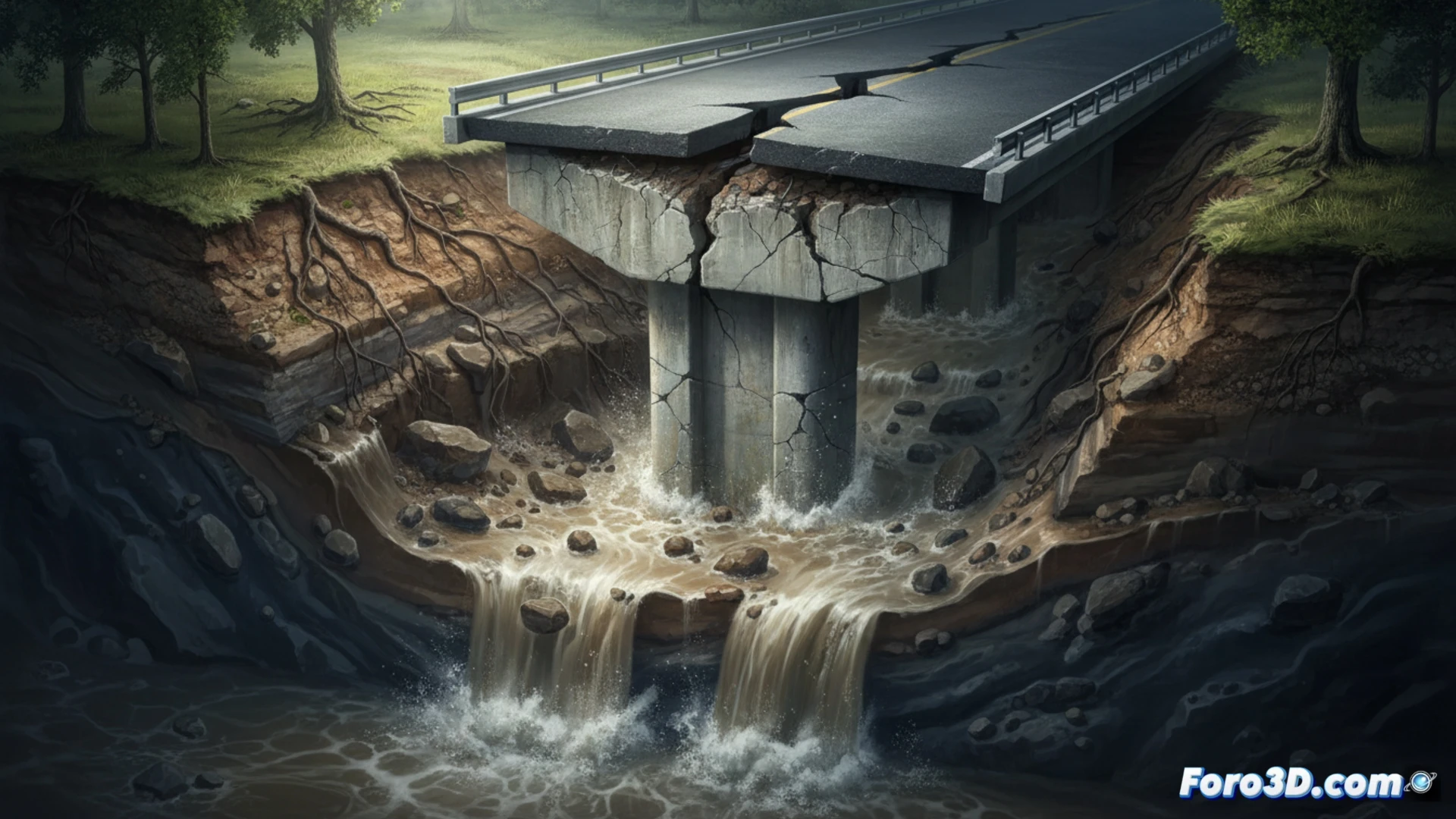
Mechanics of Disaster: Scour and Piping in 3D Simulations 💧
To understand its lethality, current 3D models allow us to visualize two key phenomena: scour and piping. Scour occurs when water flows around an obstacle (such as a bridge pier), creating vortices that excavate the riverbed. Piping is more subtle: water seeps through internal cracks in the soil, washing away fines and creating underground conduits. In a numerical simulation, we can see how these internal tunnels grow until the soil roof collapses, generating a surface subsidence that no one anticipated. Programs like FLAC3D or CFD simulations allow predicting the rate of soil loss and the critical moment of failure.
Lessons from the Field: Preventing Collapse Before the Ground Gives Way 🛠️
Cases like the collapse of the bridge in Genoa or the landslides in the Suchiate River basin remind us that hydraulic erosion does not forgive. Technical prevention involves installing inverted filters in dams and dikes, as well as deep drainage systems that relieve pore pressure. In practice, a predictive 3D model not only saves lives but also allows engineers to design deeper foundations or containment barriers. Nature always finds the weakest path; our job is to reinforce that path with data and spatial vision.
What is the most effective early monitoring method to detect internal hydraulic erosion in a bridge's foundations before a catastrophic collapse occurs?
(PS: Simulating catastrophes is fun until the computer crashes and you are the catastrophe.)