Last Friday, a critical failure at a carbon capture plant in the North Sea triggered a global alert that few mainstream media outlets knew how to interpret. Beyond the technical incident, this event exposes the fragility of the production nodes that underpin the promises of industrial decarbonization. At Foro3D, we analyze how a single faulty valve can reconfigure energy dependency maps and generate shockwaves in emissions futures markets.
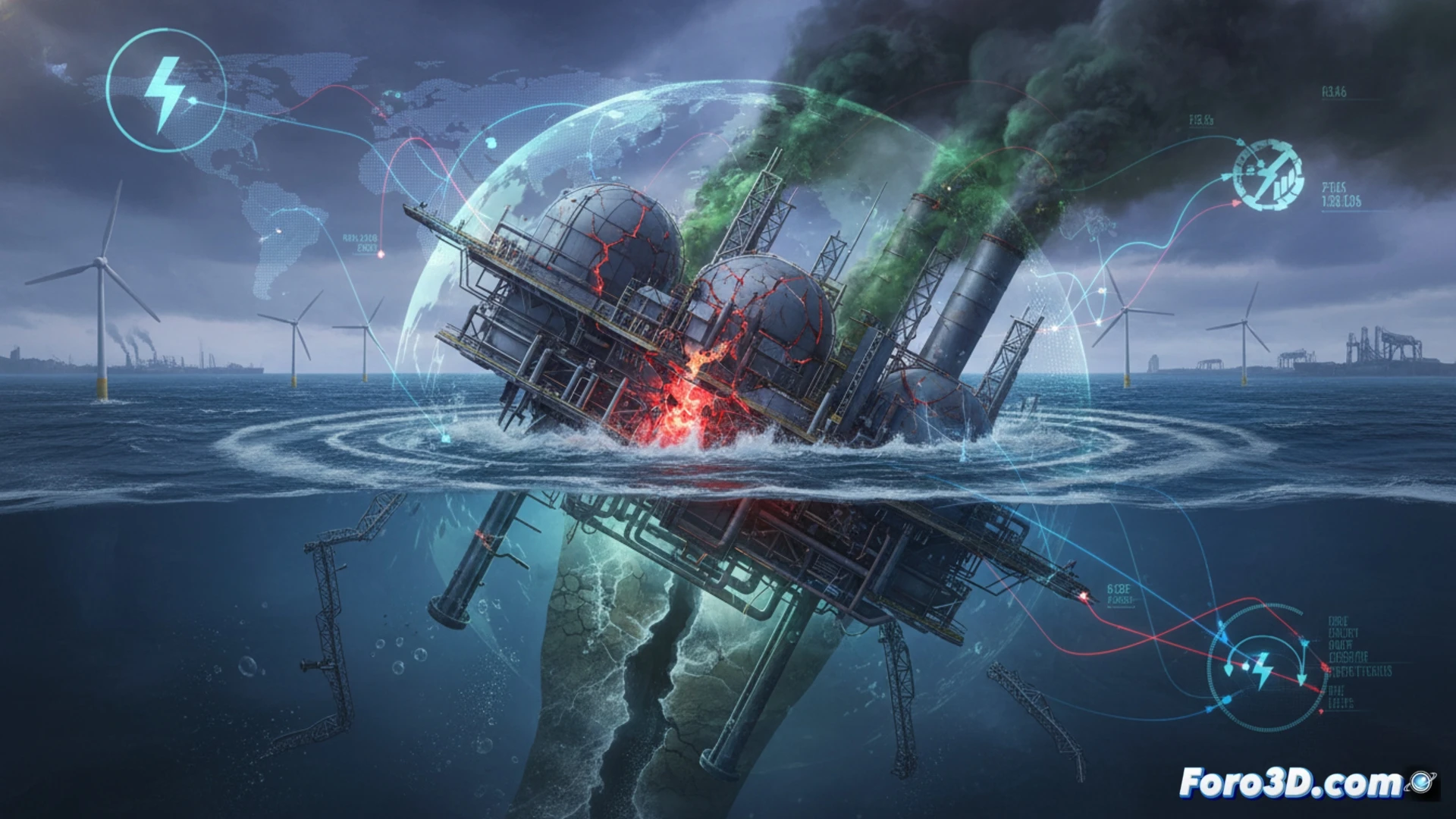
3D Mapping of Vulnerabilities: The Case of the Capture Plant 🌍
Using geospatial simulation models, we have reconstructed the affected supply network. The plant, responsible for 12% of the CO2 captured in Europe, depends on a single supplier of separation membranes based in Malaysia. Our 3D visualization shows how the disruption of this maritime route, combined with the technical shutdown, creates an immediate bottleneck. The model predicts a 23% increase in the price of carbon credits in the short term, and a diversion of flows to competing plants in the Middle East, whose storage capacities are at 94% of their limit. The simulation reveals that without supplier diversification, any failure at a critical node (capture plant or rare earth refinery) triggers a domino effect that takes up to 90 days to stabilize.
The Illusion of Technological Resilience ⚠️
This incident forces us to reconsider the geopolitics of clean technologies. It is not enough to have the best capture simulation; a precise mapping of weak links is required. The failure was not an accident, but a warning about the excessive concentration of production. While governments compete to subsidize demand, they forget to secure the supply chain of components. The next risk map should not only show oil fields, but also the location of every valve and membrane that sustains our fragile energy transition.
How can a failure in a critical carbon capture infrastructure in the North Sea redefine energy routes and dependencies in the global supply chain, and which countries would be most exposed to the new geopolitical risk map?
(PS: at Foro3D we know that a chip travels more than a backpacker on a gap year)