The evaluation of a sharp force injury requires millimeter precision to determine the mechanics of the incident. In the modern forensic pipeline, 3D scanning and photogrammetry have replaced manual measurements with a tape measure. This process allows capturing the wound's morphology, its depth, and the cut edges without contaminating the evidence, generating a digital twin that can be analyzed and presented in court.
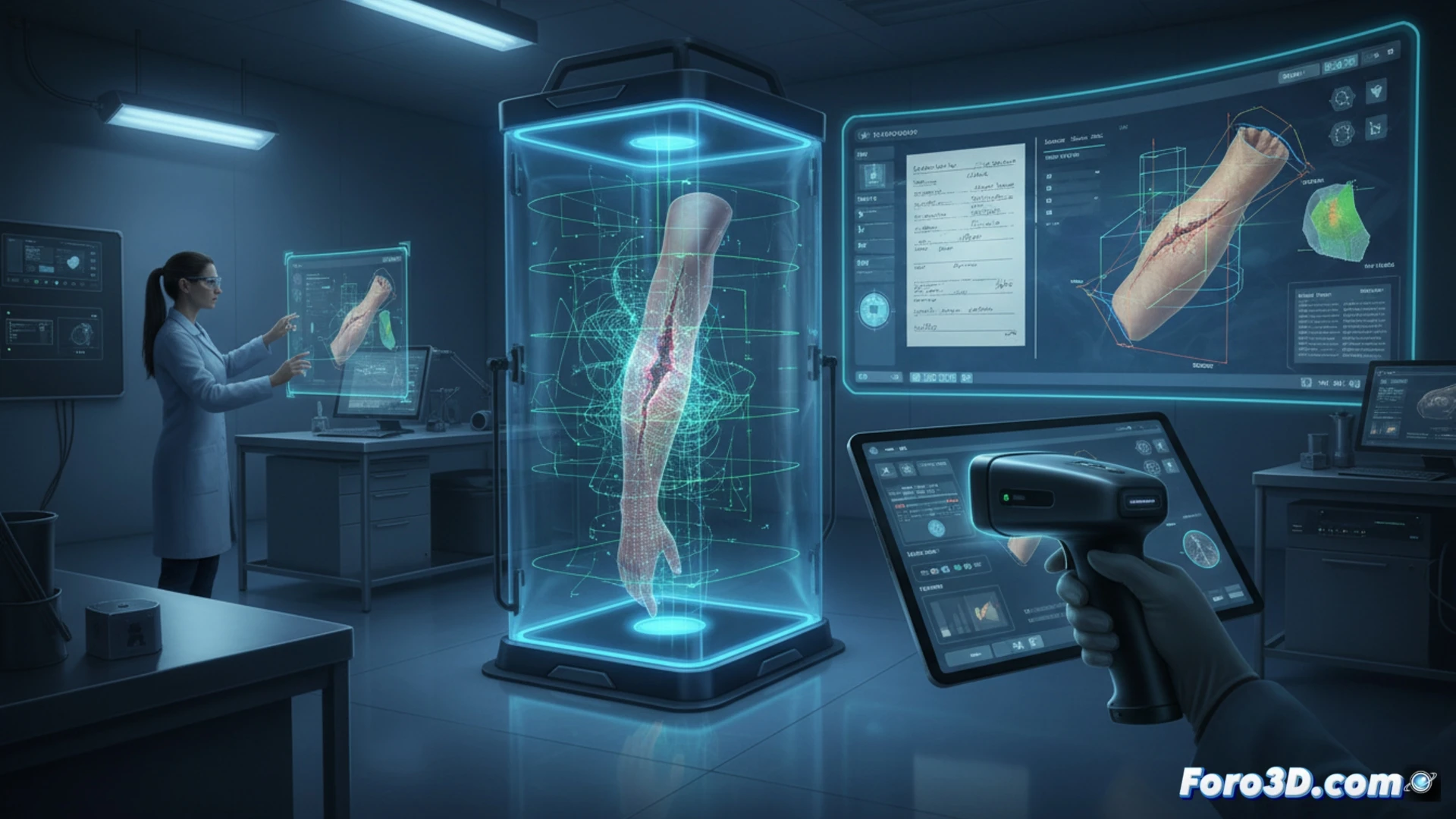
Technical workflow for capture and virtual reconstruction 🔍
The process begins with high-resolution photogrammetry on the cadaver or test mannequin, using a DSLR camera with cross-polarized light to eliminate shadows. Between 60 and 120 images are taken around the wound, covering 360 degrees. These images are processed in software such as Agisoft Metashape or RealityCapture to generate a dense point cloud and a textured mesh. In parallel, a structured light scanner (such as Artec Eva) is used to capture the exact topography of the tissue, including the depression of the wound channel. Once the mesh is ready, it is imported into Blender or MeshLab to isolate the injury geometry and measure penetration vectors. The angle of attack is simulated by adjusting a virtual cylinder (representing the weapon) within the wound volume, calculating the inclination relative to the skin plane and the maximum cut depth.
From simulation to expert report: the value of visualization ⚖️
The resulting 3D model is not only used for metric calculations but also transforms the evidence into an irrefutable visual narrative. Expert reports include animations showing the weapon's trajectory from the entry point to the wound's base. This representation allows judges and forensic experts to understand the relative position of the assailant and victim, ruling out inconsistent hypotheses. 3D documentation eliminates the subjectivity of hand-drawn sketches and ensures that the evidence can be re-examined years later without degradation.
How does the resolution of the 3D mesh of a stab wound affect the accuracy in determining the entry angle and weapon trajectory during forensic analysis?
(PS: In the forensic pipeline, the most important thing is not to mix the evidence with the reference models... or you'll end up with a ghost at the scene.)