The deformation mark on a fence after a hit-and-run is a key clue in forensic traffic accident investigation. Its geometry, depth, and fracture patterns allow inferring parameters such as the impact direction, vehicle speed, and collision angle. Documenting these damages with millimeter precision is essential for a reliable virtual reconstruction to determine liability or evaluate road safety.
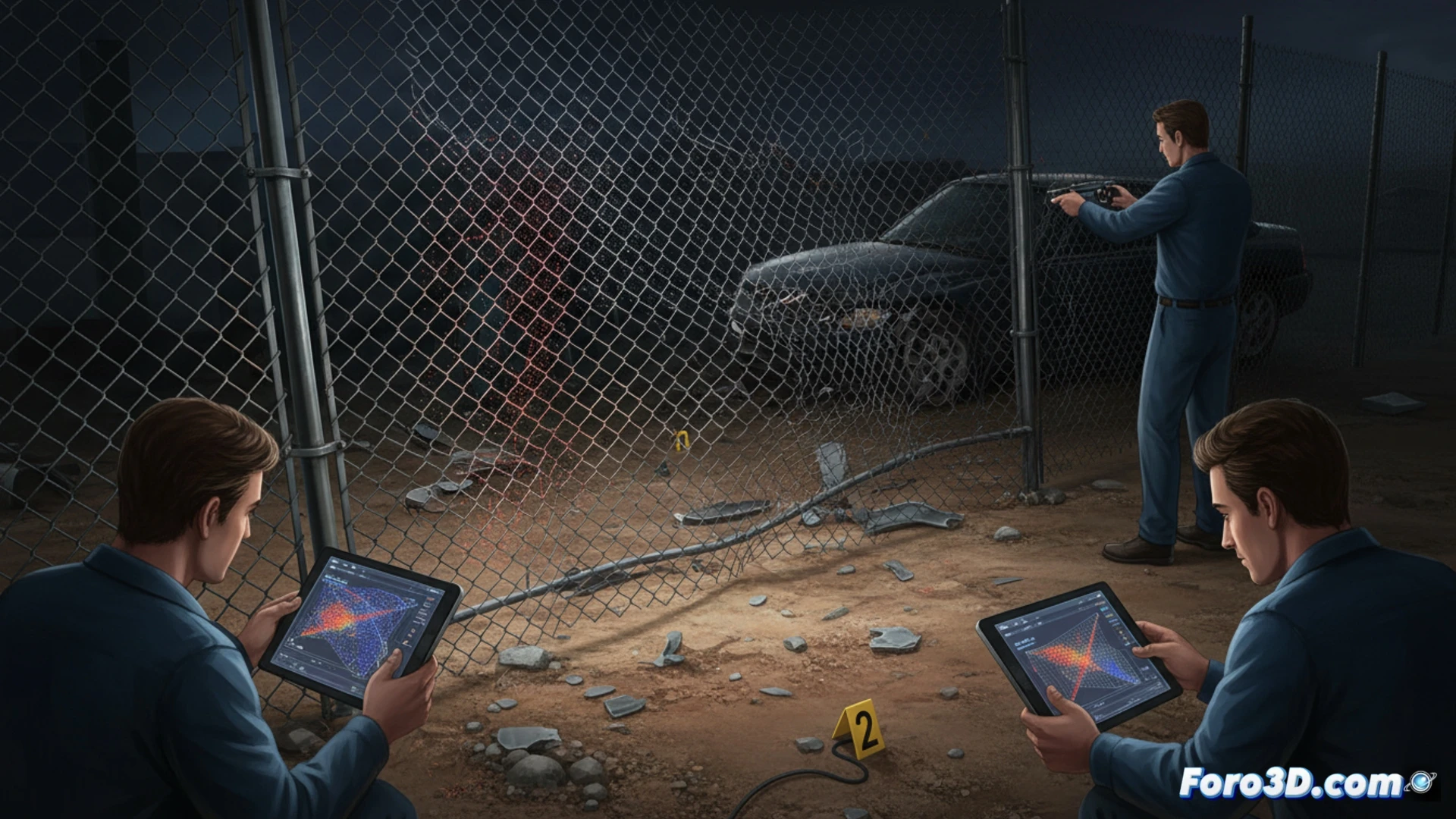
Technical methodology for capturing and analyzing deformation 🛠️
The process begins with capturing the environment using high-resolution photogrammetry or 3D laser scanning. Convergent images of the damaged fence are taken, including metric references and control points. Modeling software generates a point cloud or polygonal mesh that reproduces the deformation with sub-centimeter precision. Subsequently, the model of the involved vehicle is overlaid, and the dissipated kinetic energy is calculated using impact analysis algorithms, estimating the speed and trajectory prior to the crash.
From deformation to road prevention 🚦
Beyond assigning responsibility, 3D analysis of these marks reveals structural failure patterns in safety barriers. The data obtained allows proposing improvements in the design of perimeter fences and containment systems, as well as adjusting the location of signage or speed bumps. Each documented deformation becomes a technical lesson that, integrated into simulations, contributes to safer road environments.
What photogrammetry or laser scanning methodology do you recommend for capturing plastic deformations in post-impact metal fences with millimeter precision, considering material reflectivity and outdoor lighting conditions?
(PS: In scene analysis, every scale witness is a small anonymous hero.)