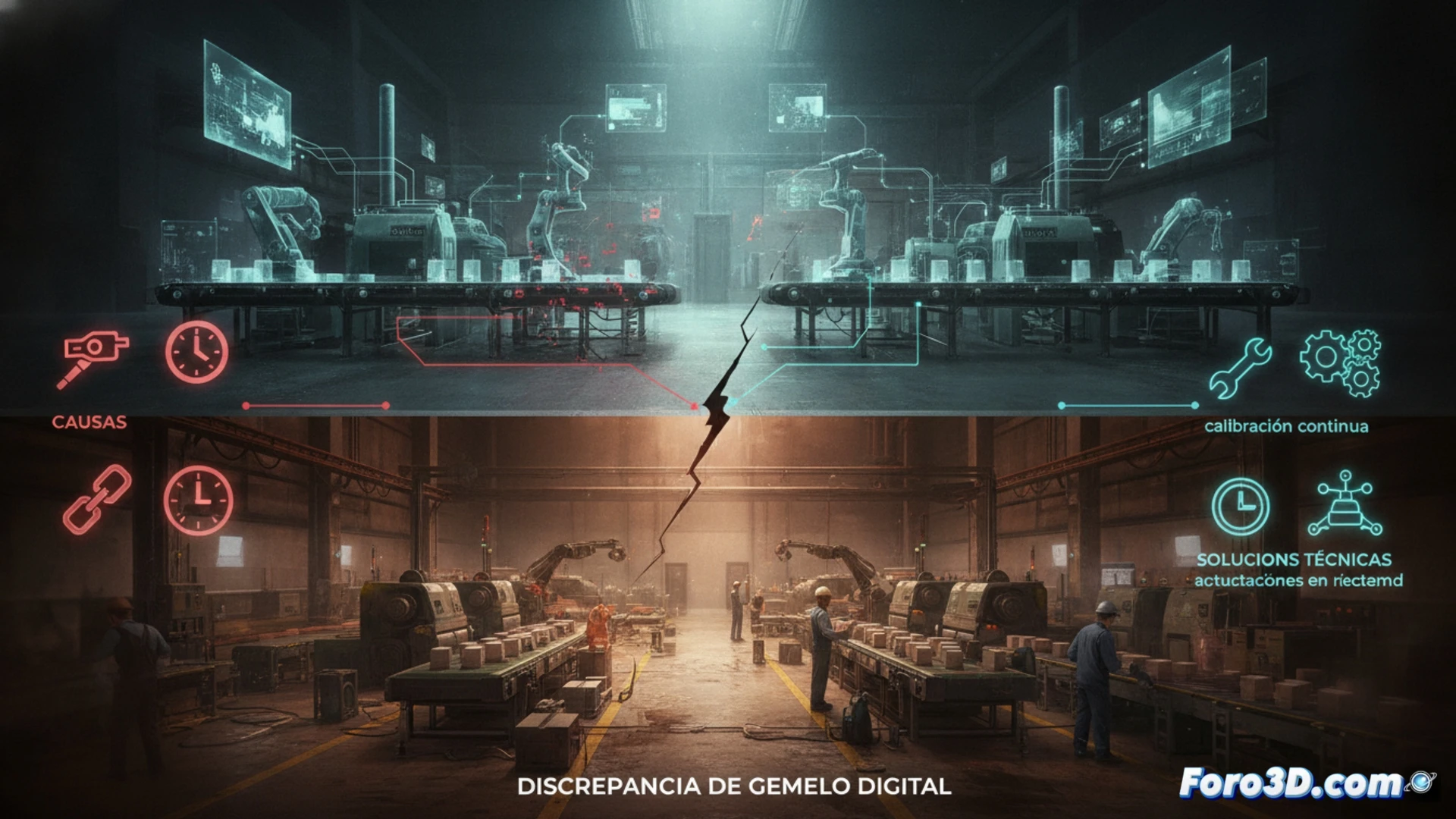
The discrepancy of a digital twin is defined as the deviation between the simulated state of a virtual replica and the actual condition of its physical asset. This phenomenon, far from being a minor error, can compromise real-time decision-making in critical sectors such as advanced manufacturing or infrastructure management. Identifying its origin is the first step to ensuring model fidelity.
Origin of Deviations in Sensors and Models 🔍
The main causes of discrepancy fall into three technical categories. First, sensor drift or failure that provides inaccurate data to the twin. Second, excessive simplification in simulation models that ignore physical variables such as friction or thermal expansion. Third, latency in data updating, where the twin operates with outdated information while the physical asset has already changed. In healthcare environments, for example, a millisecond delay in reading a cardiac monitor can generate a dangerously inaccurate virtual replica.
Towards Continuous Calibration of the Virtual Model ⚙️
To mitigate these deviations, it is recommended to implement a verification protocol based on feedback loops. Continuous calibration, using sensor fusion techniques and machine learning algorithms, allows adjusting the twin in real time. Thus, discrepancy is transformed from a problem into an opportunity for improvement, ensuring that the virtual replica not only reflects the past but accurately anticipates the future state of the asset.
When implementing a real-time digital twin, how can the discrepancy caused by latency in acquiring industrial sensor data be minimized without resorting to higher-cost hardware?
(PS: My digital twin is right now in a meeting, while I am here modeling. So technically, I am in two places at once.)