The three-dimensional digitization of ancient papyri has revolutionized textual archaeology. Through high-resolution photogrammetry and structured light scanners, it is possible to capture every fiber and relief of these fragile supports without physically touching them. This process generates 3D models that allow epigraphists to read texts invisible to the naked eye and virtually reconstruct scattered fragments, ensuring the preservation of the original.
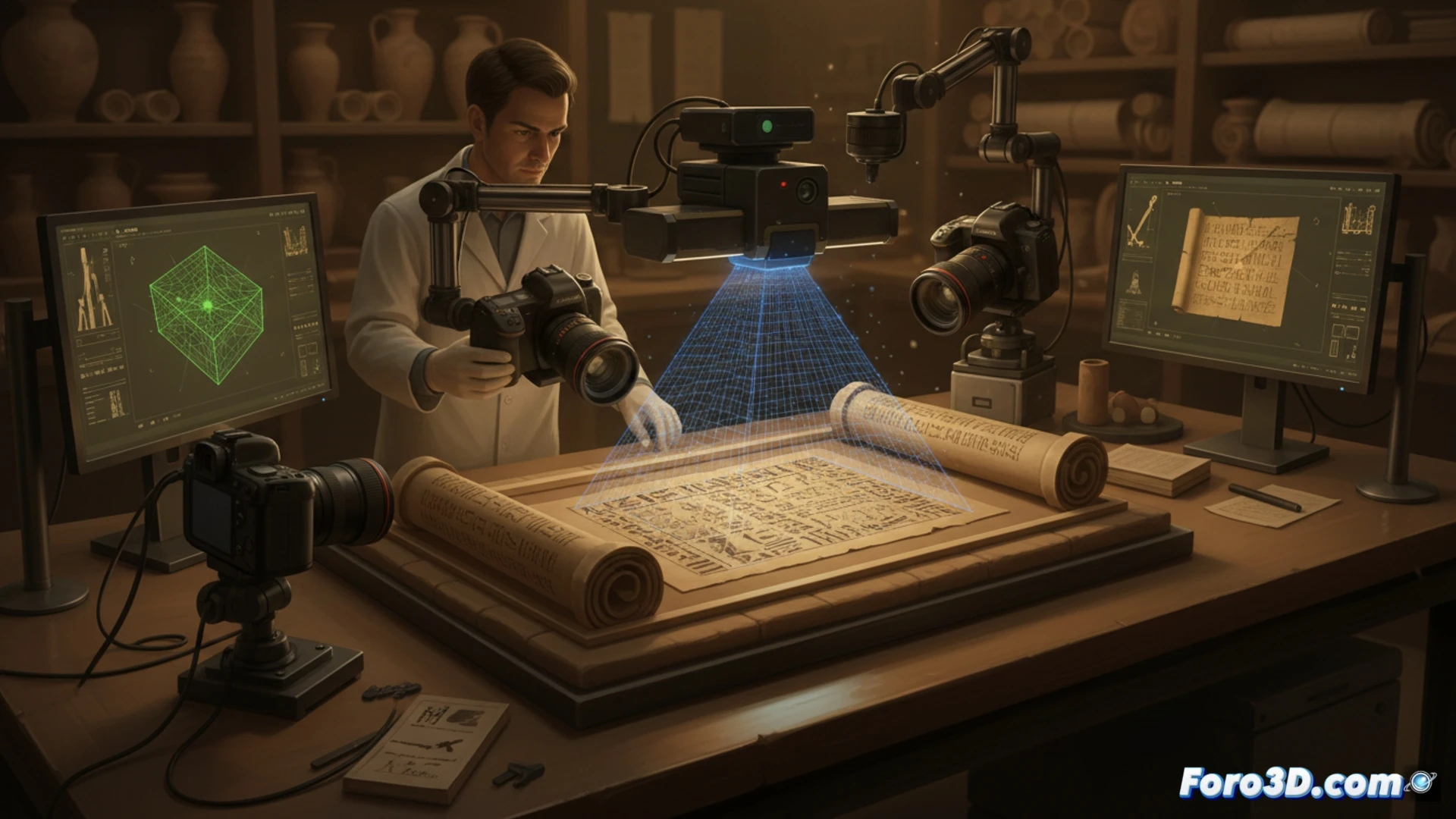
Technical workflow: macro photogrammetry and RTI 📸
The protocol begins with stabilizing the papyrus in a controlled light chamber. Between 80 and 200 photographs are taken in RAW format with macro lenses, using cross-lighting to highlight texture. Photogrammetry software (such as Agisoft Metashape) processes the images to generate a dense point cloud and a high-resolution polygonal mesh. For carbonized documents, like the Herculaneum Papyri, structured light or micro-CT is used, since visual contrast is null. The RTI (Reflectance Transformation Imaging) technique complements the 3D model by capturing surface reflectance under multiple light angles, revealing incisions and faded inks. The result is a digital file that allows rotating, zooming, and measuring the object with micrometric precision.
The challenge of fragmentation and global access 🧩
Beyond capture, the true challenge is the virtual reconstruction of papyri broken into hundreds of pieces. Pattern recognition algorithms analyze the edges of digitized fragments to match them like a three-dimensional puzzle. This process has allowed the virtual reunification of texts from the Villa of the Papyri that had been separated for centuries. Publishing these models in open repositories removes geographical barriers: a researcher in Tokyo can examine an Egyptian papyrus housed in Oxford with the same detail as if they held it in their hands, democratizing knowledge and reducing the handling of unique materials.
What technical challenges does high-resolution photogrammetry present when digitizing rolled or carbonized papyri without damaging their fragile structure?
(PS: If you dig at a site and find a USB drive, don't plug it in: it could be Roman malware.)