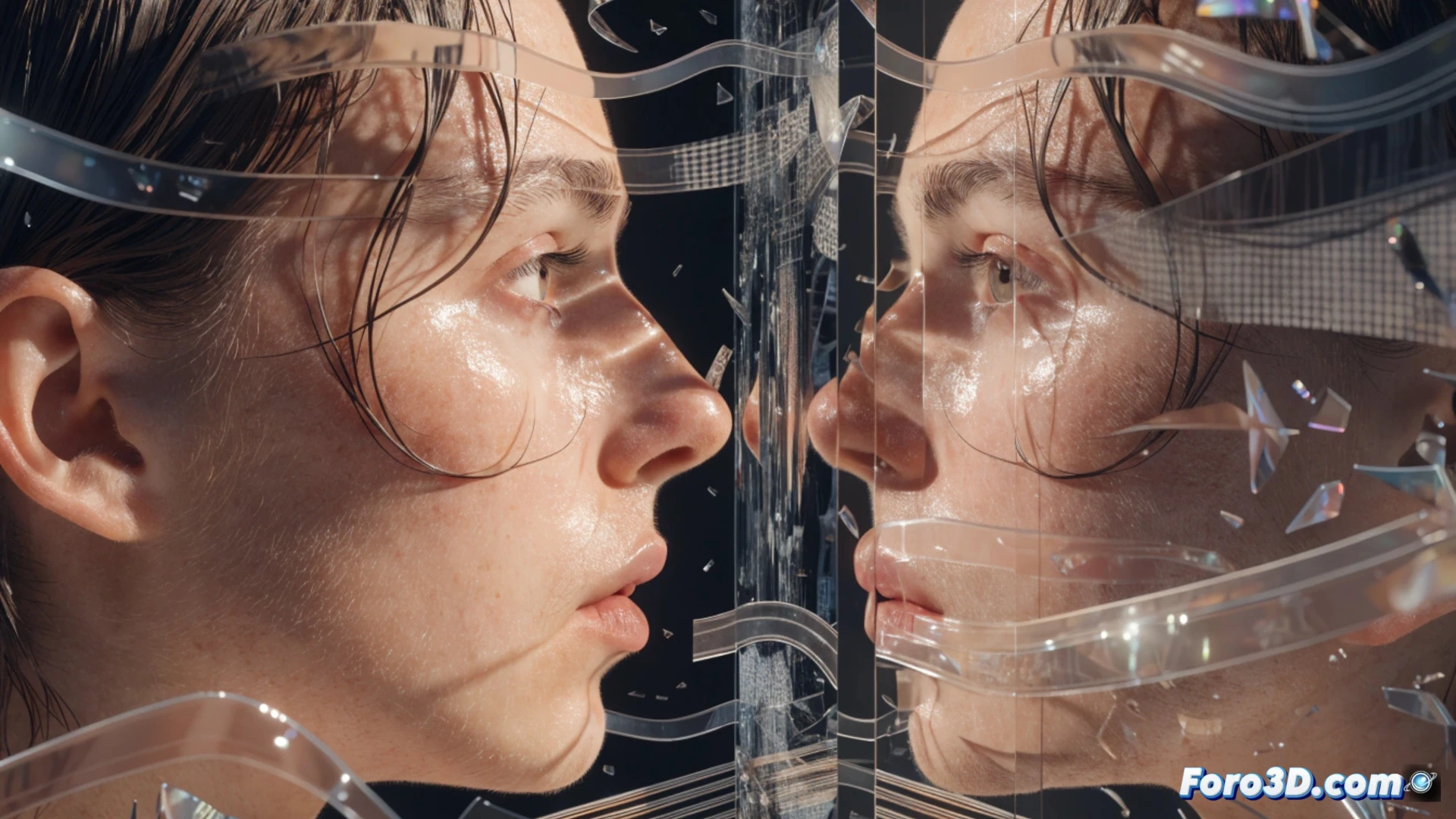
Visual manipulation has reached a level of sophistication where the human eye is no longer sufficient. The phenomenon known as Mirror Deviation describes the subtle distortion of reality in videos and images, an effect that deepfake creators exploit to alter facial geometries and reflections. 3D technology has become the key forensic tool for exposing these forgeries, analyzing the physical laws that generative algorithms have yet to perfectly replicate.
Inverse Photogrammetry and Reflection Analysis 🔍
The main technique for detecting Mirror Deviation lies in inverse photogrammetry. This process reconstructs a 3D model of the face or scene from the suspicious video or image. Once the three-dimensional mesh is obtained, inconsistencies in lighting and reflections are analyzed. In a deepfake, shadows are often cast in impossible directions, and reflections in the eyes or specular surfaces do not match the environment's light source. An algorithm can calculate the expected environment map and compare it with the one reflected in the subject's iris; any deviation greater than 5% in the curvature of the reflection reveals manipulation. This analysis is especially effective because current generators prioritize texture over the physics of light.
Physics as the Frontier of Reality 🌌
The authenticity of content no longer depends solely on its resolution, but on its coherence with the laws of the universe. Mirror Deviation reminds us that a perfect deepfake does not exist as long as physics remains more complex than the algorithm. For the forensic auditor, every reflection and every shadow is an opportunity to verify the truth. In a world where reality is distorted, geometry and light are our most reliable witnesses.
Since asymmetric deviation of ocular reflections is a common artifact in deepfakes due to inconsistent 3D lighting, what real-time light field analysis techniques could be implemented to detect this anomaly in live broadcasts?
(PS: Detecting deepfakes is like playing Where's Waldo? but with suspicious pixels.)