Cryogenic detachment represents one of the most silent threats in the energy and aerospace industries. It occurs when a structural material, subjected to temperatures near absolute zero, loses its toughness and fractures suddenly, releasing pressurized liquefied gases. This phenomenon, combining extreme thermodynamics and material fatigue, can trigger boiling liquid expanding vapor explosions (BLEVE) or the instantaneous cryogenization of the environment, turning a technical failure into a rapidly propagating catastrophe.
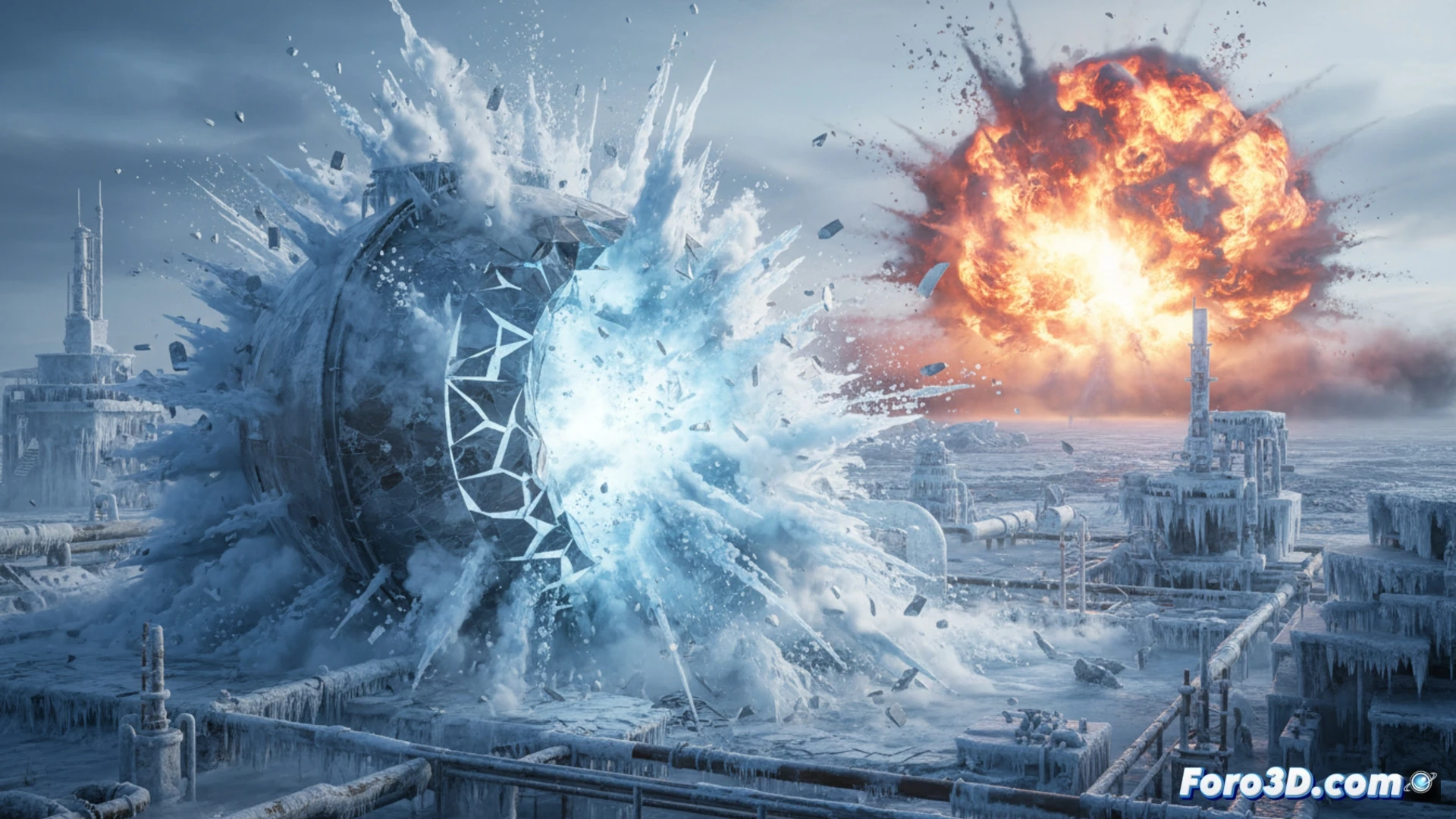
Failure Sequence: Thermal Fatigue and Phase Transitions 🔥
The 3D modeling of this disaster begins with the simulation of differential metal contraction. An LNG tank, for example, undergoes filling and emptying cycles that generate microcracks in the welds. Our geometric simulation shows how, after thousands of cycles, a critical crack propagates at sonic speed. When the primary containment ruptures, the cryogenic liquid comes into contact with the atmosphere, vaporizing violently. The vapor cloud, denser than air, spreads horizontally. The 3D visualization allows tracking the freezing front: any object within its radius—from structural steel to organic tissue—becomes brittle and collapses. The final sequence shows the delayed ignition of the cloud, generating a methane fireball that consumes the facility.
Visual Lessons: Prevention and Resilient Design 🛡️
The simulation serves not only to illustrate the horror but also to redesign safety. By visualizing critical stress points in the 3D model, engineers can reinforce weld zones with composite materials that maintain their elasticity at -160 degrees Celsius. Additionally, modeling the vapor cloud dispersion allows for strategic placement of gas sensors and containment barriers. Catastrophe is not inevitable; it is the result of not having simulated the detachment beforehand. At Foro3D, we believe that understanding failure in high definition is the first step to avoiding it.
Which critical parameters of the finite element simulation are essential to accurately predict cryogenic fracture in composite materials used in LNG storage tanks?
(PS: Simulating catastrophes is fun until the computer melts down and you are the catastrophe.)